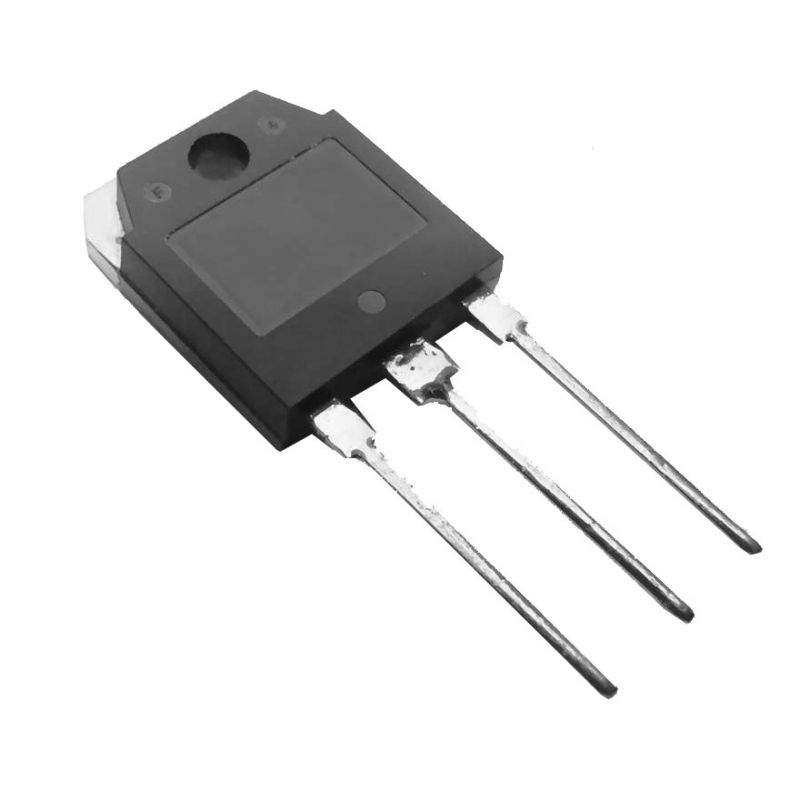


2SA1695 PNP Power Transistor (TO-3P)
46 people are viewing this right now
In Stock
SKU
191472548739
£3.99
Safe Checkout, Guaranteed

Safe Checkout, Guaranteed
The 2SA1695 is a high-power silicon PNP transistor meticulously designed for audio amplifier and high-current switching applications. Encased in the robust TO-3P package, this transistor offers superior thermal dissipation and long-term reliability, making it a preferred choice for demanding audio and power control systems. Its ability to handle significant current and voltage levels ensures clean and powerful signal amplification, contributing to exceptional audio quality and efficient power delivery. The TO-3P package is engineered to provide optimal thermal conductivity, allowing efficient heat removal from the transistor. This is crucial for maintaining stable performance, preventing overheating, and ensuring extended operational lifespan, especially under high-power conditions. As a PNP transistor, the 2SA1695 is activated by a negative voltage applied to its base, making it suitable for complementary amplifier designs when paired with an NPN transistor.
Its high gain characteristic enables it to amplify small input signals into significantly larger output signals, enhancing the overall performance of audio amplifiers. The 2SA1695 exhibits a high collector current rating, enabling it to drive power-hungry loads, such as large speakers in audio systems or high-current actuators in industrial applications. Its low saturation voltage minimizes power dissipation and improves overall efficiency, contributing to reduced heat generation and increased energy savings. This transistor is commonly employed in audio power amplifiers, where it delivers clean and distortion-free amplification to drive speakers with exceptional clarity. It's also utilized in switching power supplies, where it efficiently switches high currents to regulate voltage levels. In motor control circuits, the 2SA1695 can precisely control the speed and torque of motors, making it suitable for various industrial applications.
When selecting a transistor for high-power applications, reliability and stability are crucial. The 2SA1695 is manufactured using high-quality materials and processes, ensuring consistent performance and long-term durability. Its robust design and excellent thermal conductivity make it a dependable choice for demanding operating environments. Elevate your audio amplifier and power control designs with the 2SA1695 transistor. Its high power handling capabilities, exceptional thermal performance, and reliable operation make it an ideal choice for a wide range of demanding applications. Guarantee clean and powerful signal amplification with this high-quality transistor.
Don't compromise on quality and performance in your amplifier and power control systems. Choose the 2SA1695 for reliable and high-performance operation. Add the 2SA1695 to your cart today and experience the difference in your audio and power control applications. Experience the power, reliability, and exceptional thermal performance of the 2SA1695 and optimize your high-power circuits. Purchase now and enjoy efficient and robust amplification with the 2SA1695. Secure your high-power applications with the rugged and dependable 2SA1695 transistor.
| Product Name | 2SA1695 PNP Power Transistor (TO-3P) |
|---|---|
| SKU | 191472548739 |
| Price | £3.99 |
| 2SA1695 PNP Power Transistor (TO-3P) Color | As per image |
| Category | Transistors |
| Brand | Nikko Electronics ltd |
| Product Code | 191472548739 |
| Availability | Yes |
Shipping cost is based on order value. Just add products to your cart and use the Shipping Calculator to see the shipping price. We want you to be 100% satisfied with your purchase. Items can be returned or exchanged within 30 days of delivery.
The 2SA1695 PNP Power Transistor (TO-3P) is most effectively paired with the 2SC4468 NPN transistor to create a balanced complementary output stage in Class AB or Class B audio power amplifiers. When sourcing these components for professional audio repair or high-end DIY builds, it is crucial to ensure that both the NPN and the 2SA1695 PNP Power Transistor (TO-3P) are matched as closely as possible regarding their DC current gain (hFE). Close matching minimizes even-order harmonic distortion and ensures that the positive and negative halves of the audio signal are amplified with identical characteristics, which is essential for maintaining low Total Harmonic Distortion (THD). Furthermore, using the 2SA1695 PNP Power Transistor (TO-3P) with its intended NPN counterpart allows for a more stable biasing network. Experienced technicians often measure multiple units to find the best match, as a significant mismatch in gain can lead to DC offset issues at the speaker output and increased thermal stress on one side of the push-pull configuration, potentially compromising the long-term reliability of the amplification system.
Proper thermal management for the 2SA1695 PNP Power Transistor (TO-3P) is vital to prevent thermal runaway and ensure operational stability. The TO-3P package is specifically designed for high-power dissipation, but it requires a substantial heatsink when the transistor is handling significant collector currents. To calculate the requirements, you must consider the total power dissipation (Pd), the junction-to-case thermal resistance (Rthjc), and the maximum allowable junction temperature, which is typically 150°C. When mounting the 2SA1695 PNP Power Transistor (TO-3P), always use a high-quality thermal compound or a silicone-based thermal pad to minimize the case-to-heatsink thermal resistance. For applications where the 2SA1695 PNP Power Transistor (TO-3P) is expected to dissipate more than 20-30 watts continuously, active cooling or a large extruded aluminum heatsink is highly recommended. It is also important to derate the power handling capability as the ambient temperature rises. Monitoring the case temperature during peak load conditions ensures that the device stays within its Safe Operating Area (SOA), protecting the silicon die from localized overheating and subsequent catastrophic failure.
Yes, the 2SA1695 PNP Power Transistor (TO-3P) is highly regarded in the audio industry specifically for its excellent linearity and high-speed switching characteristics. One of the key specifications for audio performance is the transition frequency (fT), which for the 2SA1695 PNP Power Transistor (TO-3P) is typically around 20 MHz. This high fT allows the transistor to maintain a consistent gain across the entire audible frequency spectrum and beyond, which is critical for minimizing phase shift and ensuring a high slew rate in the amplifier. Additionally, the 2SA1695 PNP Power Transistor (TO-3P) exhibits a very stable DC current gain (hFE) over a wide range of collector currents, which reduces gain-related distortion during high-amplitude signal peaks. The low output capacitance (Cob) further aids in maintaining high-frequency clarity by reducing the loading on the driver stage. These technical attributes make the 2SA1695 PNP Power Transistor (TO-3P) a preferred choice for designers who prioritize clean, transparent, and powerful sound reproduction in both consumer and professional-grade power amplifiers.
When utilizing the 2SA1695 PNP Power Transistor (TO-3P) to drive inductive loads such as motors, solenoids, or large transformer-coupled stages, understanding the Safe Operating Area (SOA) is paramount. Inductive loads can generate significant back-EMF voltage spikes during switching, which may exceed the Collector-Emitter Voltage (Vceo) rating of 140V. The 2SA1695 PNP Power Transistor (TO-3P) is robust, but it must be protected by high-speed flyback diodes to clamp these transients. Furthermore, the SOA curve in the datasheet defines the maximum simultaneous voltage and current the transistor can handle without secondary breakdown. For the 2SA1695 PNP Power Transistor (TO-3P), the secondary breakdown limit is a critical factor during high-voltage, high-current pulses. Designers must ensure that the load line of the circuit never crosses the SOA boundary under any operating condition, including short-circuit or startup scenarios. Using the 2SA1695 PNP Power Transistor (TO-3P) within these conservative limits ensures that the device does not experience localized hot spots on the semiconductor die, which is the primary cause of failure in power switching applications.
The 2SA1695 PNP Power Transistor (TO-3P) can often serve as a modern, high-performance replacement for older PNP transistors originally housed in TO-3 metal cans, provided that the electrical specifications like Vceo, Ic, and Pd are compatible. However, there are physical differences that must be addressed. The TO-3P package of the 2SA1695 PNP Power Transistor (TO-3P) is a plastic-encapsulated through-hole package, whereas the TO-3 is a diamond-shaped metal package. To use the 2SA1695 PNP Power Transistor (TO-3P) in a legacy TO-3 footprint, you will likely need to modify the mounting arrangement or use an adapter plate. The primary advantage of upgrading to the 2SA1695 PNP Power Transistor (TO-3P) is the simplified mounting process; it requires only a single mounting hole and is generally easier to insulate from the heatsink using a standard mica or polyimide washer. While the thermal mass of the TO-3P is lower than the metal TO-3, the modern silicon technology inside the 2SA1695 PNP Power Transistor (TO-3P) often provides superior efficiency and faster switching speeds, making it an excellent choice for restoring or upgrading vintage audio equipment.
Paralleling multiple 2SA1695 PNP Power Transistor (TO-3P) units is a common practice to increase current handling capacity in heavy-duty power supplies or high-wattage amplifiers. The most critical precaution is preventing 'current hogging,' where one transistor carries more current than the others due to slight variations in Vbe or hFE. To ensure even current distribution, you must use emitter ballast resistors (typically 0.1 to 0.47 ohms) for each 2SA1695 PNP Power Transistor (TO-3P) in the parallel array. These resistors provide local negative feedback that balances the current flow. Additionally, it is essential to mount all parallel 2SA1695 PNP Power Transistor (TO-3P) units on the same heatsink to ensure they stay at the same temperature, as the Vbe of a transistor decreases with temperature, which can otherwise lead to a thermal-imbalance loop. For the best results, select transistors from the same manufacturing batch and match their hFE values. This careful matching and thermal coupling of the 2SA1695 PNP Power Transistor (TO-3P) units will maximize the reliability and efficiency of the overall power system.
In switching applications, the Collector-Emitter Saturation Voltage (Vce(sat)) of the 2SA1695 PNP Power Transistor (TO-3P) is a key determinant of power efficiency. When the 2SA1695 PNP Power Transistor (TO-3P) is fully turned on (saturated), the Vce(sat) represents the voltage drop across the transistor. Since power loss is calculated as P = Vce(sat) x Ic, a lower saturation voltage results in less heat generation and higher overall efficiency. The 2SA1695 PNP Power Transistor (TO-3P) is engineered to have a relatively low saturation voltage even at high collector currents, which is beneficial for DC-to-DC converters and motor control circuits. However, to achieve the lowest Vce(sat), the base drive circuit must provide sufficient current to keep the transistor firmly in the saturation region. If the 2SA1695 PNP Power Transistor (TO-3P) enters the linear region during high-current switching, the power dissipation will spike rapidly, leading to potential failure. Therefore, ensuring a robust base drive is essential when using the 2SA1695 PNP Power Transistor (TO-3P) in high-efficiency power control and switching environments.