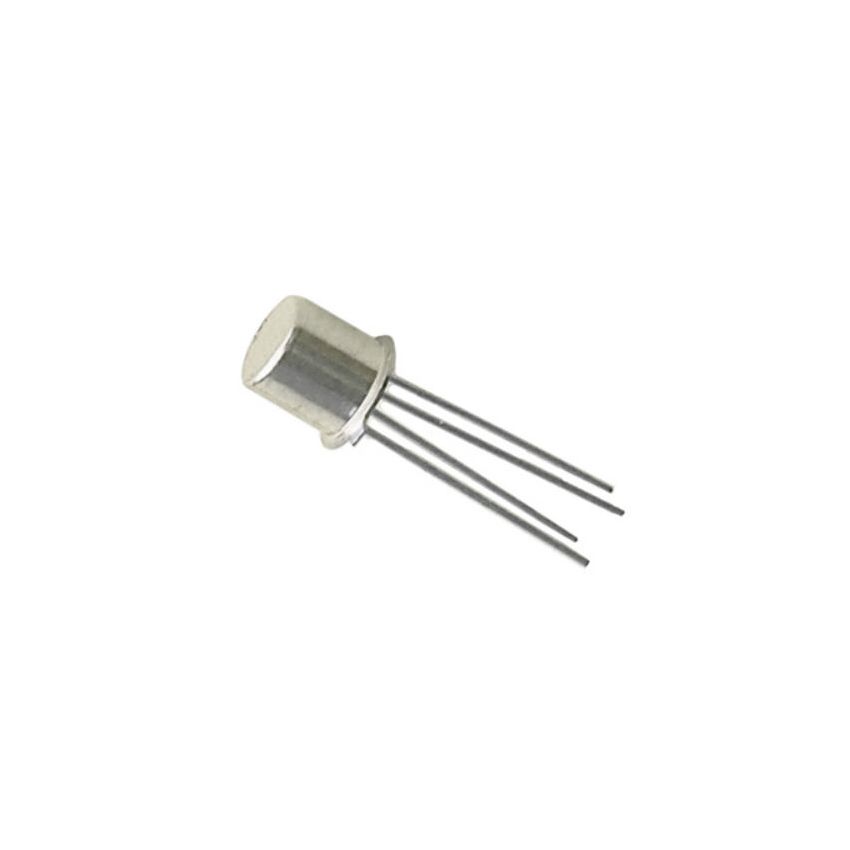

2SA431 PNP Germanium Transistor TO-72
43 people are viewing this right now
In Stock
SKU
191886278818
£8.99
Safe Checkout, Guaranteed

Safe Checkout, Guaranteed
The 2SA431 is a versatile NPN transistor housed in the compact TO-72 package, commonly used in various analog and digital circuit designs. This transistor, marked with 'A431' for easy identification, is a reliable component valued for its consistent performance and wide range of applications. Its small form factor makes it ideal for space-constrained designs where component density is a key consideration. Primarily employed for amplification and switching, the 2SA431 boasts desirable characteristics such as moderate current gain and good switching speeds. These features make it suitable for applications in audio amplification, signal processing, and small signal switching circuits. The TO-72 package ensures compatibility with through-hole mounting techniques, providing secure and reliable connections on printed circuit boards.
Its robust construction contributes to the transistor's overall durability and longevity in different operating environments. Due to its NPN configuration, the 2SA431 operates by controlling the current flow between the collector and emitter terminals based on the current applied to the base terminal. This controlled current flow is essential for amplification purposes, allowing the transistor to boost weak signals to detectable levels. In switching applications, the transistor functions as an electronic switch, turning on or off based on the presence or absence of a base current. The 2SA431 is a versatile building block for both simple and complex circuits. Its reliable performance and consistent specifications make it a popular choice for hobbyists, students, and professional engineers.
Whether you're building a low-noise amplifier, a simple switching circuit, or a signal processing module, the 2SA431 is a solid and dependable choice. Its widespread availability and proven track record make it an accessible option for both prototyping and mass production. Enhance your electronic designs with the reliable performance of the 2SA431 NPN transistor. Its combination of compact size, desirable characteristics, and proven track record make it an excellent addition to any electronic engineer's toolkit. Secure your 2SA431 transistors today and take advantage of their versatility and reliability in your next electronic project. Order now and build with confidence!
| Product Name | 2SA431 PNP Germanium Transistor TO-72 |
|---|---|
| SKU | 191886278818 |
| Price | £8.99 |
| 2SA431 PNP Germanium Transistor TO-72 Color | As per image |
| Category | Transistors |
| Brand | Nikko Electronics ltd |
| Product Code | 191886278818 |
| Availability | Yes |
Shipping cost is based on order value. Just add products to your cart and use the Shipping Calculator to see the shipping price. We want you to be 100% satisfied with your purchase. Items can be returned or exchanged within 30 days of delivery.
The 2SA431 PNP Germanium Transistor TO-72 is specifically engineered for high-frequency amplification, making it a staple in the RF (Radio Frequency) and IF (Intermediate Frequency) stages of vintage communication equipment. Unlike modern silicon counterparts, this germanium-based component offers unique carrier mobility characteristics that were highly optimized for the 10MHz to 60MHz range common in AM/FM receivers. When utilizing the 2SA431 PNP Germanium Transistor TO-72, engineers value its relatively low noise figure at high frequencies and its ability to maintain stable gain in oscillating circuits. The transition frequency (fT) is tailored for sensitive signal processing, ensuring that the transistor does not introduce significant phase shifts in narrow-band applications. Because it is a PNP device, it is often found in positive-ground configurations or specific complementary stages where its hole-conduction properties are leveraged for efficient signal swing. For technicians restoring classic hardware, maintaining the specific frequency response of the 2SA431 PNP Germanium Transistor TO-72 is critical for preserving the original sensitivity and selectivity of the RF front-end.
The 2SA431 PNP Germanium Transistor TO-72 features a specialized TO-72 metal-can package, which distinguishes it from the standard three-lead TO-18 or TO-92 packages. This four-lead configuration includes a dedicated shield lead that is internally connected to the metal case. In high-gain RF environments, connecting this fourth lead of the 2SA431 PNP Germanium Transistor TO-72 to the circuit's common ground provides an effective Faraday shield around the semiconductor junction. This significantly reduces electromagnetic interference (EMI) and parasitic oscillations that can plague high-frequency designs. By effectively grounding the envelope, the 2SA431 PNP Germanium Transistor TO-72 minimizes crosstalk between adjacent components on a densely packed PCB. This is particularly vital in multi-stage IF strips where even minor capacitive coupling can lead to instability. When installing the 2SA431 PNP Germanium Transistor TO-72, professionals must ensure the shield pin is correctly identified and tied to the lowest impedance ground path to fully realize the component's low-noise potential and superior isolation characteristics.
It is a common misconception in data entry that the 2SA431 is an NPN device; however, per the JIS (Japanese Industrial Standards) nomenclature, the '2SA' prefix identifies it strictly as a PNP Germanium transistor. Replacing a silicon NPN device with the 2SA431 PNP Germanium Transistor TO-72 would fail because the polarities are reversed and the material properties differ fundamentally. Silicon transistors typically require a base-emitter voltage (Vbe) of approximately 0.7V to conduct, whereas the 2SA431 PNP Germanium Transistor TO-72 operates with a much lower Vbe of roughly 0.2V to 0.3V. If placed in a circuit designed for silicon, the 2SA431 PNP Germanium Transistor TO-72 would likely be driven into heavy saturation or damaged due to improper biasing. Furthermore, the leakage current (ICBO) in germanium is significantly higher than in silicon. Therefore, the 2SA431 PNP Germanium Transistor TO-72 requires specific bias stabilization techniques, such as thermistor compensation or specific emitter resistor values, to prevent thermal runaway—a design consideration that is often absent in modern silicon-based NPN circuit topologies.
When designing with or sourcing the 2SA431 PNP Germanium Transistor TO-72, it is essential to respect its relatively low breakdown voltage ratings, which are characteristic of germanium technology from that era. Typically, the Collector-Base Voltage (VCBO) and Collector-Emitter Voltage (VCEO) for the 2SA431 PNP Germanium Transistor TO-72 are rated in the 15V to 30V range. Exceeding these limits can lead to immediate junction failure. Similarly, the collector current (IC) is generally limited to small-signal levels, often below 10mA to 20mA, making it unsuitable for power driving but excellent for pre-amplification. Power dissipation (PC) is also a constraint; the small TO-72 metal envelope of the 2SA431 PNP Germanium Transistor TO-72 can only dissipate a limited amount of heat (usually around 60mW to 100mW) before the junction temperature exceeds the safe operating threshold (typically 75°C for germanium). Engineers must carefully calculate the load line to ensure the 2SA431 PNP Germanium Transistor TO-72 stays within its Safe Operating Area (SOA), particularly in portable equipment where battery voltage fluctuations might occur.
The 2SA431 PNP Germanium Transistor TO-72, like all germanium semiconductors, is highly sensitive to ambient temperature changes. As the temperature rises, the intrinsic leakage current (ICBO) of the 2SA431 PNP Germanium Transistor TO-72 increases exponentially. This can shift the transistor's operating point (Q-point), potentially leading to signal distortion or thermal runaway if the circuit lacks proper thermal compensation. In vintage radio applications or outdoor signal processing gear, this sensitivity means that a 2SA431 PNP Germanium Transistor TO-72 that performs perfectly at room temperature might exhibit gain drift or instability in hotter environments. When purchasing the 2SA431 PNP Germanium Transistor TO-72 for critical applications, it is advisable to implement a robust biasing network—often involving negative feedback or temperature-sensitive resistors—to maintain consistent performance. For high-reliability restoration, technicians often match pairs of the 2SA431 PNP Germanium Transistor TO-72 or use heat sinks where space allows, though the TO-72 package is primarily cooled by convection and its lead connections.
Testing the 2SA431 PNP Germanium Transistor TO-72 requires a specialized approach because standard digital multimeters with 'hFE' slots are often calibrated for silicon transistors and may provide inaccurate readings for germanium parts. Due to the inherent leakage current in the 2SA431 PNP Germanium Transistor TO-72, a simple tester might include this leakage in the gain calculation, resulting in an artificially high hFE reading. To accurately verify a 2SA431 PNP Germanium Transistor TO-72, one should use a curve tracer or a dedicated component analyzer that can subtract ICBO from the total collector current. Typically, the hFE for these transistors falls within a moderate range (e.g., 40 to 150), which is ideal for stable RF amplification. When sourcing the 2SA431 PNP Germanium Transistor TO-72 for a stereo or balanced RF stage, gain matching is recommended. Always ensure the transistor is at a stable room temperature before testing, as even the heat from your fingers touching the TO-72 metal case can temporarily alter the gain readings of the 2SA431 PNP Germanium Transistor TO-72.
The 2SA431 PNP Germanium Transistor TO-72 was a workhorse in the mid-20th-century electronics industry, particularly within Japanese-manufactured consumer electronics. It is most frequently encountered in the converter and mixer stages of high-quality portable transistor radios, as well as in the IF amplifier strips of early television receivers. Because the 2SA431 PNP Germanium Transistor TO-72 was designed for low-power, high-frequency operation, it is also found in specialized laboratory signal generators and vintage maritime radio equipment. For collectors and repair experts, the 2SA431 PNP Germanium Transistor TO-72 is a 'must-have' for maintaining the authentic sound and reception characteristics of devices from brands like Sony, Panasonic, and Toshiba. Replacing it with a silicon alternative often changes the 'warmth' of the audio or the 'softness' of the AGC (Automatic Gain Control) response, which is why sourcing original-spec 2SA431 PNP Germanium Transistor TO-72 components is vital for period-accurate restorations. Its presence in a circuit usually indicates a design that prioritizes high-frequency sensitivity over raw power.