

2SK596-B N-Channel JFET Transistor (TO-92)
33 people are viewing this right now
In Stock
SKU
191813548354
£5.99
Safe Checkout, Guaranteed

Safe Checkout, Guaranteed
The TDA2030AL, also known as TDA2030A, is a monolithic integrated circuit intended for use as a low-frequency class AB amplifier. Housed in a TO-220-5 package, this IC is designed to deliver high-quality audio amplification in a variety of applications, including hi-fi systems, portable audio devices, and car audio amplifiers. The TDA2030AL's primary function is to amplify audio signals, providing a clean and powerful output to drive speakers. Its class AB operation ensures low distortion and high efficiency, making it ideal for applications where audio quality is paramount. Key features of the TDA2030AL include its high output power capability, allowing it to drive demanding speaker loads with ease. Its low harmonic distortion ensures accurate audio reproduction, preserving the fidelity of the original signal.
The TO-220-5 package provides excellent thermal conductivity, allowing for efficient heat dissipation and reliable operation at high power levels. This IC finds applications in a variety of audio systems, including stereo amplifiers, home theater systems, and portable audio devices. Its robust design and reliable performance make it a preferred choice for audio enthusiasts and professionals alike. The TDA2030AL's ease of use and readily available documentation further contribute to its popularity. Its well-defined pinout and comprehensive specifications make it easy to integrate into existing and new designs. Whether you're building a stereo amplifier, designing a home theater system, or developing a portable audio device, the TDA2030AL integrated circuit offers a compelling solution for achieving your audio amplification goals.
Its combination of high performance, reliability, and ease of use makes it a valuable asset in any audio project. Experience the difference that the TDA2030AL can make in your audio designs. Unlock the full potential of your audio projects with this exceptional integrated circuit. Order your TDA2030AL today and take your designs to the next level. Don't compromise on audio quality and reliability; choose the TDA2030AL and experience the difference.
| Product Name | 2SK596-B N-Channel JFET Transistor (TO-92) |
|---|---|
| SKU | 191813548354 |
| Price | £5.99 |
| 2SK596-B N-Channel JFET Transistor (TO-92) Color | As per image |
| Category | Transistors |
| Brand | Nikko Electronics ltd |
| Product Code | 191813548354 |
| Availability | Yes |
Shipping cost is based on order value. Just add products to your cart and use the Shipping Calculator to see the shipping price. We want you to be 100% satisfied with your purchase. Items can be returned or exchanged within 30 days of delivery.
The 2SK596-B N-Channel JFET Transistor (TO-92) is specifically engineered for use in electret condenser microphones due to its exceptional input impedance and low noise characteristics. In ECM applications, the JFET acts as an impedance converter, transforming the extremely high impedance of the microphone capsule into a lower impedance suitable for standard audio preamplifiers. The 2SK596-B N-Channel JFET Transistor (TO-92) excels here because it offers a very high gate-to-source resistance, ensuring that the delicate charge on the electret diaphragm is not prematurely depleted. Furthermore, its low noise figure ensures that the signal-to-noise ratio remains high, which is critical for capturing clear audio in professional recording equipment. For engineers and technicians replacing components in high-end microphones, the 2SK596-B N-Channel JFET Transistor (TO-92) provides the necessary sensitivity and electrical stability required for consistent acoustic performance across a wide frequency range.
The 'B' suffix in the 2SK596-B N-Channel JFET Transistor (TO-92) denotes a specific IDSS (Drain Current at Zero Gate Voltage) ranking, which is a critical parameter for circuit biasing. For the 2SK596-B N-Channel JFET Transistor (TO-92), the B-rank typically falls within a narrow range, often between 0.60 mA and 1.20 mA. This tight tolerance is essential for designers who need to ensure predictable performance across mass-produced audio circuits without having to manually tune each unit. When selecting the 2SK596-B N-Channel JFET Transistor (TO-92), engineers must account for this IDSS range to set the correct operating point (Q-point) on the load line. Using a 'B' ranked part ensures that the transistor operates within its linear region, providing maximum headroom and minimal harmonic distortion. If a designer were to swap this for a different rank, such as 'A' or 'C', the bias voltage would shift, potentially leading to signal clipping or reduced gain, making the specific B-rank designation vital for maintainability.
While the 2SK596-B N-Channel JFET Transistor (TO-92) is optimized for microphone impedance conversion, it is highly effective as a general-purpose small-signal amplifier in various low-voltage audio applications. Its N-channel depletion-mode structure allows it to provide significant voltage gain when configured in a common-source arrangement. The 2SK596-B N-Channel JFET Transistor (TO-92) is particularly useful in battery-powered devices because it operates efficiently at low drain-source voltages (VDS), often as low as 1.5V to 10V. Its high input impedance makes it an excellent choice for interfacing with high-impedance sensors or as a buffer stage in guitar pedals and audio mixers. However, users should be aware of its relatively low power dissipation limits compared to power MOSFETs. When using the 2SK596-B N-Channel JFET Transistor (TO-92) for general amplification, it is important to stay within the maximum ratings for drain current and power to ensure long-term reliability in the field.
Noise performance is the hallmark of the 2SK596-B N-Channel JFET Transistor (TO-92). In high-fidelity audio applications, the equivalent noise voltage (Vn) and noise figure are the primary metrics that determine the quality of the signal chain. The 2SK596-B N-Channel JFET Transistor (TO-92) is designed to minimize 'flicker noise' (1/f noise) which is prevalent at lower audio frequencies. This makes the 2SK596-B N-Channel JFET Transistor (TO-92) ideal for studio-grade microphones where a low noise floor is mandatory for capturing subtle nuances in sound. Because JFETs are majority-carrier devices, they inherently produce less noise than bipolar junction transistors (BJTs) when used with high-impedance sources. For professional audio repair or custom builds, utilizing the 2SK596-B N-Channel JFET Transistor (TO-92) ensures that the thermal noise and shot noise are kept to an absolute minimum, preserving the integrity of the original acoustic signal throughout the amplification process.
To achieve the maximum signal-to-noise ratio with the 2SK596-B N-Channel JFET Transistor (TO-92), designers usually recommend a drain-source voltage (VDS) in the range of 2V to 5V for typical microphone circuits. Since the 2SK596-B N-Channel JFET Transistor (TO-92) is a depletion-mode device, it is 'on' at zero gate-source voltage (VGS = 0). In a standard ECM configuration, a source resistor is often omitted, and the JFET is biased using the internal resistance of the microphone capsule and a load resistor at the drain. The value of this drain resistor (typically 1kΩ to 10kΩ) must be chosen carefully based on the B-rank IDSS characteristics to prevent the 2SK596-B N-Channel JFET Transistor (TO-92) from saturating. Proper decoupling of the power supply is also essential; any ripple on the VCC line can modulate the gate and introduce hum. By optimizing these biasing parameters, the 2SK596-B N-Channel JFET Transistor (TO-92) delivers a clean, transparent output with minimal distortion.
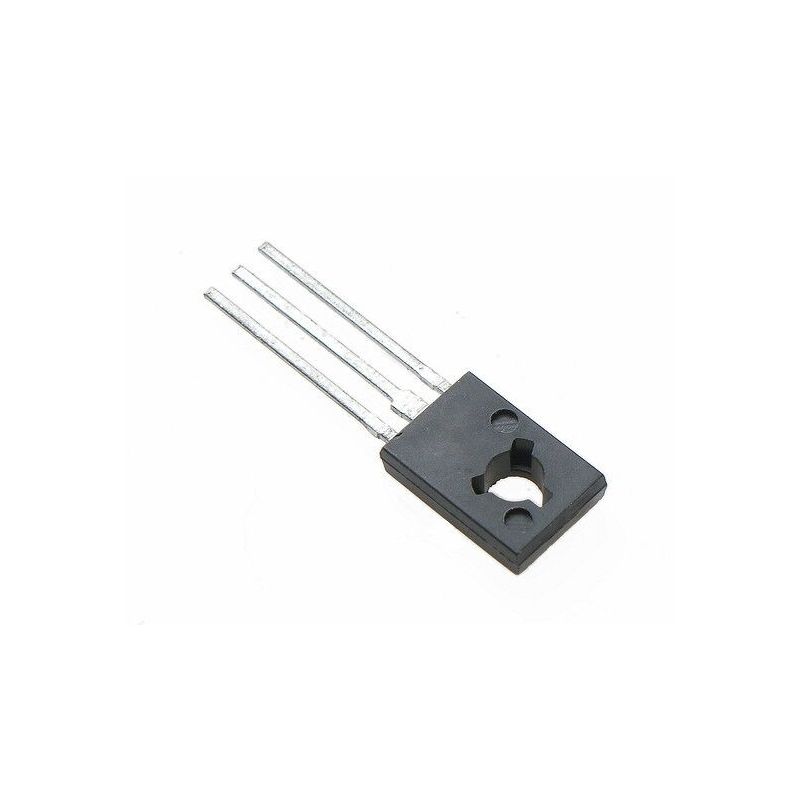
The TO-92 package of the 2SK596-B N-Channel JFET Transistor (TO-92) is a standard through-hole plastic encapsulation that offers a balance between compact size and ease of handling. While the 2SK596-B N-Channel JFET Transistor (TO-92) is a low-power device with minimal self-heating, the TO-92 form factor provides sufficient surface area for ambient cooling in standard operating environments. Mechanically, the three-lead configuration of the TO-92 package allows for secure mounting on printed circuit boards (PCBs) and is robust enough to withstand the vibrations often encountered in portable audio equipment or handheld microphones. For technicians performing repairs, the 2SK596-B N-Channel JFET Transistor (TO-92) in TO-92 is much easier to solder and desolder compared to surface-mount equivalents (like the SOT-23), making it a preferred choice for maintenance and prototyping where space is limited but manual assembly is required.
Like most Junction Field-Effect Transistors, the 2SK596-B N-Channel JFET Transistor (TO-92) is sensitive to electrostatic discharge (ESD) and excessive heat. When handling the 2SK596-B N-Channel JFET Transistor (TO-92), it is crucial to follow standard anti-static procedures, such as using a grounded wrist strap and ESD-safe work surfaces, to prevent high-voltage transients from puncturing the gate junction. During the soldering process, excessive thermal stress can degrade the internal semiconductor junctions or the lead bonds. It is recommended to use a temperature-controlled soldering iron set between 260°C and 300°C and to limit the dwell time on each lead of the 2SK596-B N-Channel JFET Transistor (TO-92) to less than three seconds. Using a heat sink (like a pair of needle-nose pliers) on the lead between the package and the solder joint can further protect the delicate internal structure of the 2SK596-B N-Channel JFET Transistor (TO-92), ensuring the longevity and performance of the component.