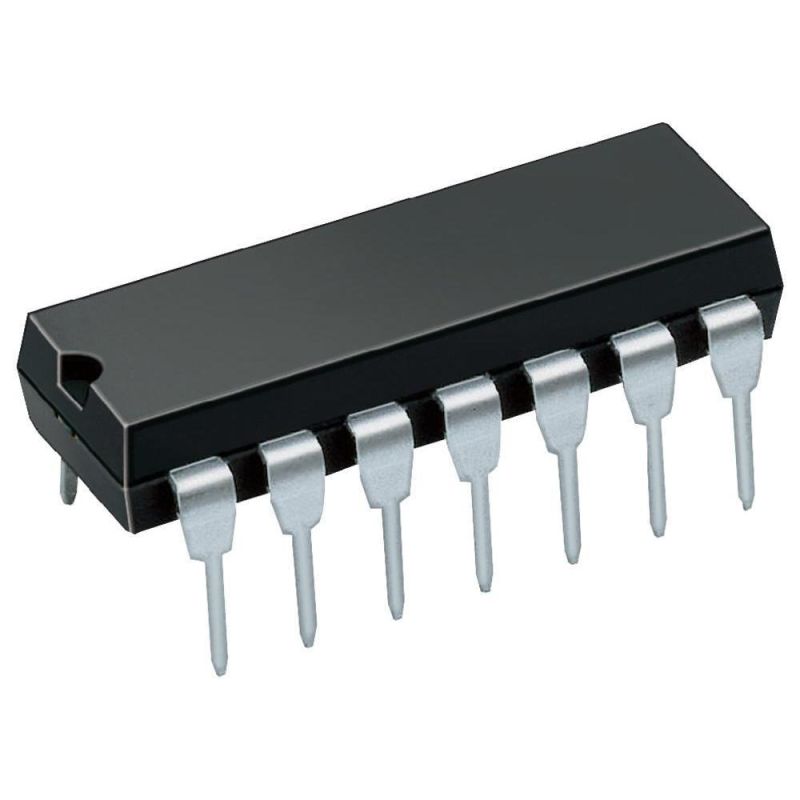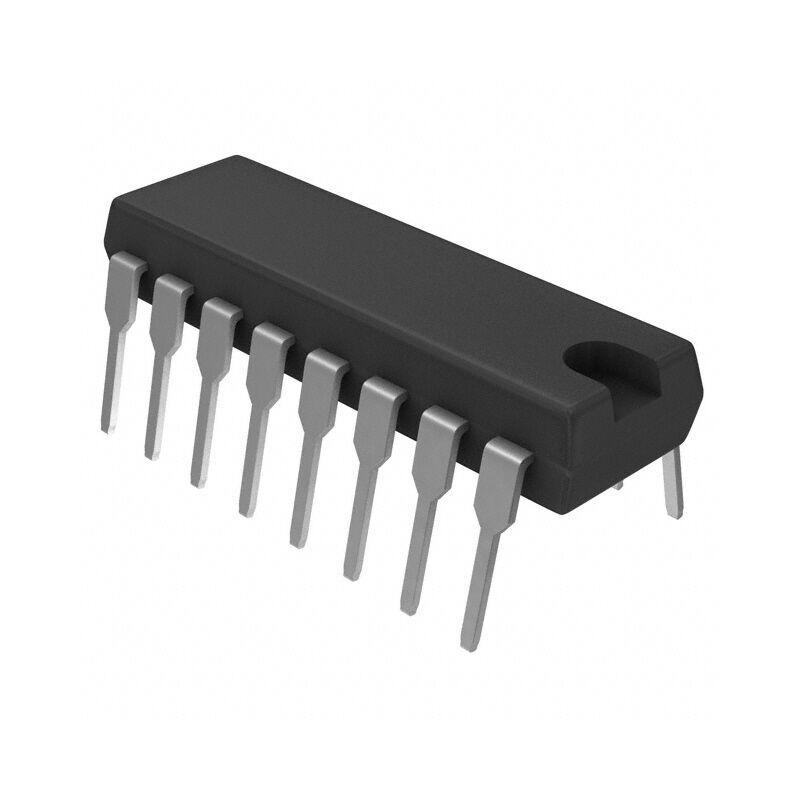


74LS92N Divide-by-Twelve Counter IC (14-Pin DIP)
23 people are viewing this right now
In Stock
SKU
191773974744
£2.55
Safe Checkout, Guaranteed

Safe Checkout, Guaranteed
The 74LS92N is a monolithic integrated circuit featuring a divide-by-twelve counter. This device is packaged in a 14-pin DIP (Dual In-Line Package) and is part of the widely used 74LS series of logic gates, known for their low-power Schottky technology. This counter consists of a divide-by-two section and a divide-by-six section, which can be cascaded to achieve a divide-by-twelve function. The 74LS92N is commonly used in frequency dividers, digital clocks, and timing circuits, providing a versatile solution for various counting and frequency division needs. Its ease of use and broad compatibility make it a staple in digital electronics. The 74LS92N excels in applications requiring frequency division and counting.
In digital clocks, this IC divides the high-frequency clock signal down to a lower frequency suitable for driving the time display. It is also used in frequency synthesizers, where it divides the output frequency of a voltage-controlled oscillator (VCO) to generate a stable and precise frequency. In timers and counters, the 74LS92N provides a convenient way to count events or measure time intervals. It can be cascaded with other counters to achieve higher counting ranges. Amateur radio equipment also utilizes the 74LS92N for frequency division and signal generation. It is used in frequency counters, signal generators, and other radio communication devices.
This integrated circuit adheres to stringent quality standards, offering engineers and designers a dependable solution for their counting and frequency division needs. The 74LS92N ensures that your circuits perform reliably, providing the necessary counting and frequency division functionality to achieve your design objectives. This IC boasts a low power consumption, making it suitable for battery-powered applications. Its TTL compatibility ensures seamless integration with other TTL logic devices. Whether you are designing digital clocks, timers, or radio communication devices, the 74LS92N is an indispensable component for robust and efficient counting and frequency division. Due to its ease of use and broad compatibility, the 74LS92N serves as a straightforward solution in many digital circuit applications, reducing development time and cost.
It is commonly used in industrial control systems, where it divides the clock signal for timing and control purposes. This functionality ensures accurate timing and control of industrial processes. The 74LS92N's robust design and comprehensive feature set make it a perfect choice for a multitude of applications. It can be reset to zero by applying a high level to both reset inputs. Its DIP package makes it easy to integrate into through-hole circuit boards. The 74LS92N is commonly used in educational projects and hobbyist circuits, where it provides a simple and effective way to implement counting and frequency division functions.
Stop improvising and start with a reliable design. Order your 74LS92N Integrated Circuit DIP today and experience the difference in your digital electronic designs!
| Product Name | 74LS92N Divide-by-Twelve Counter IC (14-Pin DIP) |
|---|---|
| SKU | 191773974744 |
| Price | £2.55 |
| 74LS92N Divide-by-Twelve Counter IC (14-Pin DIP) Color | As per image |
| Category | Integrated Circuits |
| Brand | Nikko Electronics ltd |
| Product Code | 191773974744 |
| Availability | Yes |
Shipping cost is based on order value. Just add products to your cart and use the Shipping Calculator to see the shipping price. We want you to be 100% satisfied with your purchase. Items can be returned or exchanged within 30 days of delivery.
To achieve a full divide-by-twelve count using the 74LS92N Divide-by-Twelve Counter IC (14-Pin DIP), you must externally cascade the two internal sections. The IC consists of an independent divide-by-two section (Clock A) and a divide-by-six section (Clock B). For a modulo-12 sequence, the input clock signal should be applied to the CP0 input (Pin 14). You then need to connect the Q0 output (Pin 12) directly to the CP1 input (Pin 1). This configuration ensures that the divide-by-two output triggers the divide-by-six stage, resulting in a total division of twelve. It is important to note that the 74LS92N Divide-by-Twelve Counter IC does not produce a standard binary sequence; instead, it provides a specific truncated sequence suitable for frequency division. When designing your PCB layout for the 14-pin DIP package, ensure that these jumpers are as short as possible to minimize parasitic inductance, which can cause false triggering in high-speed TTL logic environments.
The 74LS92N Divide-by-Twelve Counter IC (14-Pin DIP) is built using Low-power Schottky (LS) technology, which balances speed and power consumption. Typically, the CP0 input (divide-by-two section) can handle a maximum clock frequency of approximately 32 MHz, while the CP1 input (divide-by-six section) usually operates up to 16 MHz. However, these figures can vary based on ambient temperature and power supply stability. In terms of propagation delay, the time from the clock input to the output transition is generally around 15 to 20 nanoseconds. If you are cascading multiple 74LS92N Divide-by-Twelve Counter IC units for larger frequency division ratios, you must account for the cumulative gate delays to avoid 'glitches' or timing violations in synchronous downstream logic. For professional timing applications, always refer to the specific Vcc conditions, as the LS series is optimized for a 5V supply, and deviations can significantly impact the switching speeds and overall reliability of the counter.
The 74LS92N Divide-by-Twelve Counter IC (14-Pin DIP) features two Master Reset pins (MR1 and MR2) which are gated together to provide an asynchronous clear function. To reset the counter to a state of zero (all outputs Low), both MR1 and MR2 must be pulled to a High logic level simultaneously. This dual-input AND-gate configuration for the reset line is a safety feature that prevents accidental resets caused by noise spikes on a single line. In most practical applications using the 74LS92N Divide-by-Twelve Counter IC, if only a single reset signal is available, one pin is tied High while the other is used as the trigger, or both are tied together. Because this is an asynchronous reset, it overrides the clock inputs immediately. Engineers should ensure that the reset pulse width meets the minimum datasheet requirements (typically 25ns) to guarantee that all internal flip-flops in the 74LS92N Divide-by-Twelve Counter IC reach a stable zero state before the next clock pulse arrives.
It is a common misconception that the 74LS92N Divide-by-Twelve Counter IC (14-Pin DIP) functions as a standard 4-bit binary counter. Unlike the 74LS93, which is a 4-bit binary ripple counter, the 74LS92N is specifically designed for divide-by-twelve and divide-by-six applications. Its internal logic is wired to skip certain states. In the divide-by-twelve mode, the output sequence on pins Q0, Q1, Q2, and Q3 does not follow a 0-11 binary progression. Instead, it produces a sequence that is highly efficient for frequency division where the exact binary value of the count is less important than the division ratio. This makes the 74LS92N Divide-by-Twelve Counter IC ideal for digital clocks (specifically for the 'hours' or 'seconds' units) and timing generators. If your application requires a strict binary count from 0000 to 1011, you would need to use a 74LS191 or 74LS161; however, for pure frequency division, the 74LS92N offers a more streamlined, hardware-level solution without needing external reset gates.
The 74LS92N Divide-by-Twelve Counter IC (14-Pin DIP) operates within the standard TTL voltage range, requiring a regulated 5V DC power supply (Vcc). The acceptable operating range is typically between 4.75V and 5.25V. As a member of the Low-power Schottky family, the 74LS92N Divide-by-Twelve Counter IC is significantly more efficient than the original 74 series counters. Its typical supply current (Icc) is approximately 15mA to 27mA, depending on the switching frequency and output load. When integrating this IC into a larger digital system, it is critical to place a 0.1µF ceramic decoupling capacitor as close as possible to the Vcc (Pin 5) and Ground (Pin 10) pins. This capacitor suppresses the transient current spikes that occur during the internal flip-flop switching transitions. Failure to provide adequate decoupling for the 74LS92N Divide-by-Twelve Counter IC can lead to erratic counting behavior or electromagnetic interference (EMI) that may affect sensitive analog components nearby on the PCB.
Interfacing the 74LS92N Divide-by-Twelve Counter IC (14-Pin DIP) with 3.3V systems requires careful consideration of TTL logic levels. The 74LS92N outputs a 'High' signal (Voh) typically around 3.4V, which is generally safe for 3.3V CMOS inputs that are 5V-tolerant. However, the input requirements for the 74LS92N Divide-by-Twelve Counter IC dictate that a 'High' signal (Vih) must be at least 2.0V. While a 3.3V microcontroller output can technically trigger a 74LS92N input, the noise margin is reduced. For robust industrial or commercial designs, using a level shifter or a high-speed CMOS buffer (like the 74HCT series) is recommended to bridge the gap between 3.3V and the 5V logic of the 74LS92N Divide-by-Twelve Counter IC. Additionally, because the 74LS series uses bipolar transistors, the inputs source current (up to 0.4mA), which the driving microcontroller must be able to sink. Always verify the sink/source capabilities of your GPIO pins before direct connection to the 74LS92N.
The 74LS92N Divide-by-Twelve Counter IC (14-Pin DIP) is specifically optimized for timekeeping and frequency synthesis. In digital clock design, the division of a reference frequency (like 60Hz or 1Hz) into increments of 12 is essential for hour tracking. Using a standard binary counter would require external AND/NAND gates to reset the counter once it reaches the twelfth state. The 74LS92N Divide-by-Twelve Counter IC eliminates this need by having the divide-by-six and divide-by-two logic built directly into the silicon. This reduces component count, saves PCB space, and increases overall system reliability by removing external propagation delays associated with reset logic. Furthermore, the 14-pin DIP package is easy to prototype on breadboards and socket in production, making the 74LS92N Divide-by-Twelve Counter IC a staple for educational kits, vintage computer repairs, and dedicated timing modules where a simple, robust hardware counter is preferred over complex software-based interrupts in a microcontroller.