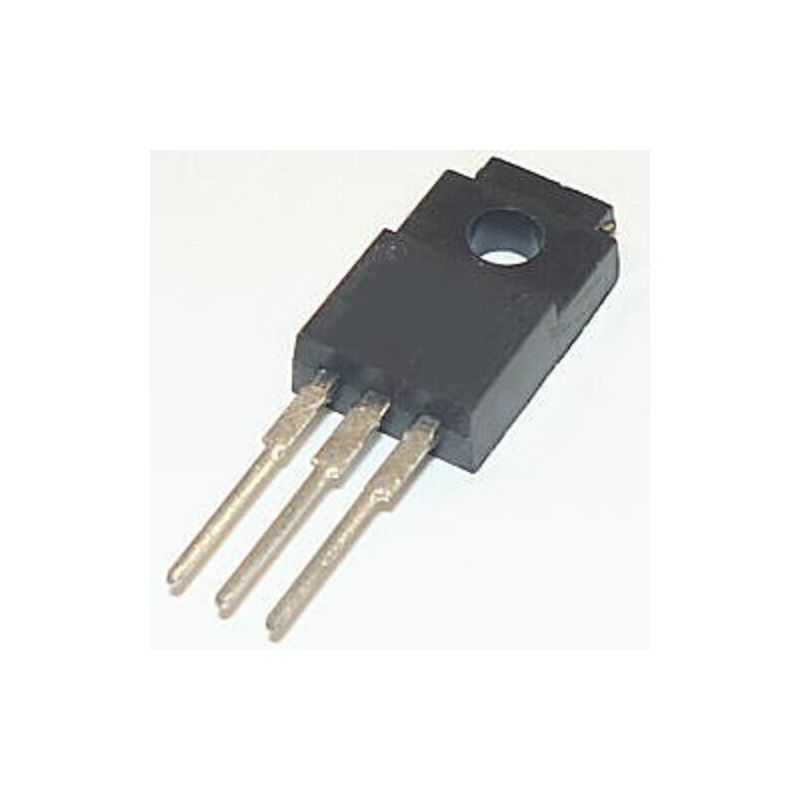


BF494 NPN RF Transistor (TO-92)
30 people are viewing this right now
In Stock
SKU
191457647942
£2.25
Safe Checkout, Guaranteed

Safe Checkout, Guaranteed
The 2SB1361 is a high-performance PNP silicon epitaxial transistor designed for a wide range of amplifier and switching applications. This versatile transistor is particularly well-suited for use in audio amplifiers, power supplies, and motor control circuits. Its robust construction and reliable performance make it a staple component in both consumer and industrial electronics. The 2SB1361 is known for its high current gain, low saturation voltage, and excellent switching characteristics, making it an ideal choice for applications requiring efficient and reliable performance. Key features of the 2SB1361 include a high collector current capability, typically around 7A, allowing it to handle substantial power loads. Its low saturation voltage minimizes power loss, contributing to improved energy efficiency and reduced heat generation.
The transistor also boasts a high breakdown voltage, providing a safety margin against voltage spikes and ensuring stable operation under varying conditions. The 2SB1361 is commonly used in audio amplifiers, where its high current gain and low distortion characteristics ensure clean and powerful audio amplification. It is also used in power supplies, where its efficient switching characteristics contribute to improved energy efficiency. In motor control circuits, the 2SB1361 is used to control the speed and direction of DC motors, providing precise and reliable control. When selecting a transistor for amplifier or switching applications, the 2SB1361 offers a compelling combination of performance, reliability, and cost-effectiveness. Its high current handling capability and low saturation voltage make it a dependable choice for demanding applications.
Whether you are designing a new amplifier circuit or repairing existing equipment, the 2SB1361 transistor is an excellent option. Its specifications are carefully optimized to provide efficient and reliable performance. The 2SB1361's performance characteristics are optimized for operation within specific bias conditions, which should be carefully considered during circuit design to achieve optimal results. Its robust design and high current handling capability ensure stable operation even under fluctuating load conditions. For those seeking a reliable and high-performing transistor for amplifier and switching applications, the 2SB1361 is an ideal choice. Add this essential component to your toolkit today and experience the difference in your electronic projects.
Don't miss out on the opportunity to enhance your designs with this proven performer. Order your 2SB1361 transistor now and take your projects to the next level. The 2SB1361 also features a high power dissipation capability, allowing it to handle substantial power loads without overheating. Its robust construction and reliable performance make it a staple component in both consumer and industrial electronics. The transistor's excellent switching characteristics make it suitable for high-frequency applications, such as switching power supplies and DC-DC converters. The 2SB1361 is an excellent choice for applications requiring high current gain, low saturation voltage, and efficient switching performance.
| Product Name | BF494 NPN RF Transistor (TO-92) |
|---|---|
| SKU | 191457647942 |
| Price | £2.25 |
| BF494 NPN RF Transistor (TO-92) Color | As per image |
| Category | Transistors |
| Brand | Nikko Electronics ltd |
| Product Code | 191457647942 |
| Availability | Yes |
Shipping cost is based on order value. Just add products to your cart and use the Shipping Calculator to see the shipping price. We want you to be 100% satisfied with your purchase. Items can be returned or exchanged within 30 days of delivery.
The BF494 NPN RF Transistor (TO-92) is specifically engineered for high-frequency applications, making it a cornerstone component for RF engineers and hobbyists alike. Its primary utility lies in the radio frequency (RF) stages of FM tuners, VHF receivers, and communication equipment. Due to its excellent frequency response, the BF494 NPN RF Transistor (TO-92) is frequently utilized in the front-end mixer and oscillator stages of radio circuits. It excels in small-signal amplification where maintaining signal integrity at high frequencies is paramount. Engineers often select this transistor for IF (Intermediate Frequency) amplifiers and low-noise RF pre-amplifiers because it provides a stable gain-bandwidth product. Furthermore, the BF494 NPN RF Transistor (TO-92) is highly effective in low-power transmission circuits and signal generators, where its ability to handle frequencies up to 260 MHz ensures reliable performance in the VHF spectrum. Its versatility extends to various consumer electronics, including television tuners and wireless remote control systems, where high-speed switching and RF sensitivity are critical requirements for consistent device operation.
The Gain-Bandwidth Product, often denoted as fT, is a critical specification for the BF494 NPN RF Transistor (TO-92), typically reaching up to 260 MHz. This high fT value signifies that the transistor can maintain a significant current gain even as the operating frequency approaches the VHF (Very High Frequency) range. In practical circuit design, this means the BF494 NPN RF Transistor (TO-92) is capable of amplifying signals in the 88-108 MHz FM band with minimal loss of gain, providing the necessary sensitivity for high-quality radio reception. When used in oscillator circuits, the high fT ensures that the BF494 NPN RF Transistor (TO-92) can sustain oscillations reliably without the parasitic capacitance of the device dampening the signal. For designers, this high-frequency capability translates to more headroom in the circuit design, allowing for better selectivity and sensitivity in receiver stages. Understanding the fT is essential for ensuring that the BF494 NPN RF Transistor (TO-92) operates well within its linear region at high frequencies, preventing signal distortion and ensuring the stability of the overall RF system.
The BF494 NPN RF Transistor (TO-92) is designed as a small-signal device, and its electrical parameters reflect its suitability for low-power RF applications. It typically features a Collector-Emitter Voltage (VCEO) rating of approximately 20V to 30V, which is more than sufficient for standard battery-operated or regulated DC power supply circuits used in RF equipment. The maximum Collector Current (IC) is generally rated around 30mA, emphasizing that the BF494 NPN RF Transistor (TO-92) is intended for signal processing rather than power driving. Operating the device within these limits is crucial for maintaining the longevity and reliability of the component. Additionally, the BF494 NPN RF Transistor (TO-92) exhibits a very low reverse transfer capacitance (Cre), which is vital for preventing unwanted feedback in high-frequency amplifier stages. By keeping the operating current within the optimal range (often between 1mA and 10mA for RF gain stages), users can maximize the linearity and minimize the noise figure of the BF494 NPN RF Transistor (TO-92), ensuring that the amplified signal remains clean and free from harmonic distortion in sensitive communication devices.
The BF494 NPN RF Transistor (TO-92) and the BF495 are very closely related and are often used interchangeably in many RF applications; however, there are subtle differences to consider for high-precision designs. The BF494 NPN RF Transistor (TO-92) is generally optimized for use in the RF and IF stages of FM receivers, specifically as a mixer or oscillator. While both share the same TO-92 package and similar pinouts, the BF494 often exhibits slightly different capacitance characteristics that may affect the tuning of high-Q resonant circuits. In most standard FM radio repairs or general hobbyist projects, the BF494 NPN RF Transistor (TO-92) serves as an excellent substitute for the BF495 due to its compatible gain and frequency response. When performing a replacement, it is important to verify the bias conditions, as the DC current gain (hFE) might vary slightly between the two models. For critical RF applications, a minor adjustment to the tank circuit or the biasing resistor may be required to achieve optimal performance when switching to the BF494 NPN RF Transistor (TO-92), ensuring the circuit remains perfectly tuned to the desired frequency.
The BF494 NPN RF Transistor (TO-92) typically follows a standard pinout configuration, but it is essential to consult the specific datasheet as some manufacturers may vary. Generally, when looking at the flat side of the TO-92 package with the leads pointing down, the sequence is Emitter, Base, and Collector (E-B-C). This layout is critical for PCB design, especially in RF circuits where lead length and parasitic inductance can significantly impact performance. When laying out a circuit for the BF494 NPN RF Transistor (TO-92), designers should keep the traces as short as possible to minimize stray capacitance. Proper grounding is also vital; often, the emitter is connected to a large ground plane to provide stability and reduce noise in common-emitter configurations. The compact TO-92 package of the BF494 NPN RF Transistor (TO-92) allows for high-density mounting, but designers must ensure there is adequate spacing to avoid capacitive coupling between the input (Base) and output (Collector) traces, which could lead to instability or self-oscillation at VHF frequencies. Correct identification of the pins on the BF494 NPN RF Transistor (TO-92) ensures the transistor is biased correctly and prevents immediate failure upon power-up.
In the world of radio frequency design, the noise figure is a measurement of how much noise a component adds to the signal. The BF494 NPN RF Transistor (TO-92) is favored in the industry because it offers a relatively low noise figure, which is essential for the first stage of a radio receiver. When a weak signal is received by an antenna, the BF494 NPN RF Transistor (TO-92) can amplify it without overwhelming the signal with thermal or shot noise. This characteristic directly improves the signal-to-noise ratio (SNR) of the receiver, allowing for clearer audio and the ability to pick up distant stations. Engineers utilizing the BF494 NPN RF Transistor (TO-92) in FM front-ends focus on optimizing the collector current to find the 'sweet spot' where the noise figure is minimized while maintaining sufficient gain. This balance is what makes the BF494 NPN RF Transistor (TO-92) a reliable choice for high-quality consumer electronics where sensitivity is a key selling point. By integrating the BF494 NPN RF Transistor (TO-92) correctly, manufacturers can ensure their products deliver crisp, clear signals even in environments with significant electromagnetic interference.
Although the BF494 NPN RF Transistor (TO-92) is a low-power device, thermal management remains a consideration, particularly when it is used in continuous-wave (CW) oscillators or high-duty-cycle RF applications. The TO-92 plastic package has a specific thermal resistance that limits its power dissipation capability, typically around 300mW to 600mW depending on the ambient temperature. When the BF494 NPN RF Transistor (TO-92) is operating at its maximum frequency and voltage limits, internal heat generation can cause a shift in the transistor's parameters, such as the base-emitter voltage and current gain. This phenomenon, known as thermal drift, can lead to frequency instability in oscillators. To mitigate this, designers should ensure that the BF494 NPN RF Transistor (TO-92) is not over-driven and that there is sufficient airflow around the component on the PCB. In some cases, using a small clip-on heatsink or ensuring the transistor is not placed near other heat-generating components like power resistors can help maintain the frequency stability of the BF494 NPN RF Transistor (TO-92). Proper thermal design ensures that the RF circuit remains within its calibrated frequency range over a wide operating temperature spectrum.