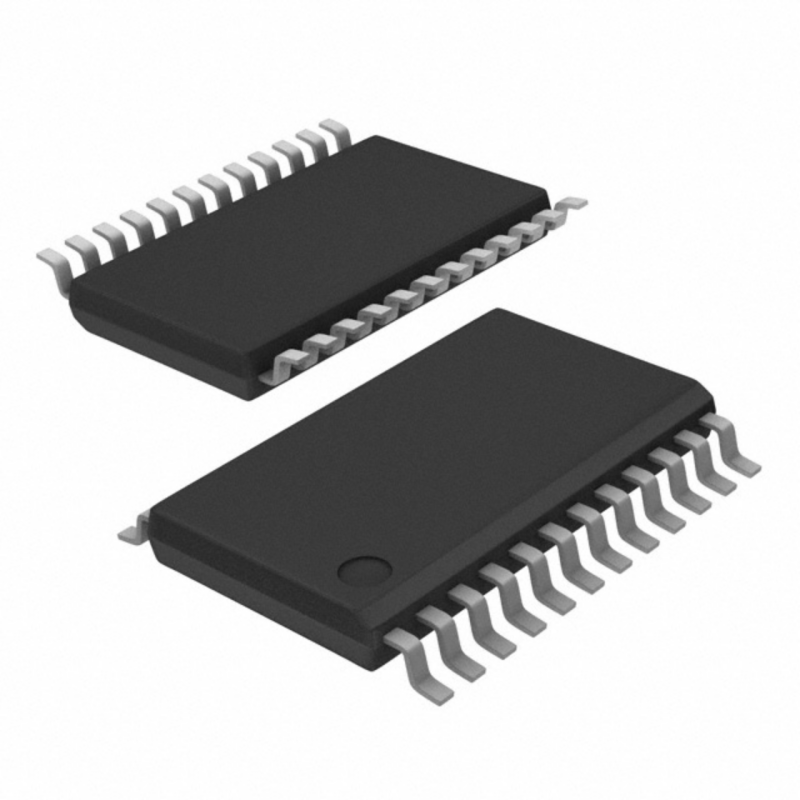


CD74HC14E Hex Inverting Schmitt Trigger IC (14-Pin DIP)
46 people are viewing this right now
In Stock
SKU
191704616608
£3.25
Safe Checkout, Guaranteed

Safe Checkout, Guaranteed
The CD74HC14E is a high-speed CMOS logic integrated circuit featuring six independent Schmitt trigger inverters. Housed in a 14-DIP (Dual In-line Package), this IC is a fundamental building block in digital electronics, offering excellent noise immunity and signal conditioning capabilities. This hex inverter with Schmitt trigger inputs is designed to provide clean, crisp digital signals, even in noisy environments. The Schmitt trigger action eliminates the effects of slow-changing or noisy input signals, ensuring reliable operation and preventing false triggering. The CD74HC14E's high-speed CMOS technology offers fast switching speeds and low power consumption, making it suitable for a wide range of digital applications. It operates over a wide voltage range, typically from 2V to 6V, providing flexibility in various circuit designs.
The 14-DIP package allows for easy insertion into breadboards and prototyping boards, making it ideal for experimentation and educational purposes. This IC is commonly used in waveform shaping, pulse shaping, and debouncing applications. The Schmitt trigger inputs provide hysteresis, which means the switching thresholds for rising and falling input voltages are different. This hysteresis prevents oscillations and ensures clean transitions in digital circuits. The CD74HC14E is essential for converting analog signals to digital signals, cleaning up noisy signals, and creating stable waveforms. Its low power consumption makes it suitable for battery-powered devices and energy-efficient designs.
Each of the six inverters operates independently, allowing for versatile use in various digital logic circuits. The IC is compatible with other CMOS and TTL logic families, making it easy to integrate into existing systems. The CD74HC14E's robust design and high noise immunity make it ideal for use in industrial control systems, automotive electronics, and other harsh environments. It can withstand a wide range of operating temperatures, ensuring reliable performance in demanding conditions. The Schmitt trigger inverters also help to reduce electromagnetic interference (EMI) by shaping the edges of digital signals, minimizing the generation of unwanted frequencies. This feature is crucial for applications where electromagnetic compatibility (EMC) is a concern.
Whether you're designing a microcontroller-based system, a digital filter, or a simple logic gate circuit, the CD74HC14E provides the performance and reliability you need. Its ease of use, high-speed operation, and excellent noise immunity make it a valuable addition to any electronic engineer's toolkit. Enhance your digital circuits with the CD74HC14E hex inverter Schmitt trigger IC. Experience reliable signal conditioning and noise immunity in your projects. Order your CD74HC14E today and take the first step towards building more robust and dependable digital systems!
| Product Name | CD74HC14E Hex Inverting Schmitt Trigger IC (14-Pin DIP) |
|---|---|
| SKU | 191704616608 |
| Price | £3.25 |
| CD74HC14E Hex Inverting Schmitt Trigger IC (14-Pin DIP) Color | As per image |
| Category | Integrated Circuits |
| Brand | Nikko Electronics ltd |
| Product Code | 191704616608 |
| Availability | Yes |
Shipping cost is based on order value. Just add products to your cart and use the Shipping Calculator to see the shipping price. We want you to be 100% satisfied with your purchase. Items can be returned or exchanged within 30 days of delivery.
The CD74HC14E Hex Inverting Schmitt Trigger IC is specifically engineered to handle noisy or slow-moving input signals that would cause standard inverters like the 74HC04 to malfunction. Unlike a standard inverter that has a single threshold voltage, the CD74HC14E Hex Inverting Schmitt Trigger IC features two distinct threshold levels: the positive-going threshold (VT+) and the negative-going threshold (VT-). The difference between these two points is known as the hysteresis voltage. This design ensures that once an input crosses a threshold, it must move significantly in the opposite direction before the output state changes again. In practical applications, this prevents 'chatter' or rapid, unwanted output oscillations when dealing with signals that have slow rise and fall times or superimposed high-frequency noise. This makes the CD74HC14E Hex Inverting Schmitt Trigger IC an essential component for signal conditioning, as it effectively 'cleans' distorted waveforms into sharp, square-wave digital signals, ensuring reliable downstream logic processing in complex industrial or consumer electronic circuits.
Yes, the CD74HC14E Hex Inverting Schmitt Trigger IC is a popular choice for designing simple, cost-effective relaxation oscillators and pulse generators. Because each of the six gates in the CD74HC14E Hex Inverting Schmitt Trigger IC has built-in hysteresis, you can create an oscillator using just a single resistor and a single capacitor. By connecting the resistor between the output and the input, and the capacitor between the input and ground, the circuit will naturally oscillate as the capacitor charges and discharges between the VT+ and VT- thresholds. This is a significant advantage over standard CMOS inverters, which cannot reliably oscillate in this configuration without additional biasing components. When using the CD74HC14E Hex Inverting Schmitt Trigger IC for timing, it is important to account for the tolerance of the internal threshold voltages, which can vary slightly between batches and with temperature. For precision timing, high-quality film capacitors and precision resistors are recommended to maintain frequency stability across the operating voltage range of 2V to 6V.
The CD74HC14E Hex Inverting Schmitt Trigger IC exhibits a strong correlation between its supply voltage (VCC) and its switching speed. When operating at the lower end of its range, such as 2V, the propagation delay is significantly higher, typically averaging around 55ns to 125ns depending on the load. This is due to the lower drive current available to charge internal and external capacitances. However, as you increase the supply voltage to 4.5V or the maximum 6V, the CD74HC14E Hex Inverting Schmitt Trigger IC becomes much faster, with propagation delays dropping to approximately 11ns to 25ns. While higher voltages improve speed and output drive capability (sourcing or sinking up to 5.2mA at 6V), they also increase the dynamic power consumption, which is calculated based on the switching frequency (f), load capacitance (CL), and the square of the supply voltage (VCC²). Engineers must balance the need for high-speed signal processing with the power budget of their specific application when selecting the operating voltage for the CD74HC14E Hex Inverting Schmitt Trigger IC.
The CD74HC14E Hex Inverting Schmitt Trigger IC can be used for level shifting, but its effectiveness depends on the specific logic levels involved. When the CD74HC14E Hex Inverting Schmitt Trigger IC is powered at 5V, its positive-going threshold (VT+) is typically around 2.7V to 3.5V. Since a 3.3V logic high signal might only reach 3.0V under load, it may not consistently cross the VT+ threshold of a 5V-powered CD74HC14E Hex Inverting Schmitt Trigger IC, leading to unreliable switching. To use this IC as a level shifter from 3.3V to 5V, it is often better to power the IC at a slightly lower voltage or ensure the 3.3V driver has a strong pull-up. Conversely, if you are shifting from 5V down to 3.3V, you can power the CD74HC14E Hex Inverting Schmitt Trigger IC at 3.3V; however, you must ensure that the 5V input signal does not exceed the VCC + 0.5V limit to avoid forward-biasing the internal ESD protection diodes. If the input exceeds this, a current-limiting series resistor is mandatory to protect the CD74HC14E Hex Inverting Schmitt Trigger IC.
Proper management of unused inputs is critical when working with the CD74HC14E Hex Inverting Schmitt Trigger IC due to its high-impedance CMOS construction. You should never leave unused input pins floating. Floating inputs can pick up electromagnetic interference (EMI) or static charge, causing the input voltage to drift into the linear region between the logic thresholds. This can cause both the N-channel and P-channel MOSFETs in the output stage to turn on simultaneously, leading to excessive 'shoot-through' current, significant heat generation, and potential failure of the CD74HC14E Hex Inverting Schmitt Trigger IC. To prevent this, all unused inputs must be tied directly to either VCC or GND. Tying them to a stable logic level ensures the internal circuitry remains in a defined state with minimal quiescent current consumption (typically only 2µA for the whole package). Since the CD74HC14E Hex Inverting Schmitt Trigger IC contains six independent gates, even if you only use one, the remaining five must be properly terminated to maintain the overall stability and longevity of the integrated circuit.
The CD74HC14E Hex Inverting Schmitt Trigger IC is an excellent hardware-based solution for debouncing mechanical switches, such as pushbuttons or limit switches. When a mechanical switch closes, it physically bounces, creating a series of rapid pulses that a fast microcontroller might interpret as multiple presses. By using the CD74HC14E Hex Inverting Schmitt Trigger IC in conjunction with a simple RC (resistor-capacitor) filter, you can create a hardware debounce circuit that provides a single, clean transition. The RC network slows down the rapid bounces, and the Schmitt trigger action of the CD74HC14E Hex Inverting Schmitt Trigger IC ensures that the output only toggles once the capacitor has charged or discharged past the specific hysteresis thresholds. Using the CD74HC14E Hex Inverting Schmitt Trigger IC for hardware debouncing is often preferred in real-time systems because it reduces the processing overhead on the MCU, eliminating the need for complex polling routines or interrupt-driven timers. This results in a more responsive and robust user interface, especially in electrically noisy environments where software debouncing might fail to distinguish between a bounce and EMI.
The CD74HC14E Hex Inverting Schmitt Trigger IC is designed primarily for logic-level signaling rather than driving high-power loads. According to the standard high-speed CMOS (HC) specifications, the CD74HC14E Hex Inverting Schmitt Trigger IC can typically source or sink up to 5.2mA per output when operating at a VCC of 6V. At a more common 4.5V operation, the drive current is rated at +/- 4mA. In terms of fan-out, the CD74HC14E Hex Inverting Schmitt Trigger IC can drive up to 10 standard LSTTL (Low-power Schottky TTL) loads. When driving other CMOS inputs, the fan-out is significantly higher—often exceeding 50 inputs—because CMOS inputs have extremely high input impedance and require very little current. However, as the number of connected inputs increases, the total load capacitance also increases, which will slow down the transition times and increase the propagation delay. If your application requires driving heavy loads like LEDs or small relays, it is recommended to use the CD74HC14E Hex Inverting Schmitt Trigger IC to trigger a dedicated transistor or a high-current buffer to avoid exceeding the package's total power dissipation limits.