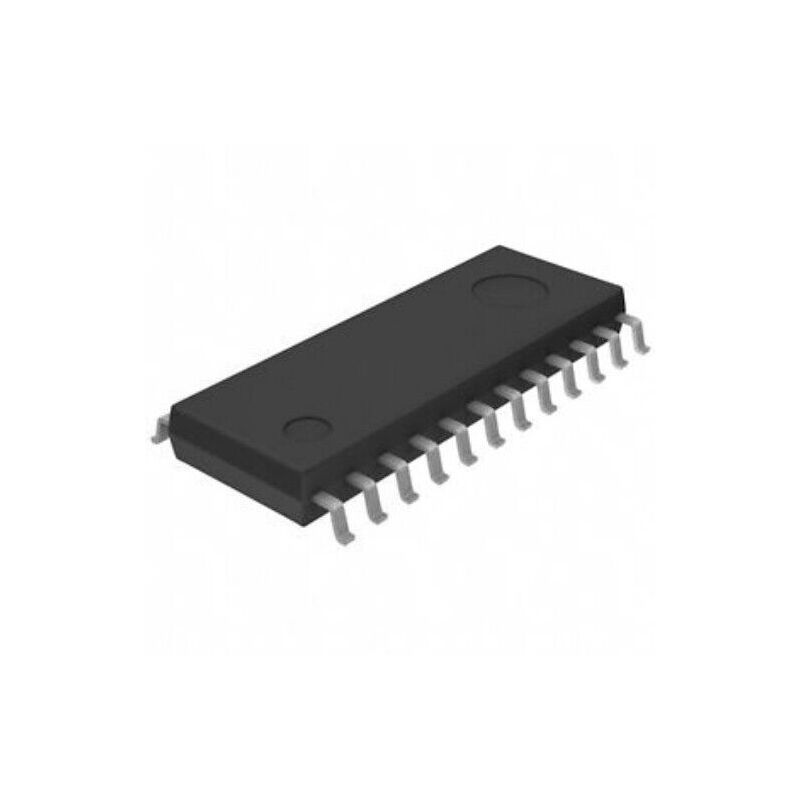


CDP1802E 8-bit CMOS Microprocessor
23 people are viewing this right now
In Stock
SKU
191887873646
£18.33
Safe Checkout, Guaranteed

Safe Checkout, Guaranteed
The CDP1802E is a classic 8-bit CMOS microprocessor integrated circuit, famously known for its radiation-hardened design and use in various space applications, including early spacecraft. Housed in a 40-DIP (Dual In-Line Package), it's a historically significant component for those interested in vintage computing, space technology, and retro electronics projects. The CDP1802E is an 8-bit microprocessor that was initially developed by RCA. Its CMOS (Complementary Metal-Oxide-Semiconductor) technology allows for low power consumption, making it suitable for battery-powered applications and environments where energy efficiency is critical. The 40-DIP package provides a convenient and robust way to interface with the microprocessor, making it compatible with breadboards, prototyping boards, and vintage computer systems. This microprocessor architecture is characterized by its unique register-based design, which allows for flexible memory addressing and efficient data manipulation.
It includes a set of general-purpose registers that can be used for storing data, addresses, and intermediate results. The CDP1802E has a versatile instruction set that supports a variety of operations, including arithmetic, logical, and data transfer instructions. These instructions allow developers to create sophisticated programs for a wide range of applications. Its CMOS design minimizes power dissipation, enhancing its suitability for power-sensitive applications like remote data logging and portable instrumentation. The CDP1802E is a vintage component, it is often sought after by hobbyists, collectors, and enthusiasts who are interested in preserving and restoring early computer systems. While modern microprocessors offer significantly higher performance and functionality, the CDP1802E remains a valuable piece of computing history.
The CDP1802E is designed to operate over a wide voltage range, offering flexibility in terms of power supply options. Its robust design and radiation-hardened characteristics make it suitable for use in harsh environments, including space applications where radiation exposure is a concern. The CDP1802E's architecture allows for efficient data transfer and manipulation, making it well-suited for real-time control applications. Its interrupt handling capabilities enable it to respond quickly to external events, making it suitable for use in industrial automation and robotics. Own a piece of computing history. Whether you're a collector, a hobbyist, or an engineer working on a vintage project, the CDP1802E offers a unique glimpse into the past.
Add the CDP1802E to your collection today and experience the legacy of this groundbreaking microprocessor. Get yours now and explore the fascinating world of vintage computing.
| Product Name | CDP1802E 8-bit CMOS Microprocessor |
|---|---|
| SKU | 191887873646 |
| Price | £18.33 |
| CDP1802E 8-bit CMOS Microprocessor Color | As per image |
| Category | Integrated Circuits |
| Brand | Nikko Electronics ltd |
| Product Code | 191887873646 |
| Availability | Yes |
Shipping cost is based on order value. Just add products to your cart and use the Shipping Calculator to see the shipping price. We want you to be 100% satisfied with your purchase. Items can be returned or exchanged within 30 days of delivery.
The CDP1802E 8-bit CMOS Microprocessor is renowned for its low power consumption, primarily due to its advanced CMOS (Complementary Metal-Oxide-Semiconductor) technology. Unlike older NMOS or PMOS designs, CMOS circuits draw significantly less power, especially in static states, making the CDP1802E ideal for applications where energy efficiency is critical and battery life is paramount. This characteristic was a key factor in its adoption for early space missions, where power budgets were extremely tight. For hobbyists and developers working on portable retro computing devices or embedded systems requiring prolonged operation on limited power sources, the CDP1802E 8-bit CMOS Microprocessor offers a historically proven, robust solution. Its efficient design minimizes heat generation, contributing to system reliability in compact or sealed enclosures, further extending its utility beyond just power saving.
Absolutely, the CDP1802E 8-bit CMOS Microprocessor is housed in a standard 40-DIP (Dual In-Line Package), which makes it exceptionally compatible with modern prototyping tools. The DIP-40 form factor is designed for through-hole mounting, allowing direct insertion into standard breadboards and perfboards without the need for specialized adapters or surface-mount soldering skills. This ease of integration is a significant advantage for hobbyists, educators, and engineers looking to experiment with vintage computing architectures or develop new retro-inspired projects. The robust pins of the 40-DIP package ensure reliable connections during iterative design and testing phases. Consequently, anyone interested in exploring the unique capabilities of the CDP1802E 8-bit CMOS Microprocessor will find it straightforward to incorporate into their existing prototyping setups, fostering hands-on learning and development.
The radiation-hardened design is a defining feature of the CDP1802E 8-bit CMOS Microprocessor, distinguishing it from many contemporary and modern processors. This inherent resilience means the chip is engineered to withstand high levels of ionizing radiation, electromagnetic interference, and extreme temperature fluctuations without performance degradation or critical failures. This characteristic was paramount for its deployment in early spacecraft and satellites, where components are exposed to harsh cosmic radiation environments. For specialized industrial or scientific applications on Earth, such as nuclear instrumentation, high-altitude electronics, or medical devices operating near radiation sources, the CDP1802E 8-bit CMOS Microprocessor offers unparalleled reliability and operational stability. Its 'rad-hard' capability ensures longevity and data integrity in environments where standard commercial-grade components would quickly fail, making it a valuable choice for robust, mission-critical systems.
The 8-bit architecture of the CDP1802E 8-bit CMOS Microprocessor defines its operational characteristics and suitability for specific retro computing projects. While not designed for high-speed, complex calculations of modern systems, its 8-bit data bus and architecture are perfect for tasks requiring direct hardware control, simple data processing, and educational purposes. It excels in applications like embedded controllers, simple games, text-based interfaces, and learning environments where understanding fundamental CPU operations is key. The instruction set is relatively small and straightforward, making it easier to program in assembly language, which is highly beneficial for those delving into the intricacies of vintage microprocessor design. For projects aiming to recreate classic computer systems or develop minimalist, efficient controllers, the CDP1802E 8-bit CMOS Microprocessor provides an authentic and capable platform, offering a hands-on experience with historical computing paradigms.
For working with the CDP1802E 8-bit CMOS Microprocessor, a range of development tools and resources are available, catering to both historical accuracy and modern convenience. While dedicated hardware development kits are rare today, robust software emulators like 'elf' or 'COSMAC ELF' emulators allow users to simulate the CDP1802E's behavior on modern computers, facilitating code development and debugging without physical hardware. Assemblers like the RCA ASM1802 or modern cross-assemblers (e.g., AS for CDP1802) are essential for translating assembly code into machine-executable instructions. Community support through forums and dedicated websites provides access to historical documentation, example code, and schematics. For hardware interfacing, simple logic analyzers and oscilloscopes are recommended for debugging physical circuits. The CDP1802E 8-bit CMOS Microprocessor benefits from a passionate community, ensuring that resources for development, whether for new designs or restorations, remain accessible and well-supported.
When integrating the CDP1802E 8-bit CMOS Microprocessor, users should be mindful of its power supply requirements, typical of CMOS devices of its era. The CDP1802E generally operates across a wide voltage range, typically from 4V to 6.5V, with 5V being the most common and recommended operating voltage for optimal performance and compatibility with TTL logic. Its CMOS nature means it has excellent noise immunity and low static power dissipation. However, it's crucial to provide a stable, clean power supply to prevent erratic behavior. Decoupling capacitors (e.g., 0.1µF ceramic) placed close to the power pins are highly recommended to filter out noise and stabilize the voltage. While robust, operating the CDP1802E 8-bit CMOS Microprocessor outside its specified voltage range can lead to unreliable operation or permanent damage. Adhering to these simple power guidelines ensures stable and long-term functionality for your vintage computing or embedded projects.
While famous for its space-faring roles, the CDP1802E 8-bit CMOS Microprocessor also found extensive use in various ground-based and industrial control applications due to its robust design and low power consumption. Historically, it powered early embedded systems, industrial process controllers, telecommunications equipment, and battery-powered portable devices. Its radiation-hardened nature translated into exceptional reliability in electrically noisy industrial environments, making it suitable for factory automation, control panels, and critical infrastructure monitoring where system uptime is paramount. For modern retro enthusiasts or designers seeking to build extremely robust, low-power embedded systems, the CDP1802E 8-bit CMOS Microprocessor remains a compelling choice. Its simplicity and direct hardware access make it ideal for educational projects, custom input/output controllers, and small-scale automation where resilience and energy efficiency are prioritized over raw processing speed, demonstrating its versatility beyond its celestial origins.