

DM74132N Quad 2-Input NAND Gate with Schmitt Trigger Inputs (DIP-14)
37 people are viewing this right now
In Stock
SKU
191748310362
£3.25
Safe Checkout, Guaranteed

Safe Checkout, Guaranteed
Implement robust and reliable logic functions in your digital circuits with the DM74132N Integrated Circuit, a quad 2-input NAND gate with Schmitt-trigger inputs, housed in a DIP-14 (Dual In-Line Package). This versatile IC is designed to provide clean and noise-immune logic signals in a wide range of digital applications. The DM74132N features Schmitt-trigger inputs that provide hysteresis, which eliminates noise and spurious switching, ensuring stable and reliable operation even in noisy environments. Its high noise immunity makes it an ideal choice for industrial control systems, automotive electronics, and other applications where noise is a concern. This IC operates from a wide voltage range, allowing it to be used in various power supply configurations. Its robust design ensures stable operation over a wide temperature range, making it suitable for use in demanding environments.
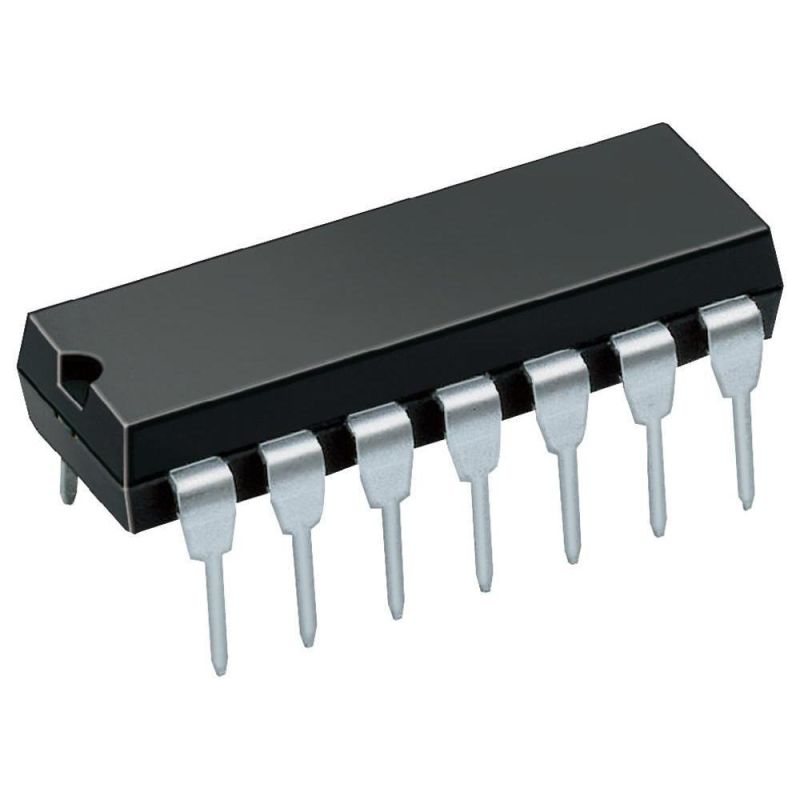
The DIP-14 package simplifies prototyping and breadboarding, making it an excellent choice for hobbyists and students. The DM74132N is commonly used in signal conditioning circuits, debounce circuits, and logic gate applications. Its high noise immunity makes it suitable for processing signals from sensors and switches. Whether you are designing a digital control system or a simple logic circuit, the DM74132N delivers the performance and reliability you need. Its ease of use and readily available datasheets simplify the design process. The DM74132N serves as a critical element in numerous digital circuits where clean logic is a must.
Whether aerospace or medical instrumentation, these integrated circuits are critical. In the world of digital circuits, the DM74132N stands out as a dependable and efficient solution for noise-immune logic gating. Its specialized design and robust construction make it an indispensable element in modern electronic circuits. Enhance the stability and reliability of your digital circuits with this high-quality integrated circuit. The DM74132N represents a mix of robustness, noise immunity, and dependability, making it a vital element for any digital implementation. Don't risk noise affecting your signals.
Order your DM74132N Integrated Circuit today and experience the difference in signal integrity. Enhance your digital performance and reliability with this essential component. Add to cart now!
| Product Name | DM74132N Quad 2-Input NAND Gate with Schmitt Trigger Inputs (DIP-14) |
|---|---|
| SKU | 191748310362 |
| Price | £3.25 |
| DM74132N Quad 2-Input NAND Gate with Schmitt Trigger Inputs (DIP-14) Color | As per image |
| Category | Integrated Circuits |
| Brand | Nikko Electronics ltd |
| Product Code | 191748310362 |
| Availability | Yes |
Shipping cost is based on order value. Just add products to your cart and use the Shipping Calculator to see the shipping price. We want you to be 100% satisfied with your purchase. Items can be returned or exchanged within 30 days of delivery.
The DM74132N Quad 2-Input NAND Gate with Schmitt Trigger Inputs (DIP-14) is specifically engineered to handle noisy or slow-changing input signals that would cause standard logic gates to malfunction. Unlike a conventional 7400 series NAND gate which has a single switching threshold, the DM74132N utilizes two distinct threshold levels: the positive-going threshold (VT+) and the negative-going threshold (VT-). The difference between these two points, known as hysteresis (typically around 0.8V), ensures that small fluctuations or noise superimposed on the input signal do not trigger unintended logic state changes. This is critical in industrial environments where electromagnetic interference (EMI) is prevalent. By providing a clean, jitter-free output transition even with slowly ramping inputs, the DM74132N Quad 2-Input NAND Gate with Schmitt Trigger Inputs (DIP-14) eliminates the need for external signal conditioning components, making it an essential component for robust digital systems that require high noise immunity and stable logic switching.
The DM74132N Quad 2-Input NAND Gate with Schmitt Trigger Inputs (DIP-14) operates within the standard TTL voltage range, typically requiring a VCC of 5.0V with a tolerance of ±5% (4.75V to 5.25V). When integrating this IC into a PCB layout, it is vital to manage power consumption and transient noise. The DM74132N exhibits a typical supply current (ICC) that varies depending on the logic state, but users should design for the maximum rated current to ensure power rail stability. To prevent high-frequency switching noise from affecting adjacent components or the gate's own performance, a 0.1µF ceramic decoupling capacitor should be placed as close as possible to the VCC pin (Pin 14) and the GND pin (Pin 7). This capacitor acts as a local energy reservoir, smoothing out the current spikes that occur during logic transitions. Proper power management ensures that the DM74132N Quad 2-Input NAND Gate with Schmitt Trigger Inputs (DIP-14) maintains its high-speed performance and noise-rejection characteristics across its entire operating temperature range.
Yes, the DM74132N Quad 2-Input NAND Gate with Schmitt Trigger Inputs (DIP-14) is an excellent choice for converting distorted or sinusoidal analog signals into clean, rectangular digital pulses. Because of its internal hysteresis, the DM74132N can take a slow-rising sine wave or a triangular wave and produce a sharp, fast-edged square wave output. This process, often called pulse restoration or squaring, is essential in timing circuits where a precise clock edge is required from a noisy reference. When using the DM74132N Quad 2-Input NAND Gate with Schmitt Trigger Inputs (DIP-14) for this purpose, engineers can utilize one input for the signal and tie the other high, or bridge both inputs together to act as an inverter. The resulting output will have consistent rise and fall times, independent of the input signal's slope. This makes the DM74132N an invaluable tool for interfacing analog sensors, optocouplers, or legacy equipment with modern digital microcontrollers and high-speed logic arrays.
In digital design, mechanical switches and buttons often produce 'bounce'—a series of rapid transitions—when actuated. The DM74132N Quad 2-Input NAND Gate with Schmitt Trigger Inputs (DIP-14) provides a hardware-based solution for this problem. By combining a gate from the DM74132N with a simple RC (resistor-capacitor) network, you can create a highly reliable debouncing circuit. The RC network slows the transition of the voltage at the input pin, and the Schmitt trigger’s hysteresis ensures that the output only changes state once the capacitor has charged or discharged past the specific thresholds. This prevents the multiple false triggers that would occur with a standard logic gate. Using the DM74132N Quad 2-Input NAND Gate with Schmitt Trigger Inputs (DIP-14) for debouncing offloads processing tasks from the CPU, as it provides a clean, single-pulse signal directly to the interrupt or clock pins of a processor, significantly improving system reliability in user-interface applications.
The DM74132N Quad 2-Input NAND Gate with Schmitt Trigger Inputs (DIP-14) is designed for standard TTL speed performance. Typically, the propagation delay from input to output (tPLH and tPHL) ranges between 15ns and 22ns when operating at the nominal 5V supply. While this is slightly slower than the 'LS' (Low-power Schottky) or 'S' (Schottky) variants, the DM74132N provides superior drive capability and noise immunity. When designing high-speed digital paths, engineers must account for these delays to avoid race conditions or timing violations. The DM74132N Quad 2-Input NAND Gate with Schmitt Trigger Inputs (DIP-14) is particularly useful in asynchronous logic where timing margins are wider but signal purity is paramount. If your application requires nanosecond-level precision, it is important to consider the capacitive load on the output pins, as increased loading will further extend the propagation delay. However, for the majority of industrial control and general logic tasks, the DM74132N offers an ideal balance of speed and reliability.
The DM74132N Quad 2-Input NAND Gate with Schmitt Trigger Inputs (DIP-14) adheres to standard TTL logic specifications regarding drive strength. It typically features a fan-out of 10, meaning a single output from the DM74132N can drive up to ten standard TTL inputs without degrading the logic levels below the required thresholds. The sinking current (IOL) is generally rated at 16mA, which is sufficient for driving indicator LEDs (with appropriate current-limiting resistors) or interfacing with various bus architectures. The sourcing current (IOH) is lower, as is typical for TTL devices, so designers should be mindful when driving high-impedance CMOS inputs or capacitive loads. If the DM74132N Quad 2-Input NAND Gate with Schmitt Trigger Inputs (DIP-14) needs to drive more than ten loads, a buffer or line driver should be used. Maintaining these load limits is essential for ensuring that the VOH (Output High Voltage) and VOL (Output Low Voltage) remain within the specified limits for reliable logic communication.
The DM74132N Quad 2-Input NAND Gate with Schmitt Trigger Inputs (DIP-14) follows the industry-standard DIP-14 pinout for quad 2-input NAND gates. This means it is physically and logically pin-compatible with the standard 7400, 74LS00, and 74LS132. However, while the pinout is the same—with VCC at pin 14 and GND at pin 7—the functional behavior of the Schmitt trigger inputs makes the DM74132N a 'drop-in' upgrade for applications suffering from noise issues. When replacing a standard 7400 with the DM74132N Quad 2-Input NAND Gate with Schmitt Trigger Inputs (DIP-14), you will gain hysteresis benefits without needing to change your PCB layout. It is important to verify that the power consumption and propagation delay of the DM74132N are compatible with your existing circuit's requirements, especially if replacing a Low-power Schottky (LS) part. For most legacy repairs and new industrial designs, the DM74132N remains a highly versatile and easily integrated component due to its standardized DIP-14 architecture.