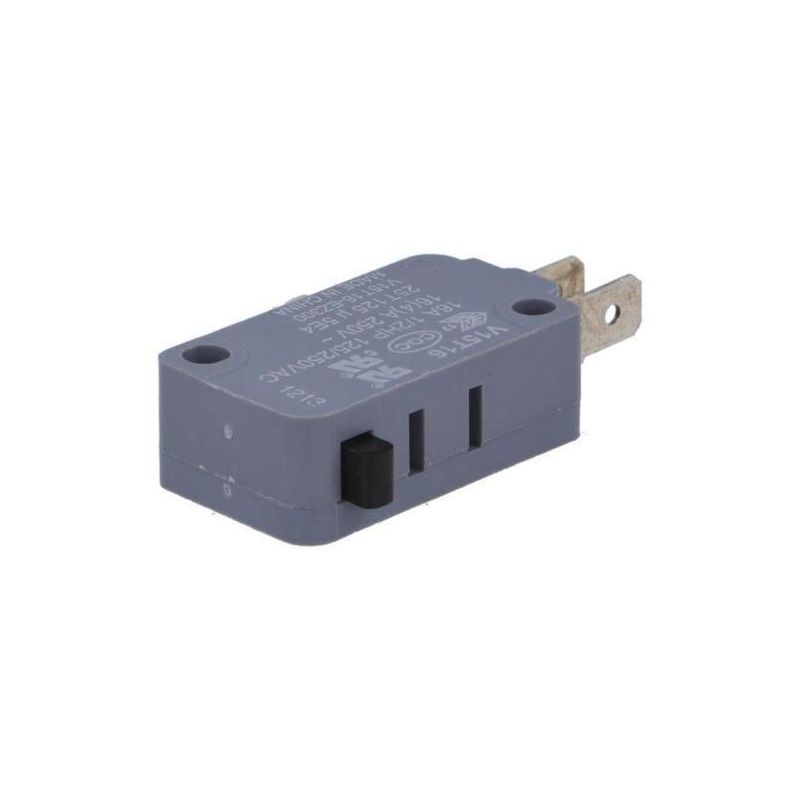


H22B2 3mm Slotted Opto Sensor, Darlington, Through-Hole
24 people are viewing this right now
In Stock
SKU
191887967651
£7.95
Safe Checkout, Guaranteed

Safe Checkout, Guaranteed
The H22B2 is a high-performance slotted optical switch sensor designed for accurate and reliable object detection, position sensing, and motion control applications. Featuring a 3mm slot width and a Darlington transistor output, this through-hole sensor offers exceptional sensitivity and switching speed. It's a versatile component for use in industrial automation, robotics, vending machines, and other applications where precise detection is essential. The H22B2 utilizes an infrared LED as the light source and a phototransistor as the detector, creating an optical path that is interrupted when an object passes through the slot. The Darlington transistor output provides high current gain, enabling the sensor to drive a variety of loads directly, such as relays, LEDs, and logic circuits. The 3mm slot width allows for the detection of small objects and provides ample clearance for various target materials.
The through-hole mounting style provides a secure and reliable connection to the circuit board. This sensor is designed for easy integration into existing electronic systems, with clearly labeled pins and a robust package that can withstand harsh environmental conditions. The H22B2 is ideal for applications where non-contact detection is required, eliminating wear and tear and providing long-lasting performance. This sensor is commonly used in printers, scanners, and copiers to detect paper presence and position. It is also used in automated machinery to detect the position of moving parts and in robotics to sense obstacles and boundaries. The H22B2 is designed to operate over a wide temperature range, making it suitable for use in both indoor and outdoor environments.
The sensor is resistant to vibration and shock, ensuring reliable performance in demanding applications. Its fast switching speed allows for accurate detection of high-speed objects. The high current gain of the Darlington transistor output simplifies circuit design and reduces the need for external amplification. Whether you need to detect the presence of an object, sense its position, or control its motion, the H22B2 is a versatile and reliable solution. Its high sensitivity, fast switching speed, and robust design make it an excellent choice for a wide range of applications. Upgrade your detection system with the H22B2 slotted optical switch sensor.
Experience the benefits of non-contact sensing, high sensitivity, and fast switching speed. Order your H22B2 today and enhance the performance and reliability of your applications. Get yours now and take your automation to the next level.
| Product Name | H22B2 3mm Slotted Opto Sensor, Darlington, Through-Hole |
|---|---|
| SKU | 191887967651 |
| Price | £7.95 |
| H22B2 3mm Slotted Opto Sensor, Darlington, Through-Hole Color | As per image |
| Category | Sensors |
| Brand | Nikko Electronics ltd |
| Product Code | 191887967651 |
| Availability | Yes |
Shipping cost is based on order value. Just add products to your cart and use the Shipping Calculator to see the shipping price. We want you to be 100% satisfied with your purchase. Items can be returned or exchanged within 30 days of delivery.
The H22B2 3mm Slotted Opto Sensor, Darlington, Through-Hole, features a Darlington transistor output, which provides significant current gain, making it capable of sinking relatively high currents compared to a standard phototransistor. Typically, its output can sink tens of milliamperes (e.g., 50-100mA, depending on specific datasheet parameters), allowing it to directly drive small relays, LEDs, or other logic circuits without an additional driver stage. When interfacing with microcontrollers, the output should be connected to a digital input pin, often with a pull-up resistor to define a high state when the sensor is 'off' (light path clear). When an object interrupts the optical path, the Darlington output turns 'on,' pulling the microcontroller input pin low. This high current capability simplifies circuit design for many industrial automation and robotics applications where precise object detection is critical.
The H22B2 3mm Slotted Opto Sensor, Darlington, Through-Hole, while offering high current gain, inherently has a slower switching speed compared to sensors with a standard phototransistor output, due to the additional transistor stage in the Darlington configuration. Typical rise and fall times (tr and tf) for Darlington outputs can range from a few microseconds to tens of microseconds. This means the H22B2 is generally suitable for applications requiring detection frequencies in the kilohertz range, such as basic position sensing, counting, or limit switching. For very high-speed detection (e.g., hundreds of kHz or MHz), where rapid transitions are paramount, a sensor with a faster output stage (like a phototransistor or photodiode with a transimpedance amplifier) might be more appropriate. Always consult the specific datasheet for the exact switching characteristics to ensure it meets the requirements of your motion control or object detection application.
The H22B2 3mm Slotted Opto Sensor, Darlington, Through-Hole, utilizes an infrared LED and phototransistor, which inherently provides some immunity to visible ambient light compared to visible-light sensors. However, strong direct infrared ambient light sources (like sunlight or certain incandescent lamps) can still potentially cause false triggers or reduce sensitivity. The slotted design offers a degree of protection against general ambient light by physically enclosing the optical path. For dusty environments, accumulation of dust on the sensor's optical surfaces can obstruct the IR beam, leading to reduced signal strength or complete failure to detect. Regular cleaning or incorporating the sensor into a sealed enclosure is recommended for such conditions. Optimal performance for the H22B2 is typically achieved within specified temperature and humidity ranges, usually found in the datasheet, to ensure reliable object detection and longevity in industrial automation settings.
The 3mm slot width of the H22B2 3mm Slotted Opto Sensor, Darlington, Through-Hole, makes it ideal for detecting small to medium-sized objects or features. It excels in applications requiring precise position sensing, such as detecting the edge of a PCB, the presence of a gear tooth, the position of a lever, or counting small parts passing through the slot. The sensor is effective with opaque materials that can completely interrupt the infrared light beam, regardless of their color or surface finish. Transparent or translucent materials might require specific testing, as their IR transmission properties vary. Its design makes it particularly well-suited for applications where the object's path is constrained and needs to pass directly through the sensor's slot, ensuring reliable interruption for accurate counting, indexing, or limit switching in vending machines or robotics.
The primary component dictating the lifespan of the H22B2 3mm Slotted Opto Sensor, Darlington, Through-Hole, is the infrared LED emitter. LEDs degrade over time, with their light output gradually decreasing. This degradation is accelerated by operating at higher currents or temperatures than specified. A typical lifespan for an IR LED can be tens of thousands to hundreds of thousands of hours under recommended operating conditions. Common failure modes include a significant reduction in IR output, leading to decreased sensitivity and unreliable detection, or complete LED failure (open circuit). The phototransistor detector is generally very robust. Mechanical stress from vibration or improper mounting can also lead to failure, especially for through-hole components. To maximize lifespan and maintain performance in critical object detection and position sensing applications, always operate the H22B2 within its specified forward current for the LED and ensure proper thermal management.
The H22B2 3mm Slotted Opto Sensor, Darlington, Through-Hole, typically operates from a DC power supply, with the phototransistor collector usually connected to a positive voltage (e.g., 5V to 30V, depending on the specific model's Vce max). The infrared LED requires a forward current to emit light, usually in the range of 10mA to 50mA. To determine the current limiting resistor (R_LED), use Ohm's Law: R_LED = (V_supply - V_f) / I_f, where V_supply is the power supply voltage, V_f is the LED's forward voltage (typically 1.2V to 1.7V for IR LEDs, found in the datasheet), and I_f is the desired forward current. For example, with a 5V supply, V_f of 1.4V, and desired I_f of 20mA, R_LED = (5V - 1.4V) / 0.02A = 180 ohms. Always refer to the H22B2's datasheet for precise V_f and maximum I_f values to ensure reliable and long-lasting operation in your automation or control system.
To improve noise immunity and prevent false triggers with the H22B2 3mm Slotted Opto Sensor, Darlington, Through-Hole, in electromagnetically noisy industrial settings, several strategies can be employed. First, ensure proper power supply decoupling with capacitors close to the sensor's power pins to filter out high-frequency noise. Using shielded cables for longer signal runs can also reduce induced noise. For the output signal, incorporating a small capacitor (e.g., 0.01µF to 0.1µF) in parallel with the pull-up resistor (if used) at the microcontroller input can create a low-pass filter, effectively smoothing out transient noise spikes. Software debouncing, where the microcontroller ignores brief, spurious changes in the sensor state, is also highly effective. Furthermore, ensuring the H22B2's optical path is clear and stable, and that the sensor is securely mounted to minimize vibration, will contribute significantly to reliable object detection and reduce false positives in demanding applications.