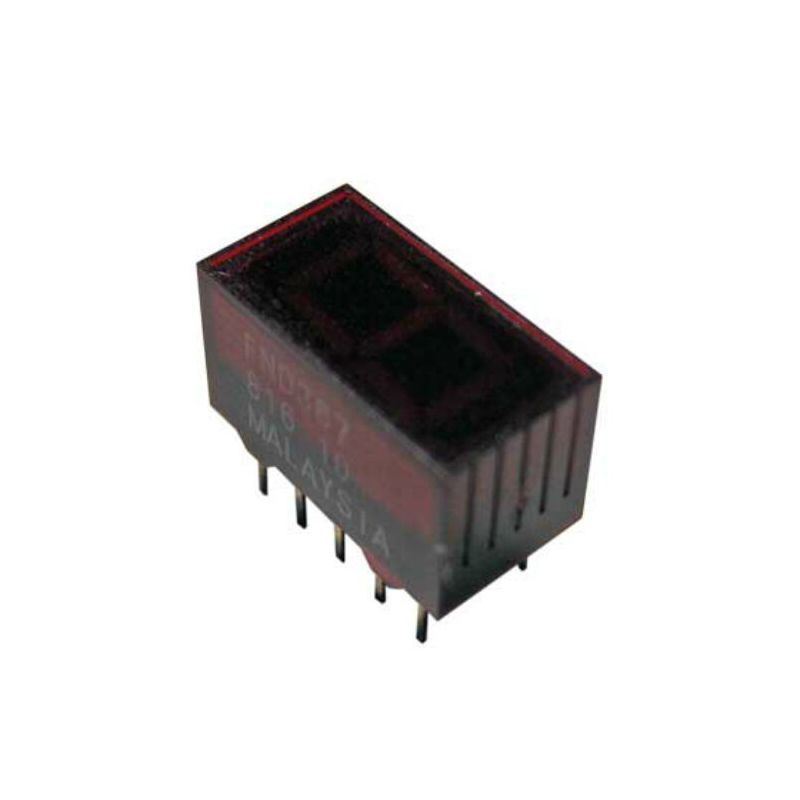


IR9331 PWM Controller IC (DIP-8)
26 people are viewing this right now
In Stock
SKU
191711023854
£7.99
Safe Checkout, Guaranteed

Safe Checkout, Guaranteed
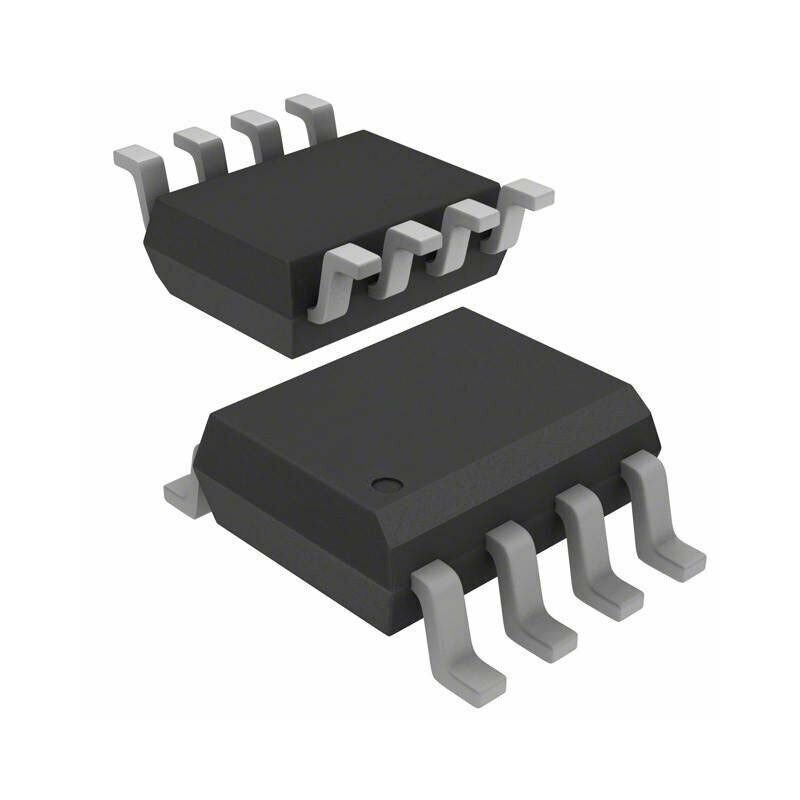
The IR9331 is a versatile integrated circuit (IC) housed in a standard 8-pin DIP (Dual In-line Package). This IC is commonly used as a pulse width modulator (PWM) controller, primarily found in switching power supplies and DC-DC converters. Its primary function is to generate the necessary PWM signals to efficiently control the switching of power transistors, enabling precise voltage regulation and power conversion. The DIP-8 package makes it easy to integrate into breadboards and prototyping boards, as well as for through-hole soldering on printed circuit boards (PCBs). The IR9331 boasts several key features that make it ideal for power management applications. It includes an oscillator that generates the timing signal for the PWM operation, an error amplifier to compare the output voltage to a reference voltage, a PWM comparator to generate the PWM signal, and output drivers to control the switching transistors.
With its ability to adjust the duty cycle of the PWM signal, the IR9331 allows for precise control over the output voltage of the power supply or DC-DC converter. This IC offers over-voltage protection, short-circuit protection and under-voltage lockout, contributing to the safety and longevity of the circuit. This makes it a perfect choice for educational projects and professional applications. The IR9331's low standby current contributes to higher energy efficiency. This feature is essential for modern electronic devices which are required to meet strict energy consumption standards. It finds application in battery chargers, LED drivers and other power regulation circuits.
This PWM controller is a cost-effective solution for regulating power. It's a dependable piece for various power management and conversion systems. Many datasheets and application notes are readily available for the IR9331, making it easy to design into your projects. We source only the highest quality components, ensuring that you receive a product that meets or exceeds your expectations. Upgrade to the IR9331 Integrated Circuit and experience the difference a premium-grade component can make. Invest in the best.
Order your IR9331 Integrated Circuit today and elevate your next project to new heights of performance and efficiency. Build with confidence, knowing that you're using a component designed for a wide range of power management applications. Add to cart now and unlock the full potential of your electronic designs.
| Product Name | IR9331 PWM Controller IC (DIP-8) |
|---|---|
| SKU | 191711023854 |
| Price | £7.99 |
| IR9331 PWM Controller IC (DIP-8) Color | As per image |
| Category | Integrated Circuits |
| Brand | Nikko Electronics ltd |
| Product Code | 191711023854 |
| Availability | Yes |
Shipping cost is based on order value. Just add products to your cart and use the Shipping Calculator to see the shipping price. We want you to be 100% satisfied with your purchase. Items can be returned or exchanged within 30 days of delivery.
The IR9331 PWM Controller IC (DIP-8) is engineered to operate within a specific voltage range typical for industrial switching power supplies. While the exact Vcc can vary based on the specific application, this IC generally requires a stable supply voltage to ensure the internal oscillator and error amplifier function with high precision. When designing with the IR9331 PWM Controller IC (DIP-8), it is critical to consult the absolute maximum ratings to avoid exceeding the breakdown voltage, which could lead to permanent silicon failure. For most DC-DC converter applications, a decoupling capacitor (typically 0.1uF to 1uF ceramic) should be placed as close as possible to the Vcc pin of the IR9331 PWM Controller IC (DIP-8) to filter out high-frequency noise and prevent erratic PWM switching. Experienced engineers often implement a small series resistor in the supply line to provide additional RC filtering, ensuring that the sensitive internal logic of the IR9331 PWM Controller IC (DIP-8) remains unaffected by the heavy switching transients occurring in the power stage.
Setting the switching frequency of the IR9331 PWM Controller IC (DIP-8) is a fundamental step in optimizing efficiency and component size. The frequency is typically determined by an external RC network connected to the timing pins of the IC. By selecting specific values for the timing resistor (Rt) and timing capacitor (Ct), you can tune the internal oscillator of the IR9331 PWM Controller IC (DIP-8) to operate anywhere from low kilohertz to several hundred kilohertz. A higher frequency allows for the use of smaller inductors and output capacitors, which is ideal for compact designs, but it also increases switching losses in the MOSFETs. Conversely, lower frequencies improve thermal efficiency but require larger magnetic components. When integrating the IR9331 PWM Controller IC (DIP-8), it is essential to balance these trade-offs. Ensure that the chosen frequency does not coincide with the resonant frequencies of your EMI filters to maintain electromagnetic compatibility and stable operation across the entire load range.
The IR9331 PWM Controller IC (DIP-8) features an integrated output stage designed to drive the gates of power transistors. However, the direct driving capability depends on the total gate charge (Qg) of the MOSFET being used and the desired switching speed. For standard logic-level or medium-power MOSFETs, the IR9331 PWM Controller IC (DIP-8) can often provide sufficient peak sourcing and sinking current to ensure crisp transitions, minimizing the time spent in the linear region where heat is generated. If you are using high-current MOSFETs with large gate capacitances at high frequencies, the internal driver of the IR9331 PWM Controller IC (DIP-8) might face thermal stress or result in slower rise/fall times. In such professional power applications, it is common practice to use the IR9331 PWM Controller IC (DIP-8) in conjunction with an external gate driver IC or a totem-pole transistor buffer to ensure the power stage operates efficiently and stays within safe thermal limits.
Achieving loop stability with the IR9331 PWM Controller IC (DIP-8) requires careful implementation of a compensation network around its internal error amplifier. The IC compares a fraction of the output voltage against an internal reference to adjust the PWM duty cycle. To prevent oscillations and ensure a fast transient response, designers typically employ Type II or Type III compensation networks using the COMP pin of the IR9331 PWM Controller IC (DIP-8). The choice of resistors and capacitors in this feedback loop determines the phase margin and crossover frequency of the power supply. When using the IR9331 PWM Controller IC (DIP-8) in a continuous conduction mode (CCM) flyback or buck converter, the compensation must account for the right-half-plane zero if applicable. Properly tuning these components ensures that the IR9331 PWM Controller IC (DIP-8) can handle sudden load steps without significant voltage undershoot or ringing, which is vital for powering sensitive microprocessors or communication equipment.
The IR9331 PWM Controller IC (DIP-8) is designed with robust protection features to safeguard both the controller and the load. Most implementations of the IR9331 PWM Controller IC (DIP-8) include a soft-start mechanism, which gradually increases the PWM duty cycle upon startup. This prevents large inrush currents that could saturate inductors or trip upstream fuses. Furthermore, the IR9331 PWM Controller IC (DIP-8) often utilizes a current-sense input to monitor the peak current in the primary switch or the output inductor. If the sensed voltage exceeds a predefined threshold, the IR9331 PWM Controller IC (DIP-8) will immediately terminate the current pulse, protecting the power MOSFETs from overcurrent damage. This cycle-by-cycle current limiting is a hallmark of the IR9331 PWM Controller IC (DIP-8), making it a reliable choice for high-availability power systems where fault tolerance is a priority. Designers should ensure the current sense traces are short and shielded to prevent noise from prematurely triggering the protection logic.
Thermal performance is a key consideration when using the IR9331 PWM Controller IC (DIP-8) in the DIP-8 package. While the DIP-8 format is excellent for prototyping and through-hole assembly, it has a higher junction-to-ambient thermal resistance (Rthja) compared to surface-mount packages with exposed pads. To maximize the lifespan of the IR9331 PWM Controller IC (DIP-8), it is recommended to provide ample copper area around the pins on the PCB to act as a heat sink. In high-power designs where the IR9331 PWM Controller IC (DIP-8) might be driving heavy loads or operating at high frequencies, ensuring adequate airflow is essential. Additionally, avoid placing heat-generating components like power inductors or MOSFETs directly adjacent to the IR9331 PWM Controller IC (DIP-8) to prevent thermal cross-talk. Monitoring the case temperature during full-load testing will help verify that the IR9331 PWM Controller IC (DIP-8) stays within its recommended operating temperature range, ensuring long-term reliability in demanding industrial environments.
Yes, the IR9331 PWM Controller IC (DIP-8) is highly suitable for isolated flyback converter topologies, which are common in AC-DC adapters and auxiliary power supplies. In such a configuration, the IR9331 PWM Controller IC (DIP-8) resides on the primary side of the circuit. To maintain galvanic isolation while providing feedback to the IC, an optocoupler is typically used in conjunction with a TL431 precision shunt regulator on the secondary side. The output of the optocoupler interfaces with the feedback or compensation pin of the IR9331 PWM Controller IC (DIP-8). This setup allows the IR9331 PWM Controller IC (DIP-8) to regulate the output voltage accurately while keeping the high-voltage input completely isolated from the low-voltage output. When laying out a PCB for an isolated design using the IR9331 PWM Controller IC (DIP-8), it is critical to maintain proper creepage and clearance distances between the primary and secondary sections to comply with international safety standards like UL or IEC.