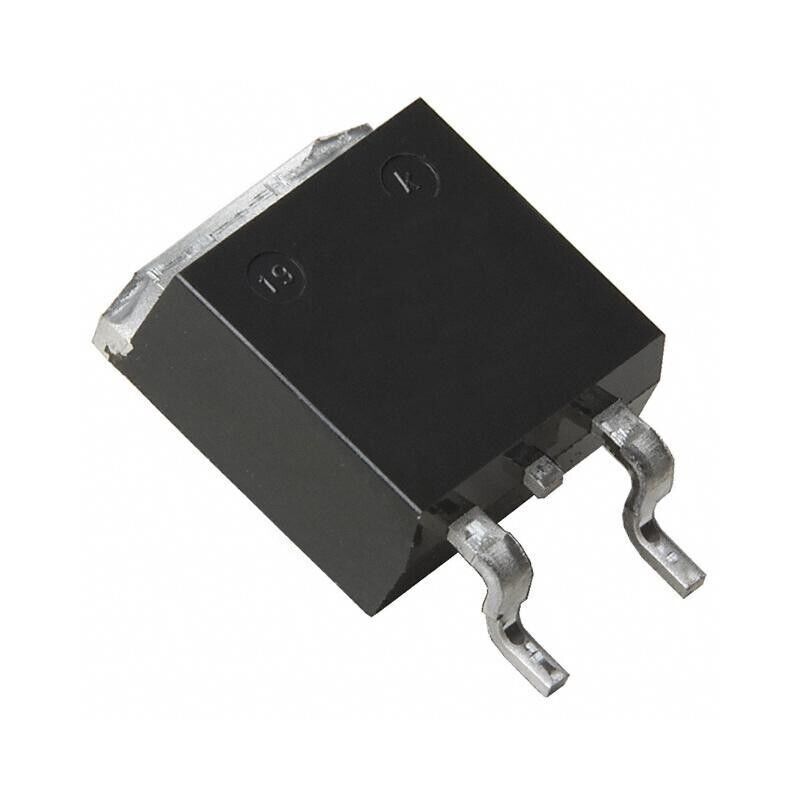


IRF9513 P-Channel Power MOSFET Transistor (TO-220)
28 people are viewing this right now
In Stock
SKU
191782710480
£3.50
Safe Checkout, Guaranteed

Safe Checkout, Guaranteed
The TDA8020HL is a highly integrated smart card interface IC designed to facilitate secure communication between a host system and a smart card. Housed in a compact 32-pin LQFP (Low-profile Quad Flat Package), this IC provides a complete solution for smart card reader applications. The TDA8020HL supports various smart card standards, including ISO 7816, EMV, and GSM, ensuring compatibility with a wide range of smart cards. Its built-in level shifters and voltage regulators simplify the interface design and reduce the number of external components required. The LQFP package allows for easy surface mounting and integration into automated assembly processes, reducing manufacturing costs and improving production efficiency. The TDA8020HL features a low-power mode, minimizing power consumption in battery-powered devices.
Its integrated security features protect against unauthorized access and data tampering. This smart card interface IC is commonly used in point-of-sale (POS) terminals, access control systems, and secure identification devices. Its high level of integration and robust security features make it an ideal choice for demanding smart card applications. The TDA8020HL is a cost-effective solution for smart card interface needs, offering a balance of performance, reliability, and affordability. Whether you're designing a new smart card reader or upgrading an existing system, the TDA8020HL provides a dependable and efficient solution. Its versatility and robust design make it a popular choice among smart card system designers.
Explore the possibilities with the TDA8020HL and unlock the potential of your smart card applications. Its compact size, low power consumption, and integrated security features make it an ideal choice for a wide range of applications. Upgrade your projects with the TDA8020HL and experience the difference in performance and reliability. Order yours today and take your smart card designs to the next level. Don't miss out on the opportunity to enhance your projects with this exceptional smart card interface IC. Invest in the TDA8020HL and witness the improvement in your smart card systems.
Add to cart now and start building smarter, more secure devices. This smart card interface IC is perfect for applications requiring secure communication with smart cards. Get yours today and see the difference!
| Product Name | IRF9513 P-Channel Power MOSFET Transistor (TO-220) |
|---|---|
| SKU | 191782710480 |
| Price | £3.50 |
| IRF9513 P-Channel Power MOSFET Transistor (TO-220) Color | As per image |
| Category | Transistors |
| Brand | Nikko Electronics ltd |
| Product Code | 191782710480 |
| Availability | Yes |
Shipping cost is based on order value. Just add products to your cart and use the Shipping Calculator to see the shipping price. We want you to be 100% satisfied with your purchase. Items can be returned or exchanged within 30 days of delivery.
The IRF9513 P-Channel Power MOSFET Transistor (TO-220) is a P-channel enhancement mode device, which means it requires a negative gate-to-source voltage (Vgs) to turn on. For professional power applications, while the gate threshold voltage (Vgs(th)) typically falls between -2.0V and -4.0V, you should aim for a Vgs of approximately -10V to ensure the device is fully saturated and achieves its lowest rated RDS(on). When using the IRF9513 P-Channel Power MOSFET Transistor (TO-220) in a high-side configuration, the gate must be pulled down relative to the source (which is connected to the positive rail). It is critical to ensure that the Vgs does not exceed the maximum rating, usually +/- 20V, to prevent permanent oxide breakdown. Engineers often use a Zener diode across the gate-source junction for protection. Because it is a P-channel device, it simplifies high-side drive logic compared to N-channel MOSFETs, as it eliminates the need for a charge pump or bootstrap circuit, making the IRF9513 P-Channel Power MOSFET Transistor (TO-220) an excellent choice for simplified DC-DC converter designs and motor control circuits.
Thermal management is a critical factor when integrating the IRF9513 P-Channel Power MOSFET Transistor (TO-220) into high-power circuits. The TO-220 package is designed for through-hole mounting and provides a metal tab connected to the drain, which is essential for heat dissipation. The junction-to-case thermal resistance (RthJC) is relatively low, but the overall performance depends heavily on the external heatsink. When the IRF9513 P-Channel Power MOSFET Transistor (TO-220) operates at high drain currents, the power dissipation (P = I² * RDS(on)) generates significant heat. If the junction temperature exceeds the maximum rated 150°C or 175°C, the device will fail. Therefore, when designing with the IRF9513 P-Channel Power MOSFET Transistor (TO-220), you must calculate the required heatsink area based on the ambient temperature and the total power losses. Using a high-quality thermal interface material (TIM) between the TO-220 tab and the heatsink is mandatory to minimize the case-to-sink thermal resistance. For high-reliability industrial environments, derating the continuous drain current by at least 20-30% is a standard practice to ensure the IRF9513 P-Channel Power MOSFET Transistor (TO-220) operates within a safe thermal margin.
The on-state resistance (RDS(on)) of the IRF9513 P-Channel Power MOSFET Transistor (TO-220) is not a constant value; it has a positive temperature coefficient. As the junction temperature rises during operation, the RDS(on) also increases, which in turn leads to higher conduction losses and further heating. For the IRF9513 P-Channel Power MOSFET Transistor (TO-220), the RDS(on) can potentially double as the temperature moves from 25°C to its maximum operating limit. This characteristic is vital for engineers to consider during the thermal modeling phase. While this positive coefficient helps in load sharing when multiple IRF9513 P-Channel Power MOSFET Transistor (TO-220) units are placed in parallel—preventing thermal runaway in a single device—it necessitates robust cooling to maintain efficiency. When sourcing the IRF9513 P-Channel Power MOSFET Transistor (TO-220) for battery-powered applications, this increase in resistance must be factored into the battery life and voltage drop calculations to ensure the system remains within specification even under heavy load and high ambient temperatures.
The IRF9513 P-Channel Power MOSFET Transistor (TO-220) is capable of high-speed switching, but its performance in high-frequency Pulse Width Modulation (PWM) is governed by its total gate charge (Qg) and internal capacitances (Ciss, Coss, Crss). In PWM applications, the transition period between the 'on' and 'off' states is where the highest power dissipation occurs. To minimize these switching losses, the gate driver must be able to source and sink enough current to quickly charge and discharge the gate of the IRF9513 P-Channel Power MOSFET Transistor (TO-220). If the gate drive is too weak, the MOSFET will linger in the linear region, leading to excessive heat. For frequencies above 20-50 kHz, the gate charge of the IRF9513 P-Channel Power MOSFET Transistor (TO-220) becomes a primary bottleneck. Designers should use dedicated MOSFET driver ICs rather than direct microcontroller pins to ensure sharp switching edges. Additionally, minimizing parasitic inductance in the PCB traces leading to the IRF9513 P-Channel Power MOSFET Transistor (TO-220) is essential to prevent ringing and voltage spikes that could exceed the maximum Vds rating.
When driving inductive loads such as motors, solenoids, or transformers, the IRF9513 P-Channel Power MOSFET Transistor (TO-220) is subjected to significant voltage stresses during turn-off due to back-EMF. The Safe Operating Area (SOA) curve in the datasheet defines the maximum current and voltage limits for various pulse durations. For the IRF9513 P-Channel Power MOSFET Transistor (TO-220), it is crucial to ensure that the simultaneous peak voltage and peak current do not cross the SOA boundaries. P-channel MOSFETs like the IRF9513 P-Channel Power MOSFET Transistor (TO-220) include an internal body diode that can act as a freewheeling diode, but for high-energy inductive spikes, an external Schottky diode is often recommended to reduce the recovery time and dissipation within the MOSFET itself. Furthermore, the IRF9513 P-Channel Power MOSFET Transistor (TO-220) has a rated avalanche energy (Eas); if the inductive energy exceeds this rating during a switch-off event without proper clamping, the device will undergo repetitive avalanche breakdown and eventually fail. Implementing snubber circuits can help protect the IRF9513 P-Channel Power MOSFET Transistor (TO-220) from these transient events.
Paralleling the IRF9513 P-Channel Power MOSFET Transistor (TO-220) is a common technique to increase the total current capacity of a power stage. MOSFETs are generally easier to parallel than bipolar transistors because of their positive temperature coefficient for RDS(on). If one IRF9513 P-Channel Power MOSFET Transistor (TO-220) carries more current, it gets hotter, its resistance increases, and it naturally pushes some of the current to the other parallel devices. However, for successful paralleling, you must ensure that the gate-source threshold voltages (Vgs(th)) are closely matched to prevent one device from turning on earlier than the others. Furthermore, each IRF9513 P-Channel Power MOSFET Transistor (TO-220) should have its own individual gate resistor (typically 10-47 ohms) to suppress parasitic oscillations and ensure uniform switching. The PCB layout must be symmetrical to equalize the trace inductance and resistance for each IRF9513 P-Channel Power MOSFET Transistor (TO-220). Failure to balance the layout can lead to dynamic current imbalances during switching transitions, potentially overstressing a single IRF9513 P-Channel Power MOSFET Transistor (TO-220) in the array.
In industrial settings, the IRF9513 P-Channel Power MOSFET Transistor (TO-220) typically fails due to three main reasons: overvoltage transients, thermal overload, and gate oxide rupture. Overvoltage occurs when a spike on the drain-source line exceeds the Vds rating, often caused by inductive kickback. Thermal failure happens when the IRF9513 P-Channel Power MOSFET Transistor (TO-220) is operated beyond its junction temperature limit, usually due to insufficient heatsinking or a short circuit in the load. Gate oxide rupture is often the result of Electrostatic Discharge (ESD) or voltage spikes on the gate drive line that exceed the +/- 20V limit. To maximize the lifespan of the IRF9513 P-Channel Power MOSFET Transistor (TO-220), engineers should implement transient voltage suppressors (TVS), ensure strict ESD handling protocols during assembly, and use active overcurrent protection circuits. When replacing a failed IRF9513 P-Channel Power MOSFET Transistor (TO-220), it is important to check the surrounding drive circuitry, as a MOSFET failure often results in a short between the gate and drain, which can propagate damage back to the PWM controller or gate driver.