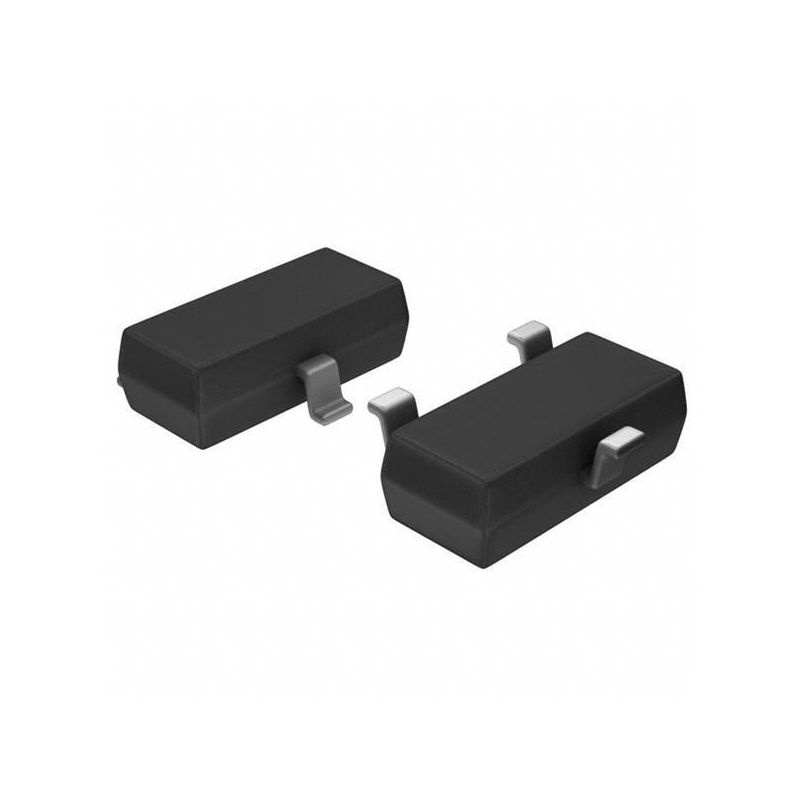


MJD42C PNP Power BJT 6A 100V DPAK
38 people are viewing this right now
In Stock
SKU
191890137117
£3.75
Safe Checkout, Guaranteed

Safe Checkout, Guaranteed
The MJD42C is a high-performance PNP bipolar junction transistor (BJT) designed for power switching and amplification applications. Encapsulated in the compact DPAK (TO-252) package, this transistor offers excellent thermal characteristics and efficient space utilization, making it ideal for use in power supplies, motor drivers, and audio amplifiers. With a voltage rating of 100V and a current rating of 6A, the MJD42C transistor provides ample headroom for handling demanding loads and transient voltage spikes. Its high gain ensures efficient amplification and switching, while its low saturation voltage minimizes power losses and improves efficiency. The DPAK package is designed for surface mount technology (SMT), facilitating automated assembly and reducing manufacturing costs. The package also features a built-in heatsink mounting area, allowing for effective heat dissipation and ensuring stable operation even at high temperatures.
This transistor excels in linear regulators, switching power supplies, and high-side switching applications. By utilizing this robust transistor, designers are able to realize more efficient and reliable circuits with minimal external components. The MJD42C transistor is designed to withstand harsh operating conditions, including high temperatures, humidity, and vibration. Its rugged construction and high-quality materials ensure consistent performance and extended lifespan. This power transistor is an excellent choice for applications requiring high current switching and linear amplification. The transistor's high power dissipation capability allows it to operate reliably in demanding environments.
The MJD42C transistor is often found in DC-DC converters, motor control circuits, and audio amplification stages. Its versatile design allows it to be used in a wide variety of applications. Whether you are designing a new power supply or upgrading an existing one, the MJD42C transistor offers a compelling combination of performance, reliability, and ease of use. Its high voltage and current ratings make it suitable for a wide range of applications, while its efficient heat dissipation ensures optimal performance. Don't compromise on performance or reliability; choose the MJD42C power transistor for your demanding power electronic applications. Invest in quality components to ensure your projects are efficient, dependable, and long-lasting.
Order your MJD42C transistor now and experience the difference it can make in your designs. Upgrade your circuits with this advanced transistor and unlock new levels of performance and efficiency. Add it to your cart today and get ready to power up your next project with confidence. Incorporate this reliable transistor into your circuit today!
| Product Name | MJD42C PNP Power BJT 6A 100V DPAK |
|---|---|
| SKU | 191890137117 |
| Price | £3.75 |
| MJD42C PNP Power BJT 6A 100V DPAK Color | As per image |
| Category | Transistors |
| Brand | Nikko Electronics ltd |
| Product Code | 191890137117 |
| Availability | Yes |
Shipping cost is based on order value. Just add products to your cart and use the Shipping Calculator to see the shipping price. We want you to be 100% satisfied with your purchase. Items can be returned or exchanged within 30 days of delivery.
Effective thermal management is paramount for the MJD42C PNP Power BJT 6A 100V DPAK to ensure reliable operation and prevent thermal runaway, especially in high-power switching applications. The DPAK (TO-252) package, while compact, relies heavily on the PCB copper area for heat dissipation. Designers must utilize a generous copper pour connected to the collector tab (which is typically the heat slug) to act as a heatsink. Calculating the maximum power dissipation based on the application's current and voltage, combined with the device's thermal resistance (Rthja), is essential to ensure the junction temperature (Tj) remains below its maximum rating. Employing thermal vias to inner layers or a dedicated heatsink, if space permits, can further enhance heat transfer. Proper solder joint quality is also crucial for efficient thermal conduction from the package to the PCB. Overlooking these aspects can lead to reduced lifespan and performance degradation of the MJD42C PNP Power BJT 6A 100V DPAK.
The MJD42C PNP Power BJT 6A 100V DPAK is exceptionally well-suited for a range of power switching and amplification tasks where its PNP configuration, 6A current rating, and 100V voltage rating offer distinct advantages. Its primary applications include low-side switching in motor control circuits, such as H-bridges for DC motors, where a PNP transistor can simplify the gate drive for the low-side switch. It's also ideal for power supply regulation, particularly in negative voltage regulators or as a pass element in linear regulators. Audio amplifier output stages can leverage the MJD42C for efficient current amplification. Furthermore, its robust specifications make it suitable for driving inductive loads, such as solenoids or relays, and in LED lighting applications requiring precise current control. The MJD42C PNP Power BJT 6A 100V DPAK provides a reliable and efficient solution for designs requiring a robust PNP power BJT.
When evaluating the MJD42C PNP Power BJT 6A 100V DPAK for switching applications, its performance characteristics differ from MOSFETs and NPN BJTs. Compared to MOSFETs, BJTs like the MJD42C typically have slower switching speeds due to their minority carrier storage time, which can limit their use in very high-frequency (MHz range) applications. MOSFETs, being voltage-controlled, require less drive current but more careful gate capacitance management. However, the MJD42C offers a predictable Vce(sat) (saturation voltage) that can be advantageous in certain designs, contrasting with a MOSFET's Rds(on) which varies with temperature. When compared to NPN BJTs, the MJD42C, being PNP, is often used in common-emitter configurations for low-side switching, simplifying the base drive from a higher voltage rail. While NPNs are generally faster, the MJD42C PNP Power BJT 6A 100V DPAK provides a robust and cost-effective solution for power switching up to tens of kilohertz, where its current gain and low saturation voltage are beneficial.
The current gain (hFE) of the MJD42C PNP Power BJT 6A 100V DPAK is a crucial parameter for designing its base drive circuit. Typically, hFE is specified over a range of collector currents (Ic) and temperatures. For power BJTs like the MJD42C, hFE tends to be highest at moderate collector currents and decreases as Ic approaches its maximum rating (6A). Similarly, hFE generally increases with temperature up to a certain point before potentially declining at very high temperatures. Designers must consider the minimum hFE specified in the datasheet for the intended operating current and temperature to ensure the transistor can be driven into saturation. Failing to provide sufficient base current based on the worst-case hFE can lead to the MJD42C operating in the active region, resulting in higher power dissipation and reduced efficiency. Always consult the MJD42C PNP Power BJT 6A 100V DPAK datasheet for specific hFE curves to optimize base drive design.
The low saturation voltage (Vce(sat)) of the MJD42C PNP Power BJT 6A 100V DPAK is a significant feature that directly contributes to improved system efficiency and reduced power dissipation. When the MJD42C is fully turned 'on' (saturated), its collector-emitter voltage drops to a minimal level, typically a few hundred millivolts, even when conducting its full 6A collector current. This low Vce(sat) means that the power dissipated by the transistor in its 'on' state, calculated as P_diss = Ic * Vce(sat), is minimized. For instance, at 6A, a Vce(sat) of 0.5V results in only 3W of dissipation, significantly less than if Vce(sat) were higher. This characteristic is critical in power applications where minimizing heat generation is essential for system reliability, component longevity, and overall energy efficiency. The MJD42C PNP Power BJT 6A 100V DPAK's optimized saturation voltage helps designers achieve compact, high-performance power solutions without requiring excessive heatsinking.
The DPAK (TO-252) package of the MJD42C PNP Power BJT 6A 100V DPAK offers several compelling advantages for power applications, especially concerning PCB design and manufacturing. Firstly, its surface-mount technology (SMT) compatibility enables automated assembly processes, significantly reducing manufacturing costs and increasing production throughput compared to through-hole components. The compact footprint of the DPAK allows for higher component density on PCBs, making it ideal for space-constrained designs. A key benefit for power applications is the integrated heat slug on the backside of the package, which is typically soldered directly to a large copper area on the PCB. This design efficiently transfers heat away from the transistor's junction to the PCB, acting as a crucial heatsink. This robust thermal path, combined with its compact size, makes the MJD42C PNP Power BJT 6A 100V DPAK in DPAK an excellent choice for efficient and reliable power management in modern electronic systems.
Effectively saturating the MJD42C PNP Power BJT 6A 100V DPAK requires careful consideration of its base drive current (Ib) and voltage (Vbe). To ensure saturation, the base current must be sufficient to drive the collector current (Ic) based on the transistor's minimum hFE (Ib ≥ Ic / hFE_min), often with an overdrive factor of 2-5 for robust switching. For the MJD42C, with a maximum Ic of 6A, if the minimum hFE is, for example, 20, a base current of at least 300mA would be needed. The base-emitter voltage (Vbe) typically falls within 0.7V to 1.3V when saturated, depending on current and temperature. A common design approach involves using a series resistor to limit the base current from a suitable control voltage source, ensuring the base-emitter junction is forward-biased. Proper base drive design for the MJD42C PNP Power BJT 6A 100V DPAK is critical not only for saturation but also for achieving fast turn-on and turn-off times, often requiring a low impedance path for reverse base current during turn-off to quickly remove stored charge.