

MJE371 PNP Power Transistor (TO-126)
20 people are viewing this right now
In Stock
SKU
191883973211
£3.49
Safe Checkout, Guaranteed

Safe Checkout, Guaranteed
The MJE371 is a versatile and reliable NPN bipolar junction transistor (BJT) housed in the TO-126 package, renowned for its robust performance in a broad spectrum of amplifier and switching applications. This transistor is designed to provide dependable signal amplification and efficient switching capabilities, making it an excellent choice for both hobbyists and professional engineers. The TO-126 package provides a good balance between power dissipation capability and ease of mounting, enabling effective thermal management. One of the key features of the MJE371 transistor is its high collector current capability, allowing it to handle substantial current loads without compromising performance. This makes it suitable for driving relays, solenoids, and other high-current devices. Its high gain (hFE) ensures efficient amplification of small signals, while its low saturation voltage minimizes power loss during switching operations.
The MJE371 is commonly used in audio amplifiers, power supplies, motor control circuits, and general-purpose switching applications. Its versatility and reliability make it a popular choice for a wide range of electronic projects. The TO-126 package facilitates easy mounting onto heat sinks, allowing for improved thermal management in high-power applications. Understanding the specifications of the MJE371 is crucial for successful implementation. Key parameters include the collector-emitter voltage (VCEO), collector current (IC), and power dissipation (PD). Operating the transistor within its specified limits ensures optimal performance and prevents damage.
Careful attention to the datasheet will help you maximize the transistor's potential in your circuit design. Furthermore, the MJE371 boasts excellent linearity and low distortion, which are essential for high-fidelity audio amplification. Its robust design and high breakdown voltage make it suitable for use in harsh environments. The MJE371 is a cost-effective solution for a wide range of transistor needs. Its reliability, versatility, and performance make it an excellent choice for both beginners and experienced electronic enthusiasts. The MJE371's ability to provide stable and consistent performance makes it an ideal component in circuits that require precise control and amplification.
This transistor is particularly useful in applications where space is a constraint but good thermal performance is still required. Its medium power dissipation capability makes it a suitable choice for a wide array of consumer and industrial electronic devices. If you are searching for a reliable and high-performing NPN transistor for your next electronic project, the MJE371 is an excellent choice. Don't compromise on quality; choose the MJE371 for its proven reliability and performance. Enhance your circuits today with the MJE371 transistor. Order now and experience the difference in your projects.
Its robust design and excellent performance specifications will ensure your circuits operate efficiently and reliably. Click here to purchase and elevate your electronic designs.
| Product Name | MJE371 PNP Power Transistor (TO-126) |
|---|---|
| SKU | 191883973211 |
| Price | £3.49 |
| MJE371 PNP Power Transistor (TO-126) Color | As per image |
| Category | Transistors |
| Brand | Nikko Electronics ltd |
| Product Code | 191883973211 |
| Availability | Yes |
Shipping cost is based on order value. Just add products to your cart and use the Shipping Calculator to see the shipping price. We want you to be 100% satisfied with your purchase. Items can be returned or exchanged within 30 days of delivery.
The MJE371 PNP Power Transistor (TO-126) is designed to handle a significant amount of power, with a maximum power dissipation rating of approximately 40 Watts when the case temperature is maintained at 25°C. However, in practical applications, the TO-126 package's ability to dissipate heat is heavily dependent on the use of an external heatsink. Without a heatsink, the device can only dissipate about 1.25 Watts in free air. When designing circuits with the MJE371 PNP Power Transistor (TO-126), engineers must calculate the junction-to-case thermal resistance (RθJC) and ensure that the thermal interface material (TIM) provides a low-resistance path to the cooling surface. Because the collector is typically connected to the mounting tab in this package, electrical isolation (such as a mica or silicone washer) is often necessary if the heatsink is grounded. Failure to manage these thermal parameters can lead to thermal runaway or permanent degradation of the silicon junction, especially when the transistor is operating near its 4-Ampere continuous collector current limit.
In switching applications, the efficiency of the MJE371 PNP Power Transistor (TO-126) is largely dictated by its collector-emitter saturation voltage, VCE(sat). For this specific PNP device, the VCE(sat) is typically rated around 0.6V to 1.0V depending on the collector current level. When the transistor is used to drive heavy loads like solenoids, DC motors, or high-power relays, a lower saturation voltage is critical because it minimizes the power lost as heat within the transistor itself (calculated as P = VCE(sat) × IC). Utilizing the MJE371 PNP Power Transistor (TO-126) effectively requires ensuring that the base drive current is sufficient to push the device into full saturation. A common rule of thumb for this transistor is a forced gain (IC/IB) ratio of 10. By optimizing the base current, designers can ensure the MJE371 PNP Power Transistor (TO-126) maintains its efficiency, reduces voltage drops across the load, and operates reliably without exceeding its thermal limits during high-frequency switching or continuous conduction cycles.
Yes, the MJE371 PNP Power Transistor (TO-126) is frequently utilized as the PNP half of a complementary push-pull output stage or driver stage in medium-power audio amplifiers. Its ideal NPN complementary counterpart is the MJE521 transistor. Using the MJE371 PNP Power Transistor (TO-126) in tandem with an NPN partner allows for symmetrical amplification of the AC audio signal, which significantly reduces total harmonic distortion (THD). When selecting these for a matched pair, it is important to look at the DC current gain (hFE) characteristics to ensure balanced performance between the positive and negative cycles of the waveform. The MJE371 PNP Power Transistor (TO-126) offers a relatively linear gain profile, which is essential for maintaining high fidelity in audio reproduction. Furthermore, the TO-126 package is preferred in these designs over smaller TO-92 packages because it provides the necessary current overhead and thermal mass to handle the dynamic peaks common in audio signals without entering the Safe Operating Area (SOA) limits.
When integrating the MJE371 PNP Power Transistor (TO-126) into power supply or regulation circuits, the most critical parameter to observe is the Collector-Emitter Voltage (VCEO), which is rated at a maximum of 40 Volts. This means the transistor can safely withstand a potential difference of 40V across its collector and emitter terminals when the base is open. For robust industrial or automotive designs, it is standard practice to provide a safety margin of at least 20%, meaning the MJE371 PNP Power Transistor (TO-126) should ideally be used in circuits with a rail voltage not exceeding 32V. Additionally, the Collector-Base Voltage (VCBO) is also rated at 40V. Exceeding these limits can lead to avalanche breakdown, causing immediate and catastrophic failure of the component. Designers should also be aware of transient voltage spikes when switching inductive loads; using a flyback diode in parallel with the load is highly recommended to protect the MJE371 PNP Power Transistor (TO-126) from back-EMF voltages that could easily surpass its 40V threshold.
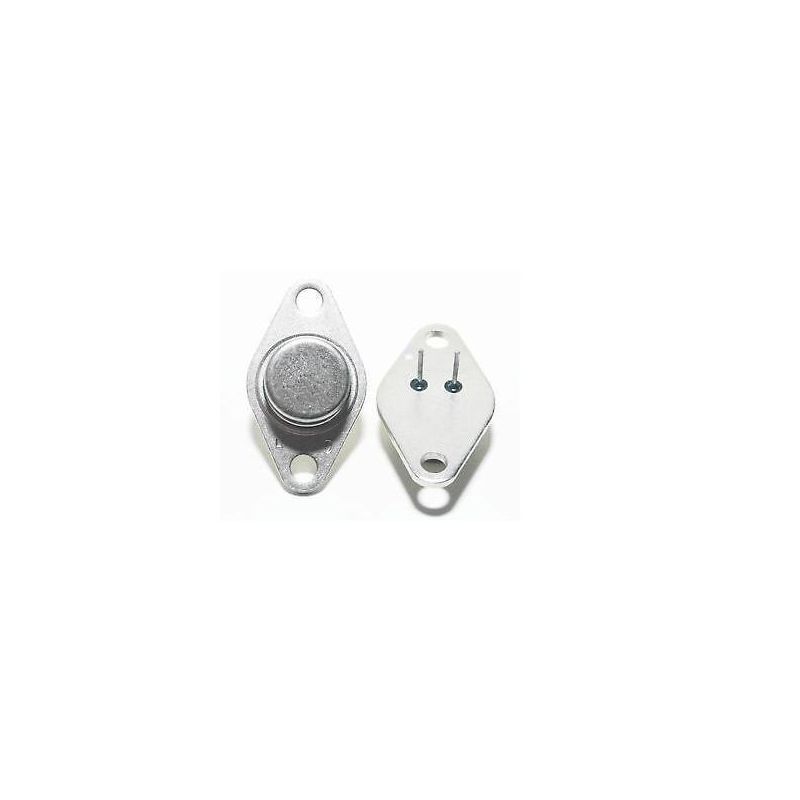
The TO-126 package of the MJE371 PNP Power Transistor (TO-126) offers a distinct advantage in high-density PCB layouts where vertical and horizontal space is at a premium. While the TO-220 is a more common 'power' package, the TO-126 is significantly narrower and has a smaller footprint, making it ideal for slim electronic assemblies or multi-channel amplifier boards. Despite its smaller size, the MJE371 PNP Power Transistor (TO-126) retains a mounting hole, allowing it to be bolted directly to a chassis or a small vertical heatsink, which provides much better thermal performance than surface-mount equivalents like the SOT-223. The lead pitch and lead diameter are also standardized, allowing for easy manual soldering or automated through-hole assembly. For engineers transitioning from lower-power TO-92 devices, the MJE371 PNP Power Transistor (TO-126) provides a significant upgrade in current handling (up to 4A) and power dissipation without requiring the much larger board real estate typically associated with TO-220 or TO-3 power transistors.
The MJE371 PNP Power Transistor (TO-126) is characterized by a transition frequency (fT) that typically falls in the range of 2.0 MHz. This parameter indicates the frequency at which the common-emitter current gain drops to unity. Because of this relatively low fT, the MJE371 PNP Power Transistor (TO-126) is best suited for low-frequency power applications, DC-to-DC converters with low switching frequencies, and linear audio amplification rather than high-speed RF or high-frequency PWM applications. In switching environments, the storage time and fall time of the transistor will limit the maximum effective switching frequency to the tens of kilohertz range. If forced to switch at higher frequencies, the MJE371 PNP Power Transistor (TO-126) will experience increased switching losses, as it spends more time in the linear region during transitions, leading to excessive heat generation. Engineers should ensure that the base drive circuit is designed to quickly remove charge from the base-emitter junction to optimize the turn-off time of the MJE371 PNP Power Transistor (TO-126).
The DC current gain, or hFE, of the MJE371 PNP Power Transistor (TO-126) is a variable parameter that depends heavily on the collector current (IC) and temperature. Typically, the MJE371 exhibits a minimum hFE of 40 and can go up to 200 at moderate current levels (e.g., IC = 500mA). However, as the collector current increases toward the 4A maximum, the gain tends to 'droop' or decrease, which is a common characteristic of power bipolar transistors. When designing a driver circuit for the MJE371 PNP Power Transistor (TO-126), it is vital to consult the datasheet's gain curves to ensure the preceding stage can provide enough base current to maintain the desired collector current. For instance, if the hFE drops to 20 at high loads, a 4A collector current would require a 200mA base current. This dependency makes the MJE371 PNP Power Transistor (TO-126) highly predictable for linear regulation, but it requires careful calculation of base resistor values to ensure the transistor stays within its intended operating region throughout its entire load range.