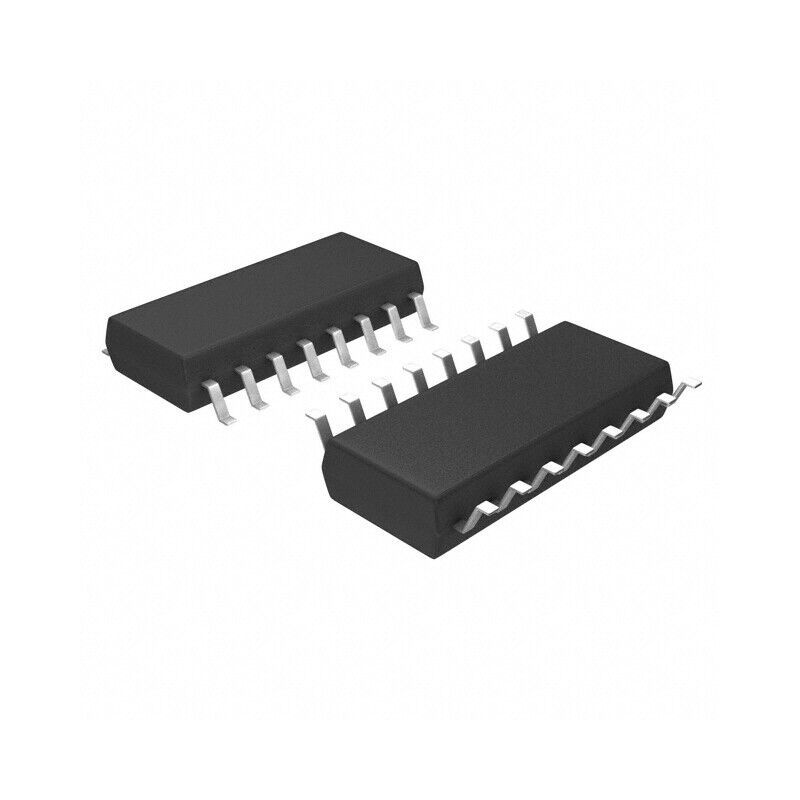
ML6622CS SOP-16 Integrated Circuit
39 people are viewing this right now
In Stock
SKU
191714372129
£7.99
Safe Checkout, Guaranteed

Safe Checkout, Guaranteed
The BF371 is a versatile NPN bipolar junction transistor (BJT) designed for general-purpose amplification and switching applications. Housed in the widely used TO-92 package, this transistor is easy to handle and integrate into various electronic circuits. The BF371 is suitable for use in audio amplifiers, signal processing circuits, and switching applications. Its moderate current gain and low saturation voltage make it a reliable and efficient choice for a wide range of designs. The TO-92 package allows for easy through-hole mounting and soldering. The BF371 features a moderate breakdown voltage, providing protection against voltage spikes and ensuring reliable operation.
Its wide operating temperature range allows for use in various environmental conditions. This transistor is a cost-effective solution for a variety of electronic design needs, offering a balance of performance, reliability, and affordability. Whether you're designing a new circuit or upgrading an existing system, the BF371 provides a dependable and efficient solution. Its versatility and robust design make it a popular choice among engineers and hobbyists alike. Explore the possibilities with the BF371 and unlock the potential of your electronic designs. Its compact size, moderate gain, and low saturation voltage make it an ideal choice for a wide range of applications.
Upgrade your projects with the BF371 and experience the difference in performance and reliability. Order yours today and take your electronic designs to the next level. Don't miss out on the opportunity to enhance your projects with this exceptional transistor. Invest in the BF371 and witness the improvement in your electronic systems. Add to cart now and start building smarter, more efficient devices. This general-purpose transistor is perfect for a wide range of applications.
Get yours today and see the difference. Experience the reliability and versatility of the BF371 transistor. Its robust design and exceptional performance make it the perfect choice for general-purpose amplification and switching. Don't settle for less – choose the BF371 and take your electronic projects to the next level. Order now and unleash the full potential of your designs. With its moderate gain and low saturation voltage, the BF371 is the ideal solution for audio amplifiers, signal processing circuits, and switching applications.
Upgrade your projects today and experience the difference!
| Product Name | ML6622CS SOP-16 Integrated Circuit |
|---|---|
| SKU | 191714372129 |
| Price | £7.99 |
| ML6622CS SOP-16 Integrated Circuit Color | As per image |
| Category | Integrated Circuits |
| Brand | Nikko Electronics ltd |
| Product Code | 191714372129 |
| Availability | Yes |
Shipping cost is based on order value. Just add products to your cart and use the Shipping Calculator to see the shipping price. We want you to be 100% satisfied with your purchase. Items can be returned or exchanged within 30 days of delivery.
The ML6622CS SOP-16 Integrated Circuit is specifically engineered as a high-performance 10BASE-T physical layer interface, integrating both the transceiver functions and essential pre-emphasis filtering into a single silicon solution. For experienced engineers, the primary advantage of the ML6622CS SOP-16 Integrated Circuit lies in its ability to manage Manchester encoding and decoding while maintaining high signal integrity over standard twisted-pair cabling. The internal filters are designed to reduce electromagnetic interference (EMI) and ensure compliance with IEEE 802.3 standards without requiring extensive external passive components. This integration significantly simplifies the analog front-end design, reducing the overall PCB footprint and BOM cost. When implementing this IC, it is crucial to ensure that the differential signal paths are perfectly balanced to minimize jitter and crosstalk. The device's architecture is optimized for low-noise environments, making the ML6622CS SOP-16 Integrated Circuit a reliable choice for legacy industrial networking equipment where robust data transmission is mandatory under varying electrical conditions. Proper termination of the transmit and receive lines is essential to prevent reflections that could degrade the link quality.
The ML6622CS SOP-16 Integrated Circuit utilizes a Small Outline Package (SOP-16) which is standard for surface-mount technology (SMT) but requires precise thermal profiling during the reflow process. For professional assembly, the ML6622CS SOP-16 Integrated Circuit should follow a standard JEDEC lead-free reflow profile, typically peaking between 245°C and 260°C depending on the solder paste composition. It is vital to monitor the soak time to ensure that the internal die of the ML6622CS SOP-16 Integrated Circuit does not experience thermal shock. In high-density layouts, thermal vias should be placed near the ground pins to facilitate heat dissipation into the inner copper layers of the PCB, as consistent operating temperatures are necessary for maintaining the timing accuracy of the internal oscillators. If hand-soldering for prototyping or repair, a temperature-controlled iron set to approximately 350°C is recommended, applying heat for no more than three seconds per lead. Using a high-quality flux will ensure clean solder joints and prevent bridging between the 1.27mm pitch leads, which is a common concern with SOP-16 packages during manual rework.
The ML6622CS SOP-16 Integrated Circuit is primarily designed for 5V supply environments, which was the standard for the era of 10BASE-T networking development. When integrating the ML6622CS SOP-16 Integrated Circuit into modern systems that utilize 3.3V microcontrollers or FPGAs, level shifting is often required to ensure reliable communication and to prevent damage to the lower-voltage components. The input thresholds of the ML6622CS SOP-16 Integrated Circuit are generally TTL-compatible, meaning they can often recognize a 3.3V high signal, but the output signals from the IC will likely reach 5V, necessitating a voltage divider or a dedicated level-shifter IC on the receive lines. Operating the ML6622CS SOP-16 Integrated Circuit outside of its specified voltage range can lead to increased propagation delays and potential instability in the internal phase-locked loops (PLLs). Designers should consult the absolute maximum ratings to ensure that power supply fluctuations do not exceed the 7V threshold, which could lead to permanent CMOS latch-up. Stable decoupling with a combination of 0.1µF and 10µF capacitors placed as close as possible to the VCC pin is mandatory.
To achieve optimal performance with the ML6622CS SOP-16 Integrated Circuit, the PCB layout must prioritize the separation of digital and analog ground planes. Noise from digital switching can easily couple into the sensitive analog transceiver sections of the ML6622CS SOP-16 Integrated Circuit, leading to increased bit error rates (BER). It is recommended to use a unified ground plane with a strategic 'moat' or split if necessary, ensuring that the return paths for the high-speed differential signals do not cross digital traces. The differential pairs connected to the ML6622CS SOP-16 Integrated Circuit should be routed with matched lengths and consistent impedance (typically 100 ohms for Ethernet) to maintain signal symmetry. Avoid using 90-degree bends in these traces; instead, use 45-degree angles or rounded corners to reduce reflections. Furthermore, placing the isolation transformer close to the ML6622CS SOP-16 Integrated Circuit helps in suppressing common-mode noise before it reaches the IC. Keeping the crystal oscillator or external clock source adjacent to the clock input pins of the ML6622CS SOP-16 Integrated Circuit will also minimize clock jitter, which is critical for the internal Manchester synchronization.
The ML6622CS SOP-16 Integrated Circuit is built using a robust CMOS process that includes internal ESD protection structures designed to withstand standard handling. However, in industrial environments where the ML6622CS SOP-16 Integrated Circuit is part of an external-facing Ethernet port, additional external ESD protection is highly recommended. The internal protection of the ML6622CS SOP-16 Integrated Circuit is typically rated for Human Body Model (HBM) standards, but it may not be sufficient to handle the severe transients associated with cable discharge events or lightning strikes. Implementing Transient Voltage Suppressor (TVS) diodes on the line side of the isolation transformer can provide an extra layer of defense, shunting high-voltage spikes to ground before they can reach the ML6622CS SOP-16 Integrated Circuit. Additionally, the SOP-16 package provides a good balance between size and lead durability, making it less prone to mechanical stress compared to smaller, leadless packages. For long-term reliability, the ML6622CS SOP-16 Integrated Circuit should be operated within its specified temperature range, as prolonged exposure to excessive heat can accelerate electromigration within the silicon interconnects.
Power management in the ML6622CS SOP-16 Integrated Circuit is designed to be efficient for its class, though it lacks the advanced 'Green Ethernet' features found in modern Gigabit PHYs. During active data transmission, the ML6622CS SOP-16 Integrated Circuit consumes power primarily through the driving of the twisted-pair medium and the operation of the internal Manchester encoder and filters. When the link is idle, the ML6622CS SOP-16 Integrated Circuit maintains a lower power state while still monitoring the line for incoming link pulses or data packets. For system designers concerned with power budgets, it is important to note that the ML6622CS SOP-16 Integrated Circuit draws a constant current to keep the internal bias circuitry active, ensuring immediate response when data transmission resumes. If the application requires extreme power savings, external circuitry may be needed to power down the VCC rail of the ML6622CS SOP-16 Integrated Circuit during long periods of inactivity, though this requires careful management of the initialization sequence upon wake-up. Understanding the current draw specifications at 5V is essential for sizing the power regulators and ensuring the thermal design can handle the heat generated during continuous high-traffic periods.
When troubleshooting a system using the ML6622CS SOP-16 Integrated Circuit, the most common failure modes involve clock instability or improper DC biasing of the analog pins. If the ML6622CS SOP-16 Integrated Circuit fails to establish a link, the first step is to verify the 20MHz (or specified frequency) clock source using an oscilloscope to ensure a clean, stable waveform. Another frequent issue arises from poor soldering on the SOP-16 pins, particularly the ground and VCC connections, which can cause intermittent resets or data corruption. If the ML6622CS SOP-16 Integrated Circuit becomes excessively hot to the touch, it may indicate a latch-up condition or a short circuit in the external transformer circuitry. Engineers should also check the DC resistance of the magnetics and ensure that the termination resistors match the cable impedance. If the ML6622CS SOP-16 Integrated Circuit is being used as a replacement part in older equipment, ensure that any electrolytic capacitors in the power filtering section have not degraded, as increased ripple voltage can severely impact the sensitive analog-to-digital conversion processes within the IC. Using a logic analyzer on the digital interface pins can help determine if the IC is communicating correctly with the MAC controller.