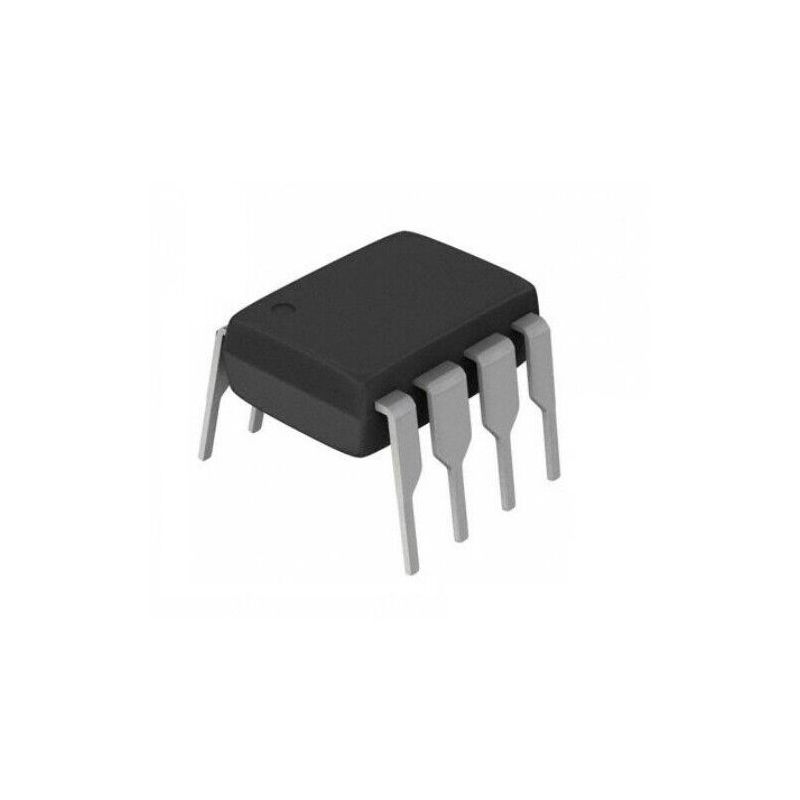


RC4151N Precision Voltage-to-Frequency Converter (DIP-8)
48 people are viewing this right now
In Stock
SKU
191816987075
£6.99
Safe Checkout, Guaranteed

Safe Checkout, Guaranteed
The RC4151N is a versatile and widely used integrated circuit housed in an 8-pin DIP (Dual In-Line Package). It's primarily recognized as a voltage-to-frequency converter (VFC), capable of transforming an analog input voltage into a corresponding frequency output. This IC is valuable in a variety of applications, including analog-to-digital conversion, frequency shift keying (FSK) modulation, and precise frequency generation. Its DIP-8 package allows for easy breadboarding and prototyping, as well as straightforward integration into printed circuit boards. The RC4151N offers a linear relationship between the input voltage and the output frequency, making it a reliable and accurate choice for signal conversion. Its key features include a wide input voltage range, excellent linearity, and a stable output frequency.
The output frequency is proportional to the input voltage, allowing for precise control and adjustment. This characteristic is particularly useful in applications requiring accurate measurements and data acquisition. The RC4151N also provides flexibility in terms of output waveform, allowing for both square wave and pulse outputs. The DIP-8 package is a classic and widely available format, making the RC4151N easy to source and integrate into existing designs. Its operating voltage typically ranges from 5V to 15V, offering compatibility with various power supply configurations. In analog-to-digital conversion applications, the RC4151N is used to convert an analog signal into a frequency, which can then be easily counted and processed digitally.
This approach offers advantages in terms of noise immunity and signal transmission over long distances. The RC4151N can also be employed in FSK modulation, where different frequencies represent different digital data bits. This technique is commonly used in communication systems for transmitting data wirelessly or over wired networks. Furthermore, the RC4151N can function as a precise frequency generator, providing a stable and accurate frequency source for various timing and control applications. When designing with the RC4151N, it's important to consider the external components required for proper operation, such as resistors and capacitors, which determine the output frequency range and linearity. Carefully selecting these components will ensure optimal performance and accuracy.
Compared to other VFCs, the RC4151N is known for its simplicity and ease of use, making it an excellent choice for both beginners and experienced electronics enthusiasts. Its wide availability and low cost further enhance its appeal. The internal architecture of the RC4151N typically involves an operational amplifier, a comparator, and a timing circuit. The input voltage is applied to the operational amplifier, which amplifies and conditions the signal. The comparator then compares the amplified signal to a reference voltage, triggering the timing circuit to generate the output frequency. Enhance your analog-to-digital conversion and frequency generation capabilities with the RC4151N INTEGRATED CIRCUIT DIP-8.
Convert voltage to frequency with accuracy and ease. Don't delay; order your RC4151N today and unlock a world of signal conversion possibilities. Perfect for students, hobbyists, and professional engineers alike. Click 'Add to Cart' now and experience the versatility of the RC4151N!
| Product Name | RC4151N Precision Voltage-to-Frequency Converter (DIP-8) |
|---|---|
| SKU | 191816987075 |
| Price | £6.99 |
| RC4151N Precision Voltage-to-Frequency Converter (DIP-8) Color | As per image |
| Category | Integrated Circuits |
| Brand | Nikko Electronics ltd |
| Product Code | 191816987075 |
| Availability | Yes |
Shipping cost is based on order value. Just add products to your cart and use the Shipping Calculator to see the shipping price. We want you to be 100% satisfied with your purchase. Items can be returned or exchanged within 30 days of delivery.
The RC4151N Precision Voltage-to-Frequency Converter is renowned for its excellent linearity, typically around 0.05%, which makes it ideal for precision instrumentation. However, achieving this level of accuracy in a practical circuit depends heavily on the selection of external passive components. The internal architecture utilizes a precision one-shot multivibrator and a switched current source. To maintain high linearity across the full dynamic range, engineers must use low-temperature-coefficient resistors and high-quality timing capacitors, such as polystyrene or polycarbonate types, as ceramic capacitors often exhibit voltage coefficients that can degrade performance. Furthermore, the RC4151N Precision Voltage-to-Frequency Converter requires careful PCB layout to minimize parasitic capacitance and noise injection into the summing junction. Since the device operates by balancing an input current with a series of precise current pulses, any leakage current on the board or instability in the reference voltage will directly translate into frequency errors. When designed correctly, the chip provides a highly predictable linear relationship between the analog input and the pulse train output, essential for high-resolution measurement systems.
Yes, the RC4151N Precision Voltage-to-Frequency Converter is a versatile building block that can be wired as a Frequency-to-Voltage converter (FVC) just as easily as its primary VFC mode. In FVC mode, the input frequency signal is typically applied to the comparator input, triggering the internal one-shot multivibrator. Each pulse delivers a precise charge to an integrating capacitor at the output. The main design trade-off when using the RC4151N Precision Voltage-to-Frequency Converter in this configuration is the balance between output ripple and response time. A larger integration capacitor will result in a smoother DC output voltage with less frequency-related ripple but will significantly slow down the circuit's ability to track rapid changes in the input frequency. Conversely, a smaller capacitor improves response speed but increases the noise floor. For optimal performance in FVC applications, it is often recommended to follow the RC4151N Precision Voltage-to-Frequency Converter with an active low-pass filter stage to remove residual switching noise while maintaining a reasonable bandwidth for the converted analog signal.
The RC4151N Precision Voltage-to-Frequency Converter is designed to operate over a wide supply voltage range, typically from +8V to +22V. This flexibility allows it to be integrated into various systems, from battery-powered sensors to industrial control rails. The supply voltage directly influences the maximum allowable input voltage and the output pulse amplitude. When operating the RC4151N Precision Voltage-to-Frequency Converter at higher supply voltages, users benefit from a larger head-room, which can improve the signal-to-noise ratio in noisy industrial environments. However, it is critical to note that the internal current source and reference are stabilized, so the conversion gain (Hz/V) remains relatively constant regardless of supply fluctuations, provided the voltage stays within the specified operating limits. For precision applications, using a regulated and decoupled power supply is mandatory to prevent supply-induced jitter in the output frequency. The RC4151N Precision Voltage-to-Frequency Converter's open-collector output (Pin 3) also requires a pull-up resistor, and the choice of the pull-up voltage allows for easy interfacing with different logic levels like 5V TTL or 15V CMOS.
Selecting the timing components for the RC4151N Precision Voltage-to-Frequency Converter is the most vital step in defining the full-scale frequency and the overall stability of the converter. The output frequency is governed by the formula f = Vin / (2.09 * Rs * Rt * Ct), where Rt and Ct are the timing resistor and capacitor respectively. For the RC4151N Precision Voltage-to-Frequency Converter to perform within its precision specifications, the timing resistor (Rt) should be a metal-film type with a low temperature coefficient (50ppm or better). The timing capacitor (Ct) is even more sensitive; it must have low dielectric absorption. While standard polyester capacitors might suffice for general-purpose use, precision applications require NPO/COG ceramic or film capacitors to prevent drift over time and temperature. Additionally, the value of the scale-setting resistor (Rs) must be chosen to ensure the internal current source remains within its linear operating region, typically around 100 microamps. Properly calculating and sourcing these components ensures that the RC4151N Precision Voltage-to-Frequency Converter provides a stable and repeatable output frequency across its entire operating life.
Interfacing the RC4151N Precision Voltage-to-Frequency Converter with digital systems like microcontrollers, FPGAs, or PLC inputs is straightforward due to its open-collector output stage. Pin 3 of the DIP-8 package is an uncommitted collector of an internal NPN transistor, which means it can sink current but cannot source it. To generate a logic-level signal, a pull-up resistor must be connected between Pin 3 and the logic supply voltage (e.g., +3.3V or +5V). This allows the RC4151N Precision Voltage-to-Frequency Converter to interface directly with different logic families without additional level-shifting components. When the internal one-shot is triggered, the transistor pulls the output low, creating a negative-going pulse. The width of this pulse is determined by the external Rt and Ct components. For high-speed digital interfacing, it is important to choose a pull-up resistor value that is low enough to ensure fast rise times (overcoming cable and pin capacitance) but high enough to stay within the RC4151N Precision Voltage-to-Frequency Converter's maximum sink current rating. This robust output structure makes the device excellent for long-distance signal transmission in electrically noisy environments.
The RC4151N Precision Voltage-to-Frequency Converter can be implemented in two primary circuit topologies: the Basic VFC and the Precision VFC (using an external operational amplifier). The Basic VFC configuration uses the internal comparator and is suitable for applications where 1% accuracy is sufficient. However, for high-end data acquisition, the Precision VFC configuration is preferred. In this mode, an external op-amp is used as an integrator at the input of the RC4151N Precision Voltage-to-Frequency Converter. This configuration eliminates the errors associated with the internal comparator's offset voltage and input bias currents. By using the external op-amp to maintain the summing junction at virtual ground, the linearity is significantly improved to 0.05%, and the dynamic range is extended. This makes the RC4151N Precision Voltage-to-Frequency Converter a much more powerful tool for 12-bit or 14-bit accurate analog-to-digital conversion. While it increases the component count, the performance gains in stability and linearity make it the standard choice for professional electronic design engineers using this specific integrated circuit.
Temperature drift is a critical concern for any analog converter, and the RC4151N Precision Voltage-to-Frequency Converter features internal temperature compensation for its reference and current source to minimize this effect. The device itself has a very low gain temperature coefficient, but the overall system drift is often dominated by the external timing components. To achieve the best thermal stability with the RC4151N Precision Voltage-to-Frequency Converter, designers should use components with complementary temperature coefficients if possible. For example, if the timing capacitor has a known positive drift, selecting a resistor with a slight negative drift can help stabilize the output frequency. Additionally, keeping the RC4151N Precision Voltage-to-Frequency Converter away from heat-generating components on the PCB, such as power transistors or voltage regulators, is essential. In extremely sensitive applications, a 'warm-up' period is recommended to allow the internal junctions of the RC4151N Precision Voltage-to-Frequency Converter to reach thermal equilibrium. By following these thermal management practices, the device can maintain high accuracy even in environments with fluctuating ambient temperatures.