

SN74HCT240N Octal Buffer and Line Driver with 3-State Outputs (DIP-20)
48 people are viewing this right now
In Stock
SKU
191881079381
£3.99
Safe Checkout, Guaranteed

Safe Checkout, Guaranteed
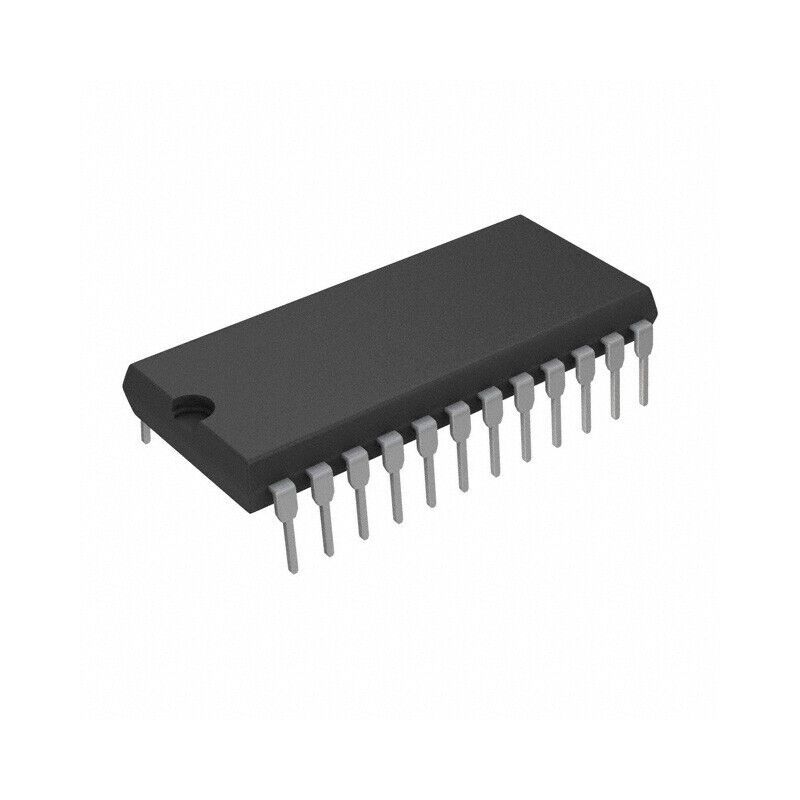
The SN74HCT240N is a high-speed octal buffer/line driver integrated circuit from the SN74HCT family, packaged in a 20-pin Dual In-line Package (DIP-20). This device features three-state outputs, making it ideal for driving highly capacitive loads or for use in memory address drivers. The SN74HCT240N is designed to interface directly with TTL and CMOS logic levels, providing versatility in mixed-logic systems. Its high-speed operation ensures minimal signal propagation delay, maintaining signal integrity in demanding applications. This integrated circuit is commonly used in memory systems, data buses, and address decoding circuits. Its octal buffer configuration allows for simultaneous buffering of eight independent signals, providing efficient signal isolation and amplification.
The three-state outputs enable multiple devices to share a common bus, allowing for flexible system architecture. The DIP-20 package facilitates easy prototyping and assembly on printed circuit boards. Its industry-standard pinout ensures compatibility with existing designs and simplifies circuit integration. The SN74HCT240N operates from a wide supply voltage range, providing flexibility in various power supply environments. Its low power consumption makes it suitable for battery-powered devices and energy-efficient designs. This buffer/line driver is known for its high noise immunity, ensuring reliable operation in noisy environments.
Its robust design ensures stable performance even under challenging conditions. The SN74HCT240N is an octal buffer/line driver that is designed for use in a variety of applications. Its CMOS technology offers low power consumption and high noise immunity. This Texas Instruments IC is suitable for memory interfacing, bus driving, and signal buffering applications. Its three state outputs make it ideal for use in multiplexed systems. Whether you're designing a high-speed memory system or a complex data bus, the SN74HCT240N offers the performance and reliability you need.
Its combination of high speed, low power consumption, and three-state outputs makes it a versatile choice for a wide range of applications. The SN74HCT240N is an excellent choice for any project requiring a high-performance octal buffer/line driver. Add this versatile IC to your component inventory today and experience the difference it can make in your projects. Order now and unlock the full potential of your digital designs!
| Product Name | SN74HCT240N Octal Buffer and Line Driver with 3-State Outputs (DIP-20) |
|---|---|
| SKU | 191881079381 |
| Price | £3.99 |
| SN74HCT240N Octal Buffer and Line Driver with 3-State Outputs (DIP-20) Color | As per image |
| Category | Integrated Circuits |
| Brand | Nikko Electronics ltd |
| Product Code | 191881079381 |
| Availability | Yes |
Shipping cost is based on order value. Just add products to your cart and use the Shipping Calculator to see the shipping price. We want you to be 100% satisfied with your purchase. Items can be returned or exchanged within 30 days of delivery.
The SN74HCT240N Octal Buffer and Line Driver with 3-State Outputs (DIP-20) is specifically engineered to bridge the gap between different logic families. As part of the 'HCT' series, this integrated circuit features input threshold levels that are fully compatible with standard TTL (Transistor-Transistor Logic) outputs, while the output stages provide full CMOS voltage swings. Specifically, it recognizes a logic high at 2.0V, which is the standard minimum for TTL, even when the device is powered by a 5V supply. This makes the SN74HCT240N Octal Buffer and Line Driver with 3-State Outputs (DIP-20) an essential component in mixed-signal environments where older 5V TTL processors or logic gates need to drive modern CMOS-based peripherals without the need for complex level-shifting circuitry. By using this buffer, engineers ensure reliable signal detection and high noise immunity, preventing the logic errors that often occur when standard CMOS 'HC' series chips are driven by TTL signals. Its high-speed performance ensures that this logic translation happens with minimal propagation delay, maintaining timing margins in high-performance digital systems.
Unlike the 74HCT244, which is non-inverting, the SN74HCT240N Octal Buffer and Line Driver with 3-State Outputs (DIP-20) provides an inverting logic function across all eight channels. This is particularly advantageous in memory address decoding and data bus applications where active-low signals are prevalent. In many microprocessor architectures, control signals like 'Read' or 'Write' are active-low; the SN74HCT240N Octal Buffer and Line Driver with 3-State Outputs (DIP-20) can simultaneously buffer these signals while providing the necessary logic inversion to match peripheral requirements. Furthermore, using an inverting buffer can sometimes simplify the overall PCB layout by reducing the number of external NOT gates required in a logic chain. The device is organized into two groups of four buffers, each controlled by its own active-low Output Enable (OE) pin. This dual-group structure allows for flexible bus management, where four bits can be enabled independently of the other four, providing superior control in 8-bit or 16-bit data architectures where signal isolation and logic inversion are required concurrently.
Yes, the SN74HCT240N Octal Buffer and Line Driver with 3-State Outputs (DIP-20) is designed specifically as a 'Line Driver,' meaning it possesses the high current-sourcing and sinking capabilities required to drive significant capacitive loads. In complex systems like backplanes or long data buses, the physical traces and connected inputs create parasitic capacitance that can degrade signal integrity by slowing down rise and fall times. The SN74HCT240N Octal Buffer and Line Driver with 3-State Outputs (DIP-20) provides a robust output drive—typically up to +/- 6mA at 4.5V—ensuring that signals transition sharply even when driving multiple gates or long PCB traces. This high-drive capability is critical for maintaining the high-speed specifications of the HCT family, preventing 'ringing' or signal rounding that could lead to data corruption. When designing with the SN74HCT240N Octal Buffer and Line Driver with 3-State Outputs (DIP-20) in these scenarios, it is recommended to place the IC close to the signal source to strengthen the signal before it encounters the impedance of the bus, effectively isolating sensitive logic from the heavy load of the transmission line.
The 3-state (or Tri-state) functionality of the SN74HCT240N Octal Buffer and Line Driver with 3-State Outputs (DIP-20) is a critical feature for any system where multiple devices share a common data or address bus. Each group of four buffers in the SN74HCT240N Octal Buffer and Line Driver with 3-State Outputs (DIP-20) is controlled by an Output Enable (OE) pin. When the OE pin is driven high, the outputs enter a high-impedance state, effectively 'disconnecting' the IC from the bus electrically. This allows another driver on the same bus to transmit data without interference or short-circuits, a phenomenon known as bus contention. When OE is pulled low, the SN74HCT240N Octal Buffer and Line Driver with 3-State Outputs (DIP-20) resumes its active inverting function. This capability is vital for memory expansion modules and multi-master micro-controller systems where only one device should talk to the bus at any given time. The high-impedance state also minimizes power consumption when the buffer is not in use, as it prevents leakage current from flowing into the bus lines.
When operating the SN74HCT240N Octal Buffer and Line Driver with 3-State Outputs (DIP-20) at high switching frequencies, power dissipation becomes a primary concern due to dynamic current consumption. While CMOS devices like the SN74HCT240N Octal Buffer and Line Driver with 3-State Outputs (DIP-20) consume very little static power, every transition of the eight internal buffers charges and discharges internal and external capacitances, drawing 'current spikes' from the supply. To mitigate this and ensure stable operation, it is essential to use a high-quality 0.1µF ceramic decoupling capacitor placed as close as possible to the VCC pin (Pin 20) and GND pin (Pin 10). This capacitor acts as a local reservoir of energy, smoothing out voltage drops caused by the simultaneous switching of all eight outputs. Additionally, the DIP-20 package provides reasonable thermal dissipation for most applications, but in very high-speed designs (approaching the device's maximum frequency limits), designers should calculate the total power dissipation based on the load capacitance and switching frequency to ensure the junction temperature remains within the specified operating range of -40°C to +85°C.
The SN74HCT240N Octal Buffer and Line Driver with 3-State Outputs (DIP-20) is often used as a modern, high-efficiency replacement for the older bipolar 74LS240. It offers significantly lower power consumption and comparable speed, while maintaining the same pinout and TTL-compatible inputs. However, when comparing it to the 74HC240, there is a key difference: the 'HC' version has CMOS-level inputs (requiring a higher voltage for logic 'High'), whereas the SN74HCT240N Octal Buffer and Line Driver with 3-State Outputs (DIP-20) has TTL-level inputs. Therefore, if your circuit relies on 3.3V logic driving a 5V buffer, the SN74HCT240N Octal Buffer and Line Driver with 3-State Outputs (DIP-20) is the correct choice, while the 74HC240 might fail to recognize the input signals correctly. Because the SN74HCT240N Octal Buffer and Line Driver with 3-State Outputs (DIP-20) is housed in a standard 20-pin Dual In-line Package (DIP), it is ideal for through-hole PCB designs, prototyping on breadboards, or replacing failed components in vintage computing equipment where the original LS-series parts are no longer efficient or available.
Propagation delay is a critical parameter for the SN74HCT240N Octal Buffer and Line Driver with 3-State Outputs (DIP-20), as it determines the maximum speed at which data can be processed through the buffer. Under standard operating conditions (VCC = 4.5V to 5.5V), the SN74HCT240N Octal Buffer and Line Driver with 3-State Outputs (DIP-20) typically exhibits a propagation delay (tpd) of approximately 13ns to 25ns, depending on the load capacitance (usually measured at 50pF). The enable/disable times for the 3-state outputs are also similarly fast, ensuring that the device can be switched in and out of the high-impedance state rapidly during bus arbitration cycles. These tight timing specifications allow the SN74HCT240N Octal Buffer and Line Driver with 3-State Outputs (DIP-20) to be used in high-speed address decoding for SRAM or Flash memory, where delays must be kept to a minimum to meet the setup and hold time requirements of the CPU. By minimizing skew between the eight channels, the SN74HCT240N Octal Buffer and Line Driver with 3-State Outputs (DIP-20) ensures that parallel data arrives at its destination synchronously, preserving the integrity of the data word.