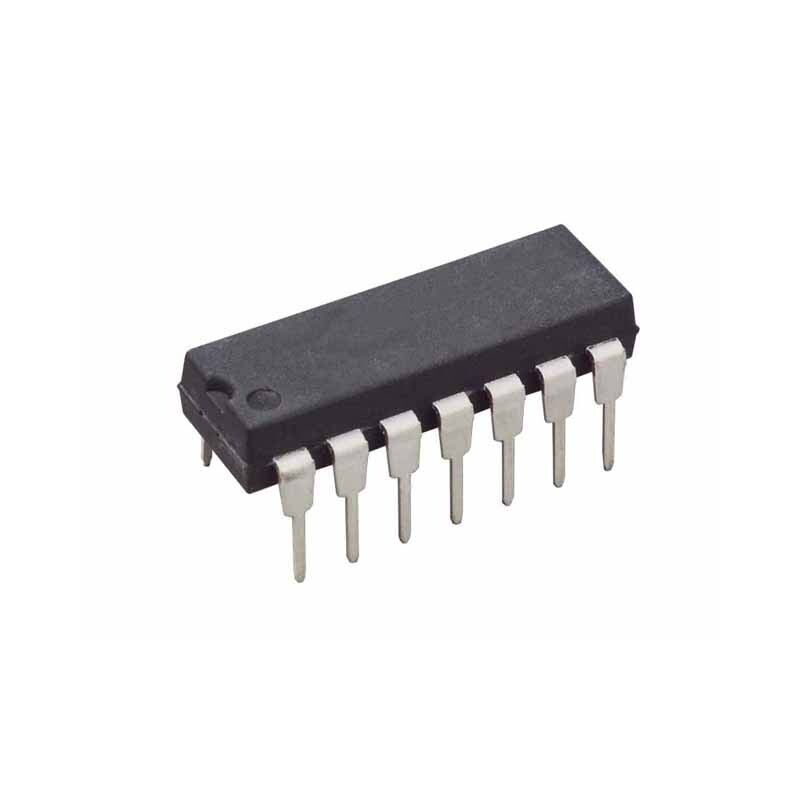


SN74LS125AD Quad Tri-State Bus Buffer IC 14-SOIC
43 people are viewing this right now
In Stock
SKU
191661382906
£3.25
Safe Checkout, Guaranteed

Safe Checkout, Guaranteed
The SN74LS125AD is a quad bus buffer gate integrated circuit with three-state outputs, housed in a 14-pin Small Outline Integrated Circuit (SOIC) package. This IC is a member of the 74LS series, known for its low-power Schottky technology, offering a balance between speed and power consumption. Designed for bus-oriented applications, the SN74LS125AD provides a convenient way to isolate or connect multiple devices to a common bus. Its three-state outputs allow the device to be in one of three states: logic high, logic low, or high-impedance. The high-impedance state effectively disconnects the output from the bus, allowing other devices to communicate without interference. This feature is crucial in multiplexing and data bus applications.
The SN74LS125AD's quad configuration means it contains four independent buffer gates within a single package, reducing component count and simplifying circuit board layout. The SOIC package is ideal for surface mount technology (SMT), enabling high-density circuit board designs and efficient manufacturing processes. This IC operates with a standard 5V power supply, making it compatible with a wide range of digital logic circuits. Its low propagation delay ensures fast and reliable data transmission. The SN74LS125AD is commonly used in memory systems, data acquisition systems, and computer peripherals. Its three-state outputs allow for easy implementation of memory addressing and data transfer schemes.
This IC provides excellent noise immunity, ensuring reliable operation in noisy environments. The SN74LS125AD's buffer gates provide a non-inverting function, meaning the output signal is the same as the input signal. This is useful for isolating signals and preventing loading effects. This integrated circuit is a popular choice for engineers and hobbyists alike due to its versatility, reliability, and ease of use. Its quad configuration and three-state outputs make it an ideal component for a wide range of bus-oriented applications. The SN74LS125AD's low power consumption makes it suitable for battery-powered devices and energy-efficient designs.
Furthermore, its small size and ease of use make it a valuable addition to any electronic design. Whether you are designing a memory system, a data acquisition system, or a computer peripheral, the SN74LS125AD is an excellent choice. Its quad configuration, three-state outputs, and low power consumption make it a versatile and reliable component. Don't compromise on data integrity. Choose the SN74LS125AD for superior performance in your bus-oriented applications. Enhance your circuits with the SN74LS125AD and experience the difference it makes.
Order now and streamline your data transmission with this essential IC. Invest in the SN74LS125AD IC today and ensure your data flows smoothly and reliably.
| Product Name | SN74LS125AD Quad Tri-State Bus Buffer IC 14-SOIC |
|---|---|
| SKU | 191661382906 |
| Price | £3.25 |
| SN74LS125AD Quad Tri-State Bus Buffer IC 14-SOIC Color | As per image |
| Category | Integrated Circuits |
| Brand | Nikko Electronics ltd |
| Product Code | 191661382906 |
| Availability | Yes |
Shipping cost is based on order value. Just add products to your cart and use the Shipping Calculator to see the shipping price. We want you to be 100% satisfied with your purchase. Items can be returned or exchanged within 30 days of delivery.
The SN74LS125AD Quad Tri-State Bus Buffer IC 14-SOIC is specifically designed with three-state outputs, which is a critical feature for managing data flow on shared buses. Unlike standard gates with only high or low outputs, the tri-state capability introduces a third, high-impedance state. In this state, the output effectively disconnects from the bus, presenting a very high impedance that prevents it from sourcing or sinking current. This allows multiple devices to share a common data bus without contention. For multiplexing, only one SN74LS125AD Quad Tri-State Bus Buffer IC 14-SOIC (or one section of it) is enabled at a time, directing data from a selected source onto the bus. For bus isolation, the high-impedance state allows the bus to be free for other communications, making the SN74LS125AD an indispensable component in complex digital architectures where resource sharing and conflict avoidance are paramount.
The SN74LS125AD Quad Tri-State Bus Buffer IC 14-SOIC leverages Low-Power Schottky (LS) technology, which offers a robust balance between switching speed and power consumption compared to older TTL families. LS devices provide faster propagation delays than standard TTL, making them suitable for moderate-speed digital systems. Simultaneously, they consume significantly less power than earlier Schottky TTL variants, which is beneficial for reducing overall system power dissipation and heat generation. While newer CMOS families might offer even lower power, the SN74LS125AD maintains excellent noise immunity and robust output drive capabilities, characteristic of the 74LS series, ensuring reliable operation in industrial and general-purpose applications. This makes the SN74LS125AD an excellent choice for designs requiring a dependable, mid-range performance solution without the higher power demands of faster, older technologies.
The SN74LS125AD Quad Tri-State Bus Buffer IC 14-SOIC features four independent buffers, each controlled by its own dedicated active-low enable input. Specifically, buffers 1 and 2 share a common enable pin (1G), and buffers 3 and 4 share another common enable pin (2G). To enable a buffer, its corresponding enable input must be driven low. When the enable input is high, the buffer's output enters the high-impedance state, effectively disconnecting it from the bus. This independent control is crucial for bus arbitration, allowing designers to precisely manage which data source is active on a shared bus at any given time. By strategically controlling the enable pins, multiple SN74LS125AD Quad Tri-State Bus Buffer IC 14-SOIC devices, or even different sections of the same device, can be used to select data paths without signal contention, ensuring clean and reliable data transfer in complex multi-master or multiplexed systems.
The SN74LS125AD Quad Tri-State Bus Buffer IC 14-SOIC, being part of the 74LS family, offers robust output drive capabilities suitable for driving multiple standard TTL loads. Typically, LS series devices can sink 8mA in the low state (IOL) and source 0.4mA in the high state (IOH). This translates to a fan-out of approximately 10 standard 74LS inputs or a similar number of 74L inputs, and fewer for older 74N TTL inputs. For heavily loaded buses or long traces, the SN74LS125AD's ability to drive significant current ensures signal integrity and prevents voltage drops that could lead to logic errors. When designing systems with the SN74LS125AD Quad Tri-State Bus Buffer IC 14-SOIC, it's essential to calculate the total current required by all connected loads to ensure it remains within the specified limits, potentially using multiple buffers or additional line drivers for extremely demanding applications to maintain proper signal levels and switching speeds.
The SN74LS125AD Quad Tri-State Bus Buffer IC 14-SOIC exhibits typical propagation delays in the range of 10 to 20 nanoseconds, depending on the specific transition (low-to-high or high-to-low) and operating conditions (temperature, voltage, load). For timing-critical data bus applications, these delays are a crucial design consideration. They introduce a finite amount of time between when an input signal changes and when the corresponding output reflects that change. In synchronous systems, these delays contribute to the overall clock-to-output delay and must be accounted for in the timing budget to ensure setup and hold time requirements of downstream registers are met. Failing to consider the propagation delay of the SN74LS125AD Quad Tri-State Bus Buffer IC 14-SOIC can lead to race conditions, glitches, or incorrect data capture, compromising system reliability. Designers should consult the device's datasheet for precise minimum and maximum propagation delay specifications under various conditions to perform accurate timing analysis.
The SN74LS125AD Quad Tri-State Bus Buffer IC 14-SOIC is primarily designed for use within TTL-compatible logic systems, typically operating on a 5V supply. Its input and output voltage levels are standardized for TTL (e.g., VIL max 0.8V, VIH min 2V). While it can often interface directly with other 5V TTL-compatible devices, its ability to interface with different logic families or voltage levels is limited without external components. For instance, interfacing with 3.3V CMOS logic often requires voltage level translation circuits, as a 5V LS output might exceed the maximum input voltage of a 3.3V CMOS device, and a 3.3V CMOS output might not reliably reach the VIH threshold of the SN74LS125AD Quad Tri-State Bus Buffer IC 14-SOIC. Therefore, while it excels in its intended TTL environment, designers should implement appropriate level shifters or voltage translators when integrating the SN74LS125AD into mixed-voltage or mixed-logic family systems to ensure proper signal integrity and prevent damage.
The power consumption of the SN74LS125AD Quad Tri-State Bus Buffer IC 14-SOIC is a crucial factor for power-efficient designs. As a Low-Power Schottky device, its quiescent power consumption is relatively low compared to older TTL families. The current draw, denoted as ICC, varies based on the output state. When outputs are actively driving (logic high or low), the device consumes power primarily through its active transistors, typically in the range of a few milliamperes (ICCL for low outputs, ICCH for high outputs). However, when the outputs of the SN74LS125AD Quad Tri-State Bus Buffer IC 14-SOIC are in the high-impedance state, the current consumption from the VCC supply significantly decreases. This characteristic is particularly advantageous in battery-powered applications or systems with strict power budgets, as disabled buffers contribute minimally to the overall power draw. Efficient power management involves enabling only the necessary buffers at any given time, leveraging the tri-state feature to reduce dynamic power consumption and extend operational life.