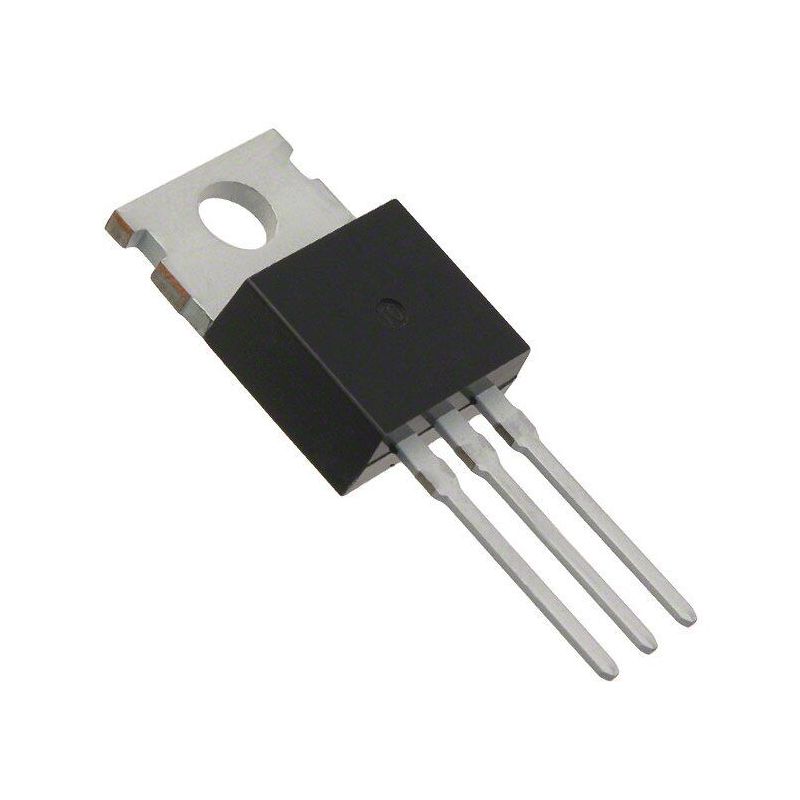


TIL154 Optocoupler DIP-6
34 people are viewing this right now
In Stock
SKU
191680389928
£3.75
Safe Checkout, Guaranteed

Safe Checkout, Guaranteed
The TIL154 is a high-performance optocoupler integrated circuit designed for isolating sensitive circuits and providing reliable signal transfer in various electronic applications. Encased in a DIP-6 (Dual In-Line Package), this optoisolator is ideal for applications requiring electrical isolation between control and load circuits, ensuring safety and preventing ground loops. This optocoupler uses an infrared LED (IRED) and a phototransistor to transmit signals optically, eliminating any direct electrical connection between the input and output. This feature is crucial in environments where high voltage or noise can compromise circuit integrity. The DIP-6 package offers easy insertion and compatibility with standard breadboards and PCB layouts, simplifying prototyping and production. The TIL154 is commonly used in industrial control, motor control, and power supply applications to isolate microcontrollers from high-voltage or noisy power stages.
It offers a high isolation voltage, providing robust protection against voltage transients and surges. Its fast switching speed ensures efficient signal transmission, making it suitable for both digital and analog signal isolation. In motor control applications, the TIL154 isolates the microcontroller from the high-voltage motor drive circuitry, protecting it from damage and ensuring reliable operation. The TIL154 is also used in communication systems to isolate data lines, preventing ground loops and reducing noise interference. Its compact size and ease of use make it a popular choice among hobbyists and professionals alike. The integrated design minimizes the need for external components, simplifying circuit design and reducing overall system cost.
Built-in protection mechanisms safeguard against overvoltage and overcurrent, enhancing the reliability and longevity of both the optocoupler and the connected circuits. The TIL154's robust construction and adherence to stringent quality standards ensure consistent performance in demanding environments. Enhance the safety and reliability of your electronic designs with the TIL154 Opto Integrated Circuit. Order now and experience the benefits of high-quality electrical isolation. Secure your circuits and ensure seamless signal transfer with this essential component.
| Product Name | TIL154 Optocoupler DIP-6 |
|---|---|
| SKU | 191680389928 |
| Price | £3.75 |
| TIL154 Optocoupler DIP-6 Color | As per image |
| Category | Integrated Circuits |
| Brand | Nikko Electronics ltd |
| Product Code | 191680389928 |
| Availability | Yes |
Shipping cost is based on order value. Just add products to your cart and use the Shipping Calculator to see the shipping price. We want you to be 100% satisfied with your purchase. Items can be returned or exchanged within 30 days of delivery.
The TIL154 Optocoupler DIP-6 is engineered to provide robust electrical isolation, a critical feature for applications involving significant voltage differences between circuits. While specific maximum isolation voltage (V_ISO) ratings, often expressed in kVrms for 1 minute or peak isolation voltage, would be detailed in the manufacturer's datasheet, optocouplers like the TIL154 typically offer isolation in the range of 2.5 kVrms to 5 kVrms. This high isolation capability is essential for safeguarding low-voltage control circuitry from high-voltage power sections, preventing ground loops, and ensuring operator safety. For industrial applications, compliance with international safety standards such as UL, VDE, and CSA is paramount. When selecting the TIL154 Optocoupler DIP-6, designers should always refer to the official datasheet for precise V_ISO specifications and certified agency approvals to ensure the component meets the stringent safety requirements of their target application, especially in contexts like motor control, power supply feedback, and industrial automation.
The performance of the TIL154 Optocoupler DIP-6 in signal transfer is heavily influenced by its Current Transfer Ratio (CTR) and switching speed. The CTR, expressed as a percentage, is the ratio of the output collector current to the input LED forward current. For a phototransistor-based optocoupler like the TIL154, CTR typically ranges from 20% to several hundred percent, indicating its efficiency in converting optical signals back to electrical signals. A higher CTR allows for lower input drive current, reducing power consumption. Regarding switching speed, the TIL154 Optocoupler DIP-6's phototransistor output generally offers switching times (turn-on/turn-off) in the microsecond range, making it suitable for many digital signal transfer applications, such as microcontroller interfacing and data communication at moderate baud rates. While it can be used for slower analog isolation by varying the LED current, its linearity might be a consideration, and its response time makes it less ideal for high-frequency analog signals. For optimal digital signal integrity, proper biasing and load resistance selection are crucial to minimize propagation delays and ensure reliable operation.
The TIL154 Optocoupler DIP-6 excels at mitigating common-mode noise and preventing ground loops due to its fundamental principle of optical isolation. By transmitting signals via an infrared LED and receiving them with a phototransistor, it completely breaks the galvanic connection between the input and output circuits. This electrical separation means that any voltage difference or noise present on the ground reference of one circuit does not directly propagate to the other. Common-mode noise, which appears equally on both signal lines relative to ground, is effectively rejected because the optical link is immune to such electrical disturbances. Ground loops, formed when multiple paths connect two points that are nominally at the same ground potential, can induce significant noise currents and compromise signal integrity. The TIL154 Optocoupler DIP-6 physically isolates these grounds, forcing signals to pass through an optical path, thereby eliminating the conductive loop and ensuring clean signal transfer. This feature is invaluable in industrial control systems, medical equipment, and other environments prone to high electrical noise.
For optimal performance and longevity of the TIL154 Optocoupler DIP-6, correctly driving its internal infrared LED (IRED) is crucial. Typically, the forward voltage (Vf) of the LED is around 1.1V to 1.5V at a nominal forward current (If). The recommended operating forward current usually falls within the range of 5mA to 20mA. Driving the LED within this specified current range ensures adequate light output for reliable signal transfer without overstressing the component. Exceeding the maximum forward current can lead to accelerated degradation of the LED, reducing its lifespan and potentially causing a decrease in the Current Transfer Ratio (CTR) over time. To optimize signal integrity, a current-limiting resistor must always be used in series with the LED to set the desired If. Additionally, for pulsed applications, the peak forward current and duty cycle limitations must be observed. Proper design ensures the TIL154 Optocoupler DIP-6 maintains its isolation integrity and signal transmission characteristics throughout its operational life, making it a reliable choice for critical applications.
The TIL154 Optocoupler DIP-6 features a phototransistor output, which is a common and versatile configuration for optocouplers. Typical collector-emitter voltage (VCE) ratings for such devices are often in the range of 30V to 80V, providing sufficient voltage standoff for interfacing with various logic levels and intermediate voltage rails. The maximum collector current (IC) is generally specified from 50mA to 100mA, indicating its capability to drive moderate loads directly. This phototransistor output acts as an open collector, requiring an external pull-up resistor connected to a supply voltage (VCC) to define the high logic level when the transistor is off. When the input LED is active, the phototransistor turns on, pulling the output close to ground. This makes the TIL154 Optocoupler DIP-6 highly compatible with microcontroller inputs, which typically operate with pull-up resistors, allowing for direct interfacing without additional buffering for many applications. It can also drive small relays, LEDs, or act as an input to other logic gates, making it flexible for diverse circuit designs requiring electrical isolation.
The TIL154 Optocoupler DIP-6, with its robust isolation and phototransistor output, is an excellent choice for several specific circuit designs beyond general signal isolation. In power supply feedback loops, it's crucial for providing isolated feedback from the output to the primary side control circuitry, regulating voltage while maintaining safety separation. Its ability to handle moderate current makes it suitable for interfacing between control logic and power switches in motor control applications, protecting sensitive microcontrollers from high-voltage motor drivers and inductive kicks. For data communication interfaces, particularly in noisy industrial environments or between systems with different ground potentials (e.g., RS-232, RS-485), the TIL154 Optocoupler DIP-6 ensures reliable data transfer by eliminating common-mode noise and preventing ground loop interference. Its DIP-6 package simplifies integration into existing PCB layouts for these applications, making it a go-to component for designers seeking reliable and cost-effective electrical isolation in critical system architectures.
The thermal characteristics and long-term reliability are vital considerations for the TIL154 Optocoupler DIP-6, particularly for applications requiring extended operational life. Optocouplers typically have a specified operating temperature range, often from -40°C to +100°C or higher, which indicates its suitability for harsh environments. It's crucial to operate the TIL154 within this range, as extreme temperatures can affect its performance parameters, including Current Transfer Ratio (CTR) and switching speed. A primary factor influencing long-term reliability is the degradation of the infrared LED (IRED) over time, a phenomenon common to all LEDs. This degradation manifests as a gradual decrease in light output, leading to a reduction in CTR. To mitigate this, designers should operate the LED well within its maximum forward current ratings and consider derating the current at higher ambient temperatures. Proper thermal management, ensuring the component's junction temperature remains below its maximum specified limit, significantly extends the operational lifespan of the TIL154 Optocoupler DIP-6, making it a dependable component for industrial and long-life electronic systems.