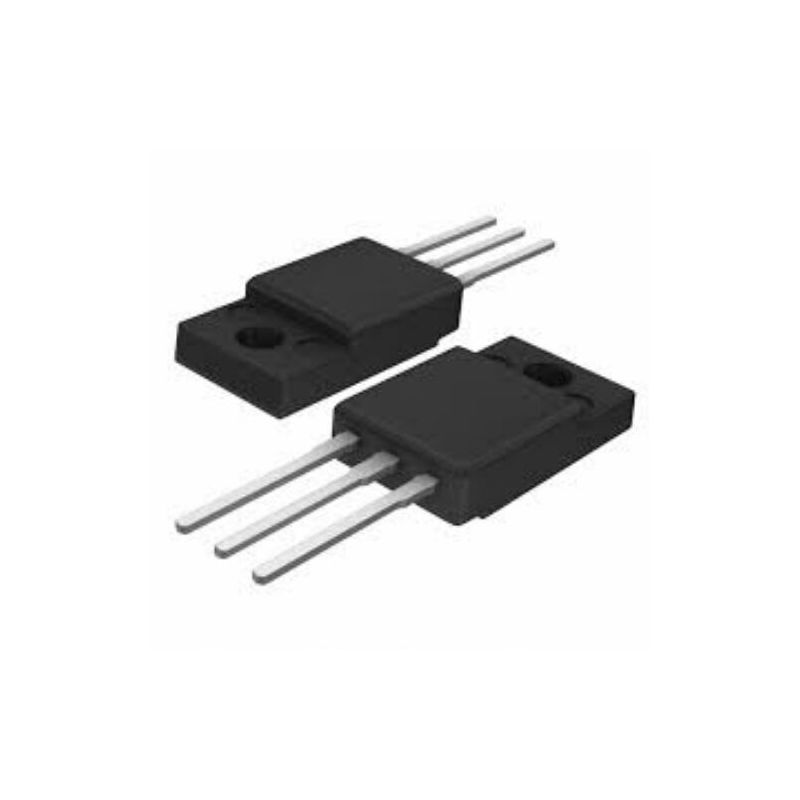


UA79GU1C 4-Terminal Adjustable Voltage Regulator TO-220 Package
39 people are viewing this right now
In Stock
SKU
191055516375
£7.99
Safe Checkout, Guaranteed

Safe Checkout, Guaranteed
The 2SB595 and 2SD525 are a complementary pair of power transistors, specifically designed for audio amplification and general-purpose switching applications. Both transistors are housed in the TO-220 package, a popular choice for its excellent thermal dissipation characteristics and ease of mounting. This complementary pair configuration is commonly used in push-pull amplifier circuits, providing efficient and high-quality audio amplification. The 2SB595 is a PNP transistor, while the 2SD525 is an NPN transistor. This complementary pairing allows for symmetrical signal handling, resulting in lower distortion and improved linearity in audio amplifier circuits. The TO-220 package is renowned for its ability to dissipate heat effectively, ensuring that the transistors operate reliably even under demanding load conditions.
An integrated heat sink can be easily attached to further improve thermal management, preventing overheating and ensuring long-term stability. The 2SB595 and 2SD525 are commonly employed in audio amplifiers, power supplies, and motor control circuits. Their ability to handle high currents and voltages makes them indispensable components in these applications. The complementary pair configuration allows for efficient and symmetrical signal amplification, resulting in improved performance and reduced distortion. From amplifying audio signals in a stereo system to controlling the speed of a motor, the 2SB595 and 2SD525 offer a reliable and cost-effective solution. Their robust thermal performance, high current handling capability, and complementary configuration make them a standout choice for a wide range of applications.
Whether you're designing a high-fidelity audio amplifier or a sophisticated power control system, the 2SB595 and 2SD525 provide the performance and flexibility you need to get the job done right. Invest in the 2SB595 and 2SD525 transistor pair today and experience the difference that high-quality complementary transistors can make in your electronic projects. Unlock the potential for efficient and high-quality amplification and ensure the reliable operation of your circuits. Don't compromise on performance – choose the 2SB595 and 2SD525 for superior results and peace of mind. Order yours now and take the first step towards building more efficient and reliable electronic systems.
| Product Name | UA79GU1C 4-Terminal Adjustable Voltage Regulator TO-220 Package |
|---|---|
| SKU | 191055516375 |
| Price | £7.99 |
| UA79GU1C 4-Terminal Adjustable Voltage Regulator TO-220 Package Color | As per image |
| Category | Voltage Regulators |
| Brand | Nikko Electronics ltd |
| Product Code | 191055516375 |
| Availability | Yes |
Shipping cost is based on order value. Just add products to your cart and use the Shipping Calculator to see the shipping price. We want you to be 100% satisfied with your purchase. Items can be returned or exchanged within 30 days of delivery.
The 4-terminal design of the UA79GU1C 4-Terminal Adjustable Voltage Regulator offers significant advantages, primarily through its ability to implement Kelvin sensing. Unlike 3-terminal regulators where the feedback path is taken directly from the output pin on the regulator itself, a 4-terminal device allows for a separate sense pin. This dedicated sense line can be connected directly to the load, effectively compensating for voltage drops that occur across the PCB traces or connecting wires between the regulator's output and the actual load. This results in superior load regulation, ensuring that the voltage delivered to the load remains precisely at the set point, even under varying current demands. For applications requiring high precision or where the load is physically distant from the regulator, this feature of the UA79GU1C 4-Terminal Adjustable Voltage Regulator significantly enhances overall system stability and performance, minimizing errors caused by resistive losses in the power delivery path.
Configuring the UA79GU1C 4-Terminal Adjustable Voltage Regulator for a specific output voltage typically involves an external resistor divider network connected to its adjust (or feedback) pin, in conjunction with the dedicated sense terminal. For most adjustable regulators, the output voltage (Vout) is determined by the internal reference voltage (Vref) and the ratio of two external resistors, R1 and R2, using a formula like Vout = Vref * (1 + R2/R1) + Iadj * R2. The sense terminal should be connected directly to the point where stable voltage regulation is critical at the load. Additionally, input and output bypass capacitors are crucial for stable operation of the UA79GU1C 4-Terminal Adjustable Voltage Regulator. A capacitor on the input helps to filter out ripple and noise from the unregulated supply, while an output capacitor improves transient response and stability, especially under sudden load changes. Careful selection of resistor values and capacitor types is essential for optimal performance and stability of the UA79GU1C 4-Terminal Adjustable Voltage Regulator.
Effective thermal management is paramount for the reliable operation and longevity of the UA79GU1C 4-Terminal Adjustable Voltage Regulator, especially given its TO-220 package. The TO-220 package is designed for moderate to high power dissipation, but it requires an external heatsink in most applications. The power dissipated by the regulator can be calculated as P_diss = (V_in - V_out) * I_load. This dissipated power generates heat that must be effectively transferred away from the device. Key considerations include selecting an appropriate heatsink with a thermal resistance (Rth) that ensures the junction temperature remains below the maximum specified limit. Factors like ambient temperature, airflow, and the thermal resistance of the heatsink-to-device interface (using thermal grease or pads) must be accounted for. Overlooking proper heatsinking for the UA79GU1C 4-Terminal Adjustable Voltage Regulator can lead to thermal shutdown, reduced efficiency, and premature device failure, making it a critical aspect of any design.
The input voltage range for the UA79GU1C 4-Terminal Adjustable Voltage Regulator will depend on its specific design, but generally, adjustable linear regulators require an input voltage that is sufficiently higher than the desired output voltage. This difference is known as the dropout voltage. The dropout voltage is the minimum voltage difference required between the input and output for the regulator to maintain regulation. For many adjustable regulators, this can range from 1.5V to 3V, although low-dropout (LDO) versions exist with much lower figures. Understanding the dropout voltage is crucial because operating the UA79GU1C 4-Terminal Adjustable Voltage Regulator with an input voltage too close to the output voltage (below the dropout threshold) will cause it to fall out of regulation. Furthermore, efficiency is directly impacted by the input-to-output voltage differential; a larger difference means more power is dissipated as heat, reducing efficiency. Therefore, carefully matching the input supply to the required output voltage while respecting the dropout voltage is essential for optimizing the performance and thermal characteristics of the UA79GU1C 4-Terminal Adjustable Voltage Regulator.
The UA79GU1C 4-Terminal Adjustable Voltage Regulator, like many modern voltage regulators, typically integrates several robust protection features to enhance its reliability and prevent damage to both the device and the downstream load. Common protection mechanisms include thermal shutdown, which automatically turns off the regulator if its internal junction temperature exceeds a safe operating limit, preventing overheating and permanent damage. Overcurrent protection (OCP) or short-circuit protection is another vital feature, limiting the output current to a safe level during fault conditions, such as a short circuit on the output. Some regulators may also include safe operating area (SOA) protection, which continuously monitors both the output current and the input-to-output voltage differential to prevent the device from operating outside its safe thermal and electrical limits. These integrated safeguards in the UA79GU1C 4-Terminal Adjustable Voltage Regulator significantly improve the robustness and longevity of power supply designs, reducing the need for extensive external protection circuitry.
The specific functionality of the UA79GU1C 4-Terminal Adjustable Voltage Regulator – whether it supports positive, negative, or both types of voltage regulation – depends entirely on its internal architecture and design. The 'UA79G' prefix often historically suggests a negative voltage regulator series (similar to the fixed 79xx series), while adjustable regulators like the LM317 are typically positive. If the UA79GU1C 4-Terminal Adjustable Voltage Regulator is indeed designed as a negative regulator, it would be used to produce a stable negative output voltage from a negative input supply. If it's a more general-purpose adjustable regulator, it might be adaptable for either, or it might be a specific type (e.g., a floating regulator) that can be configured for negative outputs with external circuitry. Without explicit datasheet confirmation, it's crucial to consult the manufacturer's specifications for the UA79GU1C 4-Terminal Adjustable Voltage Regulator to determine its intended polarity and application suitability, as using a positive regulator in a negative rail application will not function correctly.
The output stability and low noise characteristics of the UA79GU1C 4-Terminal Adjustable Voltage Regulator are critical for sensitive electronic applications, and several factors contribute to these performance metrics. As a linear regulator, it inherently offers lower output noise compared to switching regulators, due to its non-switching operation. The 4-terminal design, specifically its Kelvin sensing capability, directly enhances output stability by precisely regulating the voltage at the load, minimizing errors from trace resistance and improving overall load regulation. Furthermore, the internal design, including the reference voltage source and error amplifier, plays a significant role in determining the ripple rejection and transient response. Proper selection of input and output bypass capacitors, particularly low ESR types, is essential to further minimize output ripple and improve transient load response. For extremely noise-sensitive applications, additional filtering or specific layout techniques around the UA79GU1C 4-Terminal Adjustable Voltage Regulator might be employed to achieve optimal performance, ensuring a clean and stable power supply.