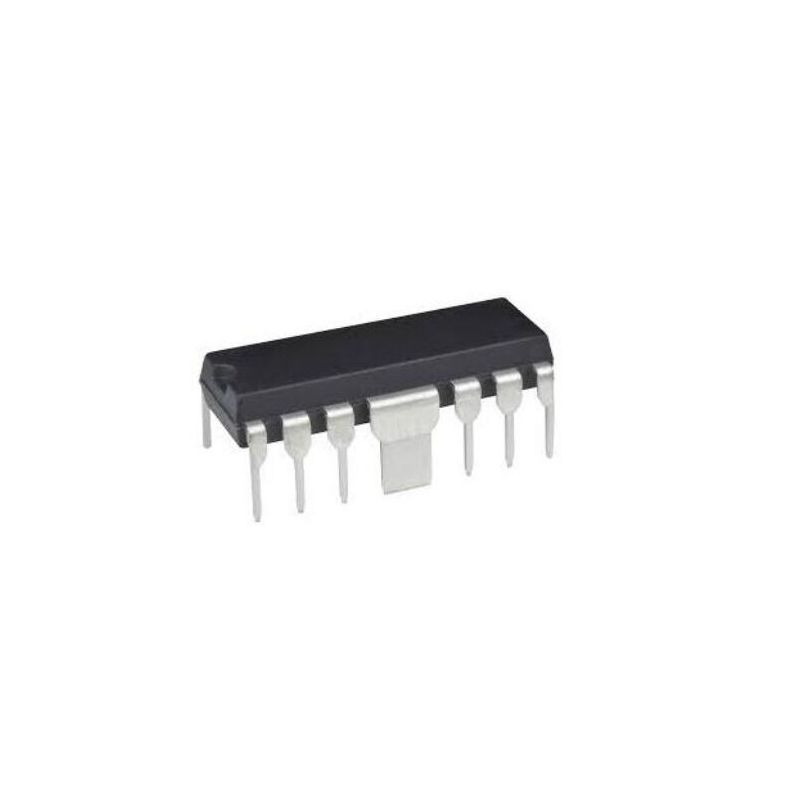


UPC1171 DIP-14 IC
45 people are viewing this right now
In Stock
SKU
191690806206
£25.00
Safe Checkout, Guaranteed

Safe Checkout, Guaranteed
Unlock the potential of your electronic projects with this lot of 5 UPC1171 Integrated Circuits, meticulously crafted in the reliable DIP-14 package. The UPC1171 is a versatile component, commonly employed in a wide array of applications, from audio amplification and signal processing to control systems and instrumentation. Each IC in this lot is manufactured to exacting standards, ensuring consistent performance and reliability across diverse circuit designs. The DIP-14 (Dual In-line Package with 14 pins) configuration provides ease of integration into breadboards, prototyping boards, and printed circuit boards (PCBs), making it an ideal choice for hobbyists, students, and professional engineers alike. Its robust design and dependable functionality have made the UPC1171 a staple in electronics for decades. Specifically, the UPC1171 integrated circuit is known for its low noise characteristics and its stable operation over a range of temperatures, making it suitable for sensitive audio preamplifiers or control circuits that demand precision.
The integrated circuitry within the UPC1171 is carefully designed to provide optimal performance within its specified parameters, reducing the likelihood of signal distortion or instability. When working with analog or mixed-signal circuits, the quality of the integrated circuit is paramount to the overall performance of the system. The UPC1171 offers a balance of precision and cost-effectiveness, making it a popular choice for many projects. These ICs are ideal for projects that require amplifying low-level signals, filtering noise, or providing a stable gain stage. Whether you're building a custom guitar amplifier, designing a sensor interface, or experimenting with feedback control systems, the UPC1171 delivers the performance and reliability you need. Moreover, the DIP-14 packaging ensures ease of handling and soldering, simplifying the assembly process.
This lot of 5 provides a cost-effective solution for projects requiring multiple instances of this versatile IC or for stocking your electronics workbench for future endeavors. Investing in quality integrated circuits like the UPC1171 is essential for achieving successful and reliable electronic designs. Don't compromise on performance. Elevate your projects with this dependable and versatile integrated circuit. Order your lot of 5 UPC1171 DIP-14 Integrated Circuits today and experience the difference quality components can make!
| Product Name | UPC1171 DIP-14 IC |
|---|---|
| SKU | 191690806206 |
| Price | £25.00 |
| UPC1171 DIP-14 IC Color | As per image |
| Category | Integrated Circuits |
| Brand | Nikko Electronics ltd |
| Product Code | 191690806206 |
| Availability | Yes |
Shipping cost is based on order value. Just add products to your cart and use the Shipping Calculator to see the shipping price. We want you to be 100% satisfied with your purchase. Items can be returned or exchanged within 30 days of delivery.
The UPC1171 DIP-14 IC is a versatile integrated circuit designed to excel in a broad spectrum of electronic applications, with a strong emphasis on audio and general signal processing. While specific internal architecture can vary, such ICs are commonly configured as operational amplifiers, comparators, or specialized control blocks. In audio applications, the UPC1171 DIP-14 IC can function as a pre-amplifier, buffer, or even a driver stage, offering low noise characteristics and sufficient bandwidth for faithful audio reproduction. For signal processing, its robust design allows for tasks such as filtering, amplification of sensor signals, or voltage-controlled functions. Its adaptability makes it suitable for creating custom analog signal chains where precise gain, impedance matching, or signal conditioning is required, ensuring consistent and reliable performance across diverse circuit designs. The component's inherent stability contributes significantly to its utility in these critical applications.
When integrating the UPC1171 DIP-14 IC into a circuit, understanding its operating voltage requirements and current consumption is crucial for proper power supply design. While exact specifications would be detailed in a datasheet, similar general-purpose ICs typically operate within a supply voltage range of ±5V to ±18V for dual supplies, or +5V to +36V for single supply configurations. This broad range makes the UPC1171 DIP-14 IC adaptable to various power architectures. Quiescent current consumption (idle current) is generally in the low milliampere range, which is efficient for many applications. However, dynamic current consumption will increase with output load and signal frequency, especially when driving significant loads or operating at higher gains. Proper power supply decoupling with capacitors placed close to the IC pins is essential to maintain stability and prevent noise propagation, ensuring optimal performance of the UPC1171 DIP-14 IC.
The DIP-14 (Dual In-line Package with 14 pins) configuration of the UPC1171 DIP-14 IC offers significant advantages, particularly for prototyping, educational projects, and certain production environments. Its through-hole design allows for easy insertion into standard breadboards and perfboards, facilitating rapid circuit development and testing without the need for specialized soldering equipment or surface-mount adapters. This ease of integration makes the UPC1171 DIP-14 IC an ideal choice for hobbyists, students, and engineers during the initial design and validation phases. Furthermore, for low-to-medium volume production or repair scenarios, DIP packages are often preferred due to their robustness and simpler manual assembly compared to smaller surface-mount devices. The larger pin spacing also reduces the likelihood of solder bridges and simplifies inspection, contributing to the overall reliability and usability of the UPC1171 DIP-14 IC in diverse applications.
Yes, the UPC1171 DIP-14 IC is well-suited for integration into control systems and instrumentation applications due to its inherent versatility and robust design. Key characteristics that support these uses include its stable operating parameters, which are essential for maintaining precision and repeatability in measurement and control loops. For instrumentation, the UPC1171 DIP-14 IC can serve as an amplifier for sensor signals (e.g., from temperature, pressure, or light sensors), providing necessary gain and buffering before analog-to-digital conversion. In control systems, it can be employed in feedback loops, error amplifiers, or signal conditioning stages for actuators. Its consistent performance across varying conditions, coupled with the ease of integration offered by the DIP-14 package, makes the UPC1171 DIP-14 IC a dependable choice for developing reliable and accurate industrial or laboratory equipment, where stability and predictable behavior are paramount.
Optimizing the performance of the UPC1171 DIP-14 IC involves adhering to best practices in PCB layout and careful selection of external components. For PCB layout, it's crucial to minimize trace lengths, especially for input and output signals, to reduce parasitic capacitance and inductance, which can degrade high-frequency performance and introduce noise. Power supply decoupling capacitors (typically 0.1µF ceramic and 10µF electrolytic) should be placed as close as possible to the IC's power pins to filter noise and ensure stable voltage rails. Ground planes are highly recommended to provide a low-impedance return path for signals and improve EMI/RFI immunity. Regarding external components, use high-quality, low-tolerance resistors for gain setting and feedback networks to maintain accuracy. For capacitive elements, choose types appropriate for the frequency range (e.g., ceramic for high frequency, electrolytic for power filtering). Following these guidelines will significantly enhance the stability, noise performance, and overall reliability of circuits employing the UPC1171 DIP-14 IC.
Many modern general-purpose integrated circuits, including those designed for versatility like the UPC1171 DIP-14 IC, often incorporate internal protection features to enhance reliability and prevent damage under fault conditions. While specific details would require consulting the official datasheet, it is common for such ICs to include some form of output short-circuit protection, which limits the current if the output is accidentally shorted to ground or a supply rail. This prevents excessive power dissipation and potential damage to the UPC1171 DIP-14 IC itself or other components in the circuit. Thermal shutdown protection is another frequently implemented feature, where the IC automatically disables its output stage if its internal junction temperature exceeds a safe operating limit, preventing irreversible damage from overheating. These protection mechanisms contribute significantly to the robustness and longevity of the UPC1171 DIP-14 IC, making it a more forgiving component to work with in various design scenarios.
When utilizing the UPC1171 DIP-14 IC for signal processing, understanding its frequency response characteristics and bandwidth limitations is paramount for achieving desired circuit performance. While precise figures are datasheet-dependent, a versatile IC like the UPC1171 DIP-14 IC typically offers a useful bandwidth ranging from a few hundred kilohertz to several megahertz, depending on the specific gain configuration. For audio applications, it should provide flat frequency response across the human audible range (20 Hz to 20 kHz) and beyond. Key parameters to consider include the Gain-Bandwidth Product (GBW), which dictates the maximum frequency at which a certain gain can be achieved, and the Slew Rate, which defines how quickly the output voltage can change. A higher slew rate is crucial for accurately reproducing fast-changing signals without distortion. Designers must select the appropriate feedback components to tailor the frequency response to the specific application, ensuring that the UPC1171 DIP-14 IC operates within its linear region across the desired signal frequencies to maintain signal integrity.