
WAVESHARE 11325 Module: USB; CP2102; 3.3÷5.5VDC; Interface: UART WSH11325
46 people are viewing this right now
In Stock
SKU
11325 / WSH11325
Module: USB; CP2102; 3.3÷5.5VDC; Interface: UART
£9.99
Safe Checkout, Guaranteed

Safe Checkout, Guaranteed
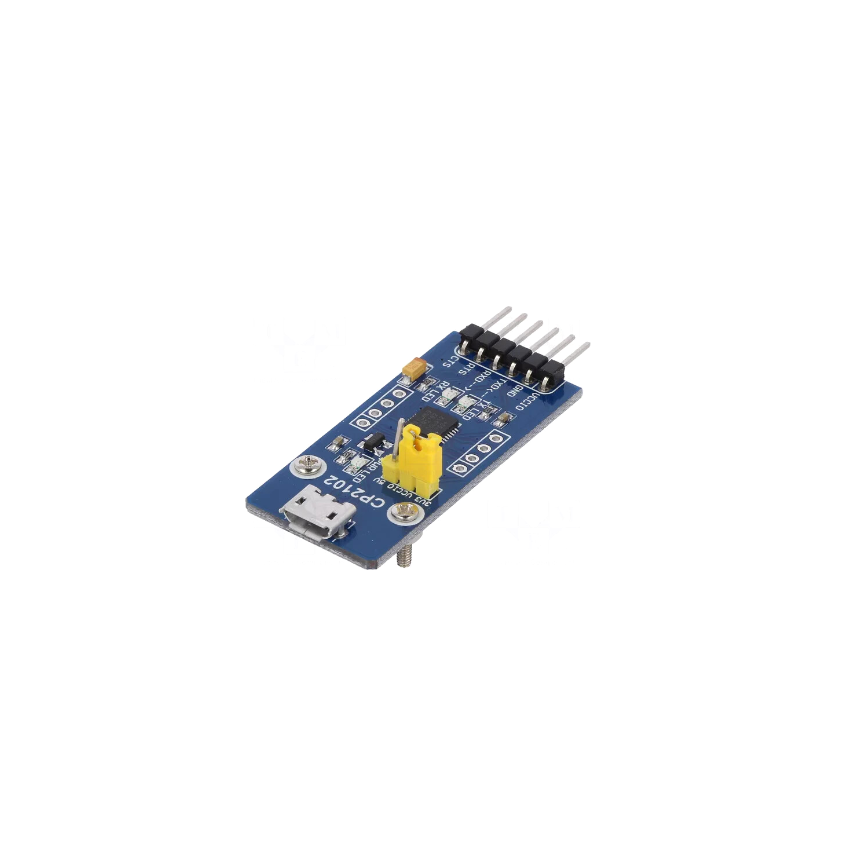
The WAVESHARE 11325 is a versatile USB-to-UART module designed around the popular CP2102 USB-to-serial bridge chip. This compact module provides a seamless and reliable way to interface microcontrollers and other serial devices with a computer via USB. Operating at a voltage range of 3.3V to 5.5V DC, it is compatible with a wide range of embedded systems. This module simplifies communication between your projects and your PC, making it ideal for development, debugging, and data logging. The UART interface enables easy integration with various microcontrollers, sensors, and other serial communication devices. The CP2102 chip on the WAVESHARE 11325 module provides a virtual COM port (VCP) interface, allowing your computer to communicate with the module as if it were a standard serial port.
This eliminates the need for complex driver installations and ensures compatibility with a wide range of operating systems. The module supports data transfer rates up to 1 Mbps, enabling fast and reliable communication. Its compact size and simple design make it easy to integrate into your projects, saving valuable space and simplifying wiring. The module includes all the necessary components for USB-to-UART conversion, including a USB connector, a CP2102 chip, and a UART interface. Key features of the WAVESHARE 11325 module include its wide operating voltage range, compatibility with various microcontrollers, and easy-to-use VCP interface. The module is suitable for a wide range of applications, including serial communication, data logging, firmware updates, and debugging.
It can be used in embedded systems, robotics projects, and industrial automation applications. The module provides a convenient and cost-effective way to add USB connectivity to your projects. Its reliability and ease of use make it an ideal choice for both beginners and experienced developers. The WAVESHARE 11325 module offers excellent performance and reliability, ensuring seamless communication between your devices and your computer. Its compact size, wide operating voltage range, and easy-to-use interface make it a versatile tool for a wide range of applications. Whether you are a hobbyist, a student, or a professional engineer, this module will simplify your development process and enhance your projects.
Don't waste time struggling with complex driver installations or unreliable serial communication. Order your WAVESHARE 11325 module today and experience the convenience and reliability of a high-quality USB-to-UART converter. Streamline your projects and unlock the full potential of your embedded systems. Invest in efficiency, invest in reliability, invest in the WAVESHARE 11325.
| Product Name | WAVESHARE 11325 Module: USB; CP2102; 3.3÷5.5VDC; Interface: UART WSH11325 |
|---|---|
| SKU | 11325 / WSH11325 |
| Price | £9.99 |
| WAVESHARE 11325 Module: USB; CP2102; 3.3÷5.5VDC; Interface: UART WSH11325 Color | As per image |
| Category | Modules |
| Brand | Nikko Electronics ltd |
| Product Code | 11325 / WSH11325 |
| Availability | Yes |
Shipping cost is based on order value. Just add products to your cart and use the Shipping Calculator to see the shipping price. We want you to be 100% satisfied with your purchase. Items can be returned or exchanged within 30 days of delivery.
The WAVESHARE CP2102 USB to UART Module 11325 utilizes the Silicon Labs CP2102 chip, which requires Virtual COM Port (VCP) drivers for proper operation. These drivers create a virtual serial port on your computer, allowing applications to communicate with the module as if it were a standard hardware serial port. Silicon Labs provides official VCP drivers for a wide range of operating systems, including Windows (XP, 7, 8, 10, 11), macOS (from OS X 10.7 and newer), and various Linux distributions. While some modern Linux kernels and macOS versions might include built-in support, it is highly recommended to download and install the latest drivers directly from the official Silicon Labs website to ensure optimal performance, stability, and access to all features of the WAVESHARE CP2102 USB to UART Module 11325. This ensures seamless integration for development, debugging, and data logging tasks.
The WAVESHARE CP2102 USB to UART Module 11325 is designed to operate with logic levels compatible with both 3.3V and 5V systems. The CP2102 chip itself typically operates internally at 3.3V, but its I/O pins are 5V tolerant, meaning they can safely receive 5V signals without damage. When the module is powered, its VCC output pin can typically provide either 3.3V or 5V (often selectable via a jumper or directly from USB VBUS). The TX and RX pins will communicate at a logic level corresponding to the voltage supplied to the module or the internal operating voltage of the CP2102, which is compatible with most microcontrollers. For example, if you connect the module to a 3.3V microcontroller, its TX/RX lines will operate at 3.3V logic. This broad compatibility makes the WAVESHARE CP2102 USB to UART Module 11325 highly versatile for interfacing with a wide array of embedded systems without requiring external level shifters in most common scenarios.
Yes, the WAVESHARE CP2102 USB to UART Module 11325 fully supports hardware flow control signals, specifically Request To Send (RTS) and Clear To Send (CTS), as well as Data Terminal Ready (DTR) and Data Set Ready (DSR). These signals are crucial for reliable serial communication, especially at higher baud rates or when interfacing with devices that cannot process data as quickly as it is transmitted. Hardware flow control prevents data loss by allowing the receiving device to signal the transmitting device to pause data transmission until it is ready to receive more. Furthermore, the DTR pin, often paired with RTS, is commonly utilized in microcontroller programming (e.g., for ESP32/ESP8266, Arduino boards) to automatically trigger reset and enter bootloader mode, streamlining the firmware upload process. The availability of these dedicated pins on the WAVESHARE CP2102 USB to UART Module 11325 enhances its utility for advanced embedded development and debugging.
The WAVESHARE CP2102 USB to UART Module 11325, leveraging the robust CP2102 chip, is capable of supporting very high baud rates for serial communication. The CP2102 datasheet specifies support for baud rates up to 1 Mbps, and in many practical applications, it can reliably achieve even higher speeds, often up to 2 Mbps, depending on the host system's capabilities and the quality of the USB connection. While the module itself can handle these speeds, the actual maximum reliable baud rate you achieve will also depend on several external factors. These include the stability and processing power of the target microcontroller, the length and quality of the connecting wires, and potential electromagnetic interference. For most common embedded development tasks, such as debugging or data logging, the WAVESHARE CP2102 USB to UART Module 11325 provides ample bandwidth and reliability at standard and high baud rates.
Yes, the WAVESHARE CP2102 USB to UART Module 11325 can indeed supply power to a connected target device, deriving it directly from the USB port of your computer. The module typically provides both 3.3V and 5V power output pins, making it convenient for powering microcontrollers or small peripheral circuits. The 5V output usually comes directly from the USB VBUS line, while the 3.3V output is generated via an onboard linear regulator. It's important to note the current limitations: the 5V output is generally capable of supplying up to 500mA (the standard USB 2.0 limit), though the actual usable current through the module might be less due to trace resistance. The 3.3V output, regulated from the 5V, typically has a lower current capability, often around 100-200mA, depending on the specific regulator used on the WAVESHARE CP2102 USB to UART Module 11325. Users should always ensure that the target device's power requirements do not exceed these limits to prevent damage to the module or the USB port.
The WAVESHARE CP2102 USB to UART Module 11325 features a standard and intuitive pinout, making it straightforward to connect to most microcontrollers and serial devices. The essential pins for basic communication include VCC (power input/output), GND (ground), TXD (Transmit Data from the module), and RXD (Receive Data to the module). When connecting to a microcontroller, remember to cross-connect these: the module's TXD pin should connect to the microcontroller's RXD pin, and the module's RXD pin should connect to the microcontroller's TXD pin. Additionally, for advanced applications requiring hardware flow control or automatic programming, the WAVESHARE CP2102 USB to UART Module 11325 typically exposes pins for RTS (Request To Send), CTS (Clear To Send), DTR (Data Terminal Ready), and DSR (Data Set Ready). Some modules may also include a dedicated 3.3V output from an onboard regulator. Always consult the specific product documentation or silkscreen on your WAVESHARE CP2102 USB to UART Module 11325 to confirm the exact pin assignments.
Absolutely, the WAVESHARE CP2102 USB to UART Module 11325 is exceptionally well-suited for programming popular microcontrollers such as ESP32, ESP8266, and Arduino boards that do not have an integrated USB-to-serial converter. The CP2102 chip is a widely recognized and reliable choice in the embedded community for this very purpose. Its robust drivers, broad operating system compatibility, and crucial support for DTR (Data Terminal Ready) and RTS (Request To Send) signals are key. These control lines are often essential for automatically triggering the reset sequence and placing microcontrollers like the ESP32/ESP8266 into programming mode, or for managing the bootloader process on Arduino-compatible boards. The WAVESHARE CP2102 USB to UART Module 11325 provides a stable and efficient bridge between your development environment on a PC and your target microcontroller, making it an indispensable tool for flashing firmware, debugging, and serial communication during development.