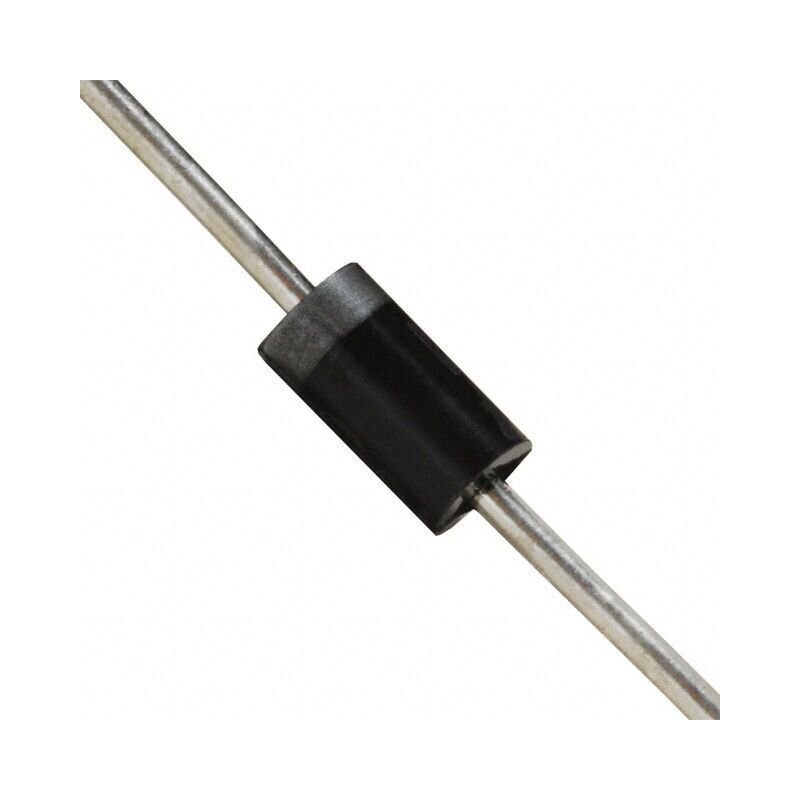


15V 0.4W Zener Diode DO-35
21 people are viewing this right now
In Stock
SKU
15V/0.4W
£1.99
Safe Checkout, Guaranteed

Safe Checkout, Guaranteed
Regulate voltage with precision and reliability using our ZENER 15V/0.4W Diode, a crucial component for voltage regulation and overvoltage protection in a wide range of electronic circuits. Encased in the compact and versatile DO-35 package, this Zener diode maintains a stable 15V voltage output, dissipating up to 0.4W of power, making it ideal for stabilizing power supplies, creating reference voltages, and protecting sensitive circuits from voltage spikes. Zener diodes are specifically designed to operate in the reverse breakdown region, maintaining a constant voltage across their terminals when the reverse voltage exceeds the Zener voltage. This unique characteristic makes them invaluable for voltage regulation applications. The 15V Zener voltage is a common value used in various circuits for voltage clamping, voltage shifting, and creating stable reference voltages. Its robust design ensures stable and consistent performance across a wide operating temperature range.
These diodes are used for voltage regulation, surge suppression and voltage clipping. Using this Zener diode will simplify the design of your power supply and protection circuits. The DO-35 package is a through-hole package, which is easy to solder and handle, making it suitable for both prototyping and production environments. The small size of the package allows for easy integration into densely populated circuit boards. It helps to protect your circuits from overvoltage conditions. Employ the diode for applications such as regulated power supplies, voltage references, and overvoltage protection circuits.
Whether you're a student learning about Zener diode circuits, a hobbyist building your own electronics projects, or a professional engineer designing complex electronic systems, this Zener diode offers a reliable and cost-effective solution. Key features include its stable 15V Zener voltage, 0.4W power dissipation capability, and compact DO-35 package. It provides accurate voltage regulation and effective overvoltage protection, enhancing the reliability and lifespan of connected equipment. Stabilize your circuits and protect your valuable components with the ZENER 15V/0.4W Diode. Don't leave your circuits vulnerable to voltage fluctuations; invest in reliable voltage regulation today. Order yours now and enjoy peace of mind knowing your circuits are protected!
| Product Name | 15V 0.4W Zener Diode DO-35 |
|---|---|
| Condition | New |
| SKU | 15V/0.4W |
| Price | £1.99 |
| 15V 0.4W Zener Diode DO-35 Color | As per image |
| Category | Diodes |
| Brand | Nikko Electronics ltd |
| Product Code | 15V/0.4W |
| Availability | Yes |
Shipping cost is based on order value. Just add products to your cart and use the Shipping Calculator to see the shipping price. We want you to be 100% satisfied with your purchase. Items can be returned or exchanged within 30 days of delivery.
Selecting the correct series resistor (Rs) is crucial for the stable and safe operation of the 15V 0.4W Zener Diode. This resistor limits the current flowing through the Zener diode to a safe operating point, ensuring it remains in its reverse breakdown region without exceeding its maximum power dissipation. To calculate Rs, you'll need the input voltage (Vin), the desired Zener voltage (Vz = 15V), and the desired Zener current (Iz). A common practice is to choose Iz to be roughly half of the maximum Zener current (Izmax = Pzmax / Vz = 0.4W / 15V ≈ 26.6mA) for stable regulation, or a value specified in the datasheet for optimal performance (e.g., test current). The formula is Rs = (Vin - Vz) / Iz. It's also important to consider the load current (IL) if the Zener is supplying a load, in which case the current through Rs would be Iz + IL. Always ensure that the power dissipated by the resistor (P_Rs = (Vin - Vz) * (Iz + IL)) is within its rating, and that the Zener diode's power dissipation (P_Zener = Vz * Iz) does not exceed 0.4W. Proper calculation ensures reliable voltage regulation and extends the lifespan of your 15V 0.4W Zener Diode.
Ensuring the 15V 0.4W Zener Diode operates within its specified power dissipation limit is vital for preventing damage and ensuring long-term reliability. The maximum power dissipation (Pzmax) for this Zener diode is 0.4 watts. The power dissipated by the Zener diode (Pz) is calculated by multiplying its Zener voltage (Vz = 15V) by the current flowing through it (Iz). Therefore, Iz must always be less than or equal to Pzmax / Vz, which for the 15V 0.4W Zener Diode is 0.4W / 15V ≈ 26.6mA. In practical applications, you must account for variations in input voltage and load current. When the input voltage is at its maximum and the load current is at its minimum (or zero), the Zener current will be at its highest. Design your series current-limiting resistor (Rs) to ensure that under these worst-case conditions, Iz does not exceed 26.6mA. Additionally, consider the ambient temperature, as higher temperatures reduce the maximum allowable power dissipation. For critical applications, derating curves found in the datasheet provide guidance on reducing the power limit at elevated temperatures, safeguarding your 15V 0.4W Zener Diode.
The Zener voltage tolerance for the 15V 0.4W Zener Diode, like most Zener diodes, typically ranges from ±5% to ±10%, although specific datasheets should always be consulted for the precise value for this particular component. A ±5% tolerance means the actual Zener voltage could be between 14.25V and 15.75V at its specified test current and temperature. Temperature significantly affects the Zener voltage stability. Zener diodes exhibit a temperature coefficient (TC), which describes how much the Zener voltage changes per degree Celsius. For Zener voltages around 5V-6V, the TC is often close to zero, offering excellent temperature stability. However, for a 15V Zener Diode, the temperature coefficient is typically positive, meaning the Zener voltage will slightly increase as the operating temperature rises. This change might be in the order of mV/°C. For applications requiring high precision, designers might consider using a temperature-compensated Zener diode or incorporating additional circuitry to mitigate these temperature-induced voltage variations, ensuring the stability of the 15V 0.4W Zener Diode output.
Reverse leakage current (Izr) for the 15V 0.4W Zener Diode refers to the small current that flows when the diode is reverse-biased below its Zener voltage, but before it enters the breakdown region. Ideally, this current would be zero, but in real-world components, a minuscule current always flows due to minority carriers. Izr is typically measured at a specific reverse voltage, often well below the Zener voltage (e.g., at 1V or 5V). For most standard voltage regulation applications where the Zener diode is intended to operate firmly in its breakdown region, Izr is usually negligible and does not significantly impact circuit performance. However, Izr becomes a critical design factor in low-power, battery-operated, or high-impedance circuits. In such scenarios, even a small leakage current can lead to significant power consumption, discharge batteries prematurely, or cause unwanted voltage drops across high-impedance paths, affecting the accuracy and efficiency of the circuit. When designing sensitive measurement circuits or quiescent current-sensitive systems, minimizing Izr is paramount, and selecting a 15V 0.4W Zener Diode with a very low specified Izr value from its datasheet becomes essential to maintain circuit integrity.
The 15V 0.4W Zener Diode can provide basic transient overvoltage protection, particularly for sensitive circuits requiring clamping at or near 15V. When a voltage spike exceeds its Zener voltage, the diode rapidly conducts in reverse, clamping the voltage across the protected circuit to approximately 15V and shunting the excess current away. This characteristic makes it useful for protecting low-power circuits from moderate transients. However, it has limitations compared to dedicated transient voltage suppression (TVS) diodes or varistors. TVS diodes are specifically designed for transient suppression, offering much faster response times (picoseconds), significantly higher peak pulse power dissipation capabilities (often in kilowatts), and lower clamping voltages under high current conditions. The 15V 0.4W Zener Diode, with its 0.4W continuous power rating, can only handle relatively small, short-duration transient energy. Exceeding its peak pulse power rating, which is typically much higher than its continuous rating but still limited, will permanently damage the device. For robust protection against severe lightning strikes or inductive load switching transients, a higher-power TVS diode or a multi-stage protection scheme combining a 15V 0.4W Zener Diode with other components would be more appropriate.
The DO-35 package for the 15V 0.4W Zener Diode is a small, axial-leaded glass package, widely recognized for its compact size and through-hole mounting versatility. From a mounting perspective, its leads allow for easy insertion into PCBs, facilitating hand soldering or automated assembly processes for through-hole components. This makes it a popular choice for prototyping and applications where surface-mount technology isn't preferred or feasible. In terms of thermal management, the DO-35 package is suitable for the 0.4W power dissipation rating of this Zener diode under typical ambient conditions. Heat is primarily dissipated through the leads into the PCB traces and through convection from the package surface. For applications pushing the 0.4W limit or operating in higher ambient temperatures, good PCB layout with adequate copper area connected to the leads can aid heat transfer. Regarding space constraints, its small cylindrical form factor is advantageous for dense circuit designs while still offering a physically robust solution compared to some smaller surface-mount packages. The compact DO-35 package ensures the 15V 0.4W Zener Diode can be integrated into a wide array of electronic products without demanding excessive board real estate.
The minimum Zener current (Izk), also known as the knee current, is a critical parameter for the 15V 0.4W Zener Diode because it represents the minimum reverse current required for the diode to enter and maintain stable operation in its breakdown region. Below Izk, the Zener diode does not exhibit its specified stable Zener voltage; instead, the voltage across it will drop significantly, behaving more like a conventional reverse-biased diode with increasing impedance. This means the diode will not effectively regulate the voltage. In circuit design, it is imperative to ensure that the current flowing through the 15V 0.4W Zener Diode never falls below Izk, even under worst-case conditions, such as minimum input voltage and maximum load current. If the load current fluctuates, the series resistor must be chosen such that the current remaining for the Zener diode (Iz = I_total - I_load) always stays above Izk. Failing to meet this minimum current requirement will result in poor voltage regulation, where the output voltage might sag or become unstable, undermining the primary function of the 15V 0.4W Zener Diode in your circuit.